

Aleph Alpha
AI AutomationUpdated November 13, 2026
German sovereign AI stack for government and regulated industry: the open-weight Kolibri model, an on-premise agent platform and forward-deployed services.
We may earn a commission when you sign up through our links. It does not affect our reviews.
What is Aleph Alpha?
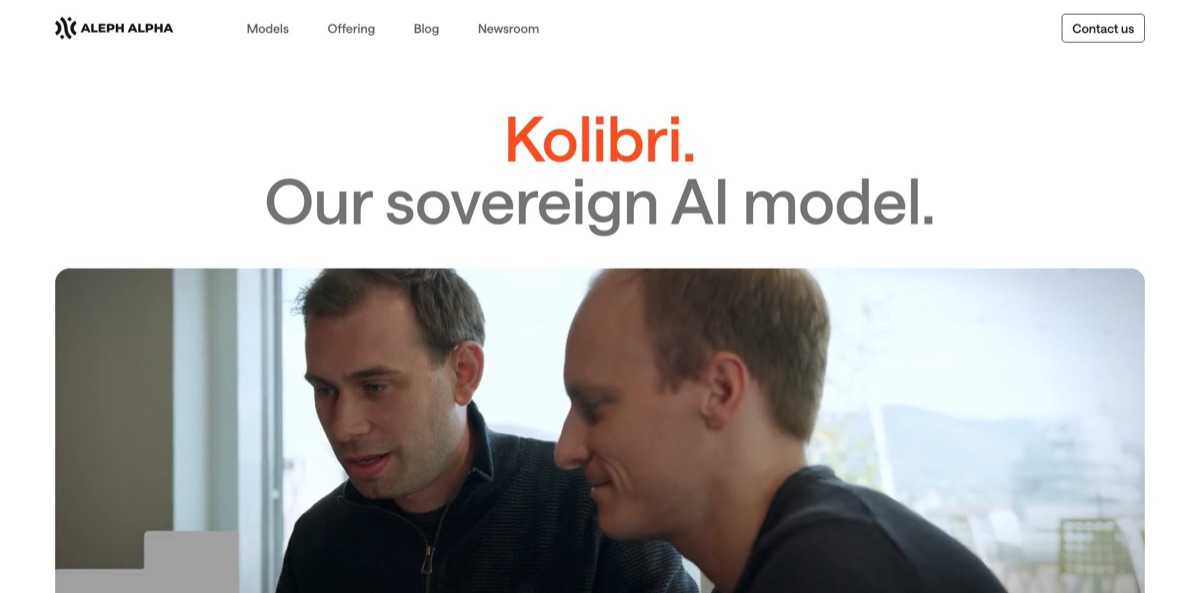
Heidelberg-based Aleph Alpha builds sovereign generative AI for government agencies and regulated industry, sold as a stack you can run on your own hardware. The pieces are Kolibri, an open-weight German and English language model; a platform (documented as PhariaAI) for document parsing, agent orchestration and model serving; packaged workspace solutions; and forward-deployed engineers who scope, specialize and integrate each use case. It solves a control problem: public bodies and manufacturers that cannot send sensitive files to foreign cloud APIs get a model and runtime inside their own data center, with audit trails and EU AI Act documentation. The weak spots are cost of entry and uncertainty. There is no self-serve plan, the stack needs GPUs and Kubernetes skills, and in September 2026 the company signed a binding agreement to merge into Cohere, pending regulatory approval. Pick it if German-language sovereignty is a hard requirement.
How to start using Aleph Alpha?
You have two doors in, depending on who you are. Developers can download the Kolibri-1 weights from Hugging Face under the Apache 2.0 license and serve them on their own GPUs, or fill in the Kolibri API sign-up form on the website, which asks for company, industry, region, interest and a business email. Organizations go through the Contact sales form instead, where you can attach a PDF briefing or RFC of up to 15 MB and request a call back. There is no instant account creation, so expect a conversation before you touch the product.
The first real scenario is usually scoped with the forward-deployed team. Their Solutioning service maps how the work runs today, builds low-fidelity prototypes and raises fidelity as confidence grows. A typical starting point is document Q&A in PhariaAssistant: you open Collections in the left sidebar, click Create collection and upload up to 100 documents in .doc, .docx, .pdf or .txt format, each up to 1,000 pages and 100 MB. If your admins configured a SharePoint connection, an Add from SharePoint button pulls files from there instead.
The key setup work happens on the infrastructure side. A self-managed installation expects Kubernetes 1.29 or newer, Helm 3, JFrog credentials supplied by Aleph Alpha, NVIDIA Ampere, Lovelace or Hopper GPUs (minimum two with MIG, three without), 24 CPU cores, 128 GB RAM and a Postgres 14 database. Cloud installs are supported on STACKIT, AWS EKS, Google GKE and Azure AKS. Once the stack is up, PhariaOS is where admins manage access to models and hardware, and end users build helpers under Agents, Create agent, then refine them in the Configure tab and call them in chat with the @ symbol.
Before any wider rollout, check the grounding. Answers are designed to quote the source passages they rely on, and the models are trained to abstain when your documents lack enough evidence, so test questions you know have no answer in the collection. PhariaCatch collects structured feedback from subject-matter experts, and the platform tracks performance and business impact per use case, which gives you numbers for the go or no-go decision.
Who is it for?
Public Sector IT Leads
Agencies that handle citizen data cannot route administrative German through a foreign API. Aleph Alpha offers a model trained in Germany, deployable on-premises or air-gapped, with a legal report for the EU AI Act. Its own case study describes an assistant rollout to 80,000 users in a government agency.
Regulated Enterprise CIOs
Banks, insurers and critical-infrastructure operators need generative AI that passes data-protection and audit reviews. The platform logs every agent action and ties responses to a named user, model and prompt. That turns governance into a platform setting rather than a fresh compliance project for each use case.
Industrial Engineering Teams
Automotive and aerospace suppliers drown in requirement specifications and historic RFQs. The Industrial Engineering Workbench compares and structures those documents, connects to PLM tools and runs as an extension for Siemens Polarion. Engineers stop reading old documents line by line because every suggestion shows its source.
ML and Platform Engineers
Teams that want a capable German model without licensing friction can pull Kolibri under Apache 2.0. With roughly 3B active parameters per token, it is cheap to serve once you have the GPU memory to hold all 78B weights. You keep full control over fine-tuning and deployment.
Compliance and Data Protection Officers
You need to document where training data came from and how outputs are produced. Aleph Alpha publishes a technical report on data governance, signs the EU GPAI Code of Practice and states that customer production data is never used for training. That gives you paperwork to attach to your own risk assessment.
Aleph Alpha pricing
Aleph Alpha does not publish a price list. There is no pricing page on aleph-alpha.com, every commercial path runs through the sales or API sign-up forms, and the company frames deals around specialized models, solutions and forward-deployed services sized to each customer. Pricing is quote-based. The only component with a fixed price is the open-weight model, which costs nothing to license but needs serious GPUs to run. Some third-party inference providers resell Kolibri tokens, but those are their rates, not Aleph Alpha’s.
Free. Apache 2.0 license on Hugging Face, commercial use allowed. You pay for your own hardware: roughly 78 GB of FP8 weights, with a minimum of two A100 80 GB cards or one H200.
Custom. Access is granted after a sign-up form aimed at the public sector; no per-token rate is published.
Custom. Available for on-premises, air-gapped, hybrid or managed sovereign cloud deployment, including the PhariaAI-as-a-Service offering announced with STACKIT in May 2025.
Custom. Workspace Essentials and the Industrial Engineering Workbench are sold as bundled workspace products with optional customization.
Custom. Solutioning, specialization, deployment and integration work scoped per project.
Aleph Alpha key features
Kolibri is a Mixture-of-Experts model with 78B total and about 3B active parameters per token, released on 3 October 2026. It handles German and English, offers a controllable reasoning mode and native tool calling, and supports a context of up to 1M tokens (256k recommended). The small active size keeps serving cost low, so you can run a strong model on two data-center GPUs instead of a cluster.
German specialization goes deeper than translation
Around 23% of the pre-training data is German, and a German-optimized tokenizer represents German text with fewer tokens. The model reasons in German when prompted in German, so German-speaking staff can read and inspect its reasoning traces.
Document AI parses dense tables, charts, technical drawings and poor-quality scans into usable data, then makes them searchable with access control. Recent releases added hybrid search that combines BM25 keyword matching with dense vectors, ingestion of Word, Excel, PowerPoint and EPUB files, and audio transcription. Retrieval quality is where most document workflows fail, and this is the layer that addresses it.
Grounded answers with abstention mean responses quote source passages, and the model is trained to say it does not know when your documents lack evidence. Users and testers single out this behavior as a strength. You trade some helpfulness for fewer confident hallucinations, which is the right trade in legal and administrative work.
The agent runtime composes agents from reusable skills, connects tools through open protocols such as MCP, and puts approval gates on steps with real consequences. Every action is logged and traceable.
PhariaAssistant gives end users Chat, Summarization, Translation across more than 40 languages, plus Generation and Transcription in beta. Custom applications built in PhariaStudio appear inside the same portal, so staff get one interface instead of a dozen pilots.
Flexible deployment covers on-premises, air-gapped, hybrid and Kubernetes-based cloud installs on STACKIT, AWS, Google Cloud or Azure. The November 2026 release added a full German interface for Pharia Data and a beta Trigger API for event-driven workflows, which shows the stack is still actively maintained.
Aleph Alpha Pros & Cons
Pros
Aleph Alpha is one of very few vendors that can offer a German-trained model, a full runtime and on-site engineers under European control. Kolibri is genuinely open under Apache 2.0, so you can evaluate it without a sales call, and its abstention training suits work where a wrong answer costs more than no answer. The platform runs fully air-gapped, logs every agent action and ships with EU AI Act documentation, which shortens procurement in public administration. Its customer list on the homepage includes Bundesagentur für Arbeit, Deutsche Bank, Infineon and SAP. Release notes show monthly updates through November 2026. Start by benchmarking Kolibri on your own German documents before talking licenses.
Cons
Nothing is self-serve: there is no free platform tier, no public pricing and no instant API key, so small teams cannot try the full product. Self-hosting needs Kubernetes expertise and several NVIDIA GPUs. Independent reviewers find Kolibri weaker than comparable Qwen models at coding, multi-turn tool calling and answering from memory. The company also carries strategic risk: about 50 jobs were cut in January 2026, its co-CEO left in September, and the merger agreement with Cohere means the combined company will operate under the Cohere name, with integration and product details still to be announced. Ask sales for a written product roadmap and support commitment that covers the post-merger period.
Use Aleph Alpha if you want…
- Run generative AI fully on-premises or air-gapped.
- Process administrative German documents with a German-trained model.
- Deploy an open-weight LLM under the Apache 2.0 license.
- Build document agents that cite sources and abstain.
- Give a large workforce one governed AI workspace.
- Analyze requirement specifications inside Siemens Polarion or PLM tools.
- Document EU AI Act compliance for your AI stack.
- Get engineers on site to scope and integrate use cases.
Aleph Alpha alternatives
 Le Chat (Mistral)Read review →
 H2O.aiRead review →
 Kore.aiRead review →
 Microsoft CopilotRead review →
 Claude AIRead review →
Aleph Alpha Reviews
Hacker News commenters on the Kolibri launch liked that the model is trained to admit when an answer is not in the documents and saw real value in reasoning over German paperwork. Others questioned what it is for, given its weaker coding and general knowledge.
One developer running Kolibri on an RTX Pro 6000 reported around 170 tokens per second at FP8 thanks to the small active parameter count, but said it spends too many tokens overthinking; another user suggested trying the lower reasoning modes.
An IBM engineer’s independent breakdown rates Kolibri highly for long German documents, tokenizer efficiency and refusing to guess, yet ranks it behind Qwen models for coding agents, multi-turn tool calls and closed-book questions, and notes it needs about 78 GB of GPU memory.
Skeptical Hacker News readers said the launch benchmarks skipped some newer Qwen releases and that a dense Qwen 27B model beats Kolibri on German in its own harness. One asked whether the sovereign label still holds once Cohere owns the company.
TechCrunch’s analysis notes that Aleph Alpha brought little revenue into the deal and calls it not an alliance between equals, while a retrospective essay by Thorsten Meyer judges the mid-2024 pivot to sovereign enterprise AI sound but late.
FAQ
Is Aleph Alpha free to use?
The Kolibri model weights are free to download and use commercially under Apache 2.0. The platform, solutions, API access and services are quote-based, and there is no free self-serve tier.
Is Aleph Alpha being acquired by Cohere?
Yes. Cohere and Aleph Alpha announced plans to combine in April 2026 and signed a binding business combination agreement on 16 September 2026, under which the merged company will operate as Cohere. The deal is still subject to regulatory approval, and Aleph Alpha says it operates independently until closing.
Can Aleph Alpha run on-premises or air-gapped?
Yes. The platform installs on your own Kubernetes cluster with NVIDIA GPUs, including air-gapped setups, and also on STACKIT, AWS, Google Cloud or Azure.
Which languages does Aleph Alpha support?
Kolibri is trained for German and English only. The PhariaAssistant translation app covers more than 40 languages using separate translation models.
Does Aleph Alpha train on my data?
According to the company, customer production data is never used for training. Kolibri is specialized with simulated customer environments and evaluation sets instead.
Is there an Aleph Alpha API?
Yes. You can request Kolibri API access through a sign-up form, the platform exposes a Responses API for inference, and Python SDKs are published on GitHub.
What hardware does Kolibri need?
The FP8 weights take about 78 GB of memory. The minimum is two A100 80 GB GPUs, two H100 SXM5, or a single H200, B200 or B300.
Is Aleph Alpha compliant with the EU AI Act?
Its models are trained for conformity with the EU AI Act and ship with a legal report, and the company is a signatory of the EU GPAI Code of Practice. Your own deployment still needs its own risk assessment.
Similar tools
 GPT WorkspaceAI agent for Google Docs, Sheets, Slides, Gmail and Drive that edits your files, runs GPT formulas in bulk and automates routine
 FPT.AIVietnamese enterprise AI platform from FPT Smart Cloud for chatbots, call-center voicebots, document reading and eKYC that automate customer operations.
 Frigate NVROpen-source NVR that runs real-time AI object detection on your own hardware and sends camera events to Home Assistant and other MQTT