

Apify
Data AnalysisUpdated October 5, 2026
Apify is a powerful web scraping and automation platform for extracting structured data using pre-built or custom actors.
We may earn a commission when you sign up through our links. It does not affect our reviews.
What is Apify?
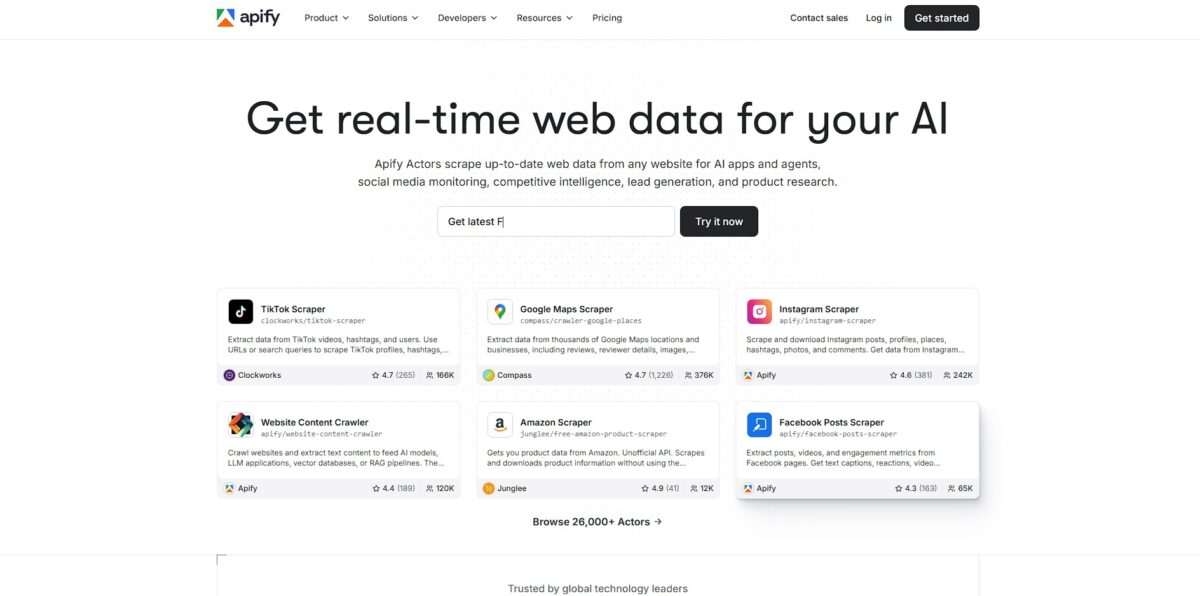
Apify functions as a cloud runtime for “Actors,” which are containerized scripts designed to turn websites into structured data or automate browser-based chores. You can deploy your own Python or JavaScript crawlers or grab one of the 20,000 pre-built scrapers from their store to harvest LinkedIn leads or Amazon pricing without setting up a single server. It handles the messy parts of the web, like rotating residential proxies and bypassing CAPTCHAs, so you don’t have to rewrite your logic every time a site changes its layout. While it is built for developers who want to avoid infrastructure management, it offers enough low-code templates for non-coders to pull data into a spreadsheet. In practice, hours of manual clicking become a scheduled API endpoint. Use the store first to see if someone already solved your target site before building from scratch.
How to start using Apify?
Head to the Apify Console and create an account. You can start by browsing the Store, which houses thousands of pre-built scrapers for sites like Instagram, Google Maps, or Amazon. Picking an existing tool saves you from writing code when you just need a quick CSV of product prices. You can test a workflow in minutes without setting up a local environment.
If a pre-made Actor doesn’t fit, you’ll want the Apify CLI. Install it via NPM to build and deploy custom scrapers from your machine. It uses Crawlee, their open-source library that handles browser fingerprinting and proxy rotation automatically. I noticed this is where the learning curve hits, as you need basic JavaScript or Python knowledge to customize how the scraper interacts with complex menus or infinite scrolls. Crawlee is also what keeps your scrapers from being instantly blocked by anti-bot protections.
Configure your runtime settings in the Console once your code is live. You set memory limits and select proxy groups here. Higher memory helps with heavy headless browsers, but it eats through your usage credits faster. The trade-off is speed versus cost, so start small and scale up only if the scraper crashes. That gives you granular control over your compute budget.
Finally, connect your data to the rest of your stack. You can set up Webhooks to trigger a Slack notification or send the JSON results to a database the second a run finishes. It’s more reliable than manually downloading files every morning. This matters because it turns a one-off script into a hands-off data pipeline.
Start with a pre-built Store Actor to understand the platform’s logic before trying to deploy your own custom code.
Who is it for?
Node.js and Python Developers
Build and host scrapers using Crawlee or the Apify SDK without managing your own server infrastructure or proxy rotation. The platform handles the annoying parts like headful browser scaling and fingerprinting automatically. This saves you from the “it works on my machine but fails in production” headache.
AI Engineers and LLM Builders
Extract clean text from complex websites to feed RAG pipelines or train custom models. You get markdown-ready data instead of a mess of HTML tags and scripts. This prevents your token costs from exploding on useless structural noise.
Growth Hackers and Lead Gen Specialists
Pull prospect lists from LinkedIn, Google Maps, or Instagram into spreadsheets without writing a single line of code. It bypasses the need for official APIs that often have strict rate limits or hidden costs. You can find contact info that isn’t always visible in basic searches.
E-commerce and Market Researchers
Monitor competitor pricing and stock levels across Amazon or Shopify in real-time to adjust your own strategy. The platform rotates residential proxies so you don’t get blocked after the first hundred requests. I’ve seen this work for tracking volatile daily discounts.
Open Source Contributors
Publish your own custom scrapers on the Store and earn passive income when others use them. Apify handles the billing and infrastructure, so you just focus on the code logic. It’s a niche way to monetize specialized scraping skills.
SEO Professionals
Track search rankings and SERP features across different geographic locations using localized proxies. You can see exactly what a user in Paris or Tokyo sees without leaving your desk. This clears up why your global traffic might be dipping in specific regions.
Apify pricing
Apify pricing follows a hybrid model that blends fixed monthly tiers with usage-based consumption. You choose a base plan for features and prepaid credits, then pay for what you actually use once those credits run out. It is a bit like a prepaid phone plan for scrapers where you can top up or just pay for the overage on your next bill.
Free: $0/month. You get $5 in monthly credits and 8GB of RAM. Good for tinkering or running a small, recurring script that does not hit heavy anti-scraping walls. You are limited to community support, which can be slow if your Actor breaks on a Friday night.
Starter: $49/month ($39 in some regions). This jumps you to 32GB of memory and includes $49 in platform credits. You get email and chat support, which is vital when a target site changes its HTML structure and your scraper starts returning null. This plan prevents your account from being locked immediately if you go slightly over your limit.
Scale: $199/month. Includes $199 in credits and 128GB of RAM. This is where you get access to 100 shared proxies and priority support. It handles large-scale crawls that would crash smaller instances, making it the choice for production-grade data pipelines.
Business: $999/month. You get $999 in credits and a dedicated account manager. This tier includes personal technical training sessions to optimize your code. Inefficient code burns through credits faster than it should.
Enterprise: Custom pricing. This removes all caps on credits and data retention. It is built for massive organizations that need guaranteed SLAs and custom infrastructure.
Apify Store costs: Some pre-built scrapers (Actors) charge their own fees. You might see a flat monthly rental or a pay-per-result fee on top of the platform usage. Note that residential proxies are a separate cost ($7-$8 per GB), which can surprise you if you are scraping sites with heavy bot detection.
Apify key features
Pre-built Actors for Instant Scraping
Choose from thousands of ready-made scrapers for sites like Instagram, Google Maps, or Amazon. This removes the need to write custom code when you just need a CSV of product prices or reviews. You can start extracting data in minutes instead of spending days on development.
Crawlee Library for Reliable Crawling
Use the open-source library to handle proxy rotation, fingerprinting, and browser management automatically. It makes your scrapers appear human-like to stay under the radar of modern bot protections. As a result, your scripts won’t break as often due to IP bans or sophisticated anti-bot blocks.
Adaptive Playwright Crawler
This feature automatically switches between fast, lightweight HTTP requests and full browser rendering based on what the page needs. It optimizes for speed on simple pages but uses the full power of Playwright for heavy JavaScript sites. You save on compute costs and time without sacrificing the ability to scrape complex, dynamic websites.
Serverless Micro-app Hosting
Deploy your scrapers as “Actors” on Apify’s cloud infrastructure with built-in storage and scheduling. You skip the headache of managing your own servers or worrying about hardware scaling. Your scrapers get a stable environment where they can run 24/7 without intervention.
Smart Proxy Management
Access a large pool of residential and datacenter proxies that rotate per request or per session. I noticed this effectively bypasses rate limits (429 errors) and geographic restrictions. The result is high success rates for large-scale data extraction tasks.
Unified Data Storage and Export
Save results directly into datasets that you can export as JSON, CSV, or Excel. You can also feed this data into other tools via webhooks or APIs. That simplifies the pipeline from raw web content to usable business data.
Apify Pros & Cons
Pros
Apify handles the heavy lifting of proxy rotation and browser fingerprinting so you can scrape data from sites that usually block bots. You don’t have to manage a local server or fight with IP bans because the platform executes code in a specialized cloud environment. The Store contains thousands of pre-built scripts for platforms like Instagram or Google Maps, which lets you start extracting structured data in minutes without writing custom code. Your focus shifts from infrastructure maintenance to actual data analysis. If you are a developer, using the SDK provides total control over headful browser scaling. Use pre-built Actors first to save on development time.
Cons
The platform uses a complex credit-based system that can make your monthly bill unpredictable if a site changes its layout and forces your scraper to run longer. While the interface is clean, the learning curve is steep for anyone who isn’t comfortable with JavaScript or Python. The free tier limits your compute power, so processing massive datasets requires a quick jump to a paid plan. You pay for not managing your own servers with a higher cost per execution than running a local script. This matters because a small coding error can drain your prepaid credits before you notice the bug. Monitor your Actor’s usage logs daily to avoid unexpected overages.
Use Apify if you want…
- Scale web scraping without managing your own server infrastructure.
- Turn any website into a structured, machine-readable dataset.
- Automate browser-based chores using pre-built cloud actors.
- Bypass anti-bot protections with reliable smart proxy rotation.
- Feed real-time web data directly into your AI models.
- Schedule automated data extraction runs while you sleep.
- Deploy custom scrapers written in JavaScript or Python easily.
- Access thousands of specialized scrapers for popular platforms.
Apify alternatives
Apify Reviews
The range of pre-built Actors in the Store is a massive time-saver for lead generation; it turns hours of custom coding into a few clicks.
It is the most complete and reliable scraping solution we have found, though the credit-based pricing can be tricky to predict for long runs.
The platform makes automating repetitive web tasks effortless, but expect a learning curve if you are a non-technical user trying to customize complex scrapers.
Great for scaling data collection without managing infrastructure, but some niche store actors can be hit-or-miss regarding maintenance and reliability.
FAQ
Is web scraping with Apify legal?
Web scraping is generally legal when extracting publicly available data, such as prices or reviews, and Apify provides the infrastructure to do this ethically by respecting robots.txt files and avoiding the circumvention of technical barriers like passwords.
What are Apify Actors?
Actors are serverless cloud programs that perform web scraping and automation tasks; they can be run manually, via API, or on a schedule, and they scale automatically based on the complexity of the job.
How does Apify handle anti-scraping protections?
Apify uses sophisticated techniques to bypass blocks, including browser fingerprinting, residential proxy rotation, and the use of specialized libraries like Crawlee to emulate human behavior and avoid IP rate-limiting.
Can I monetize the scrapers I build on Apify?
Yes, developers can publish their custom Actors to the Apify Store and earn passive income through a monetization scheme where customers pay for the computing resources or specific usage of the tool.
Does Apify offer support for custom enterprise solutions?
Apify provides Professional Services for enterprise clients, offering fully managed data extraction solutions, dedicated account managers, and custom development from their in-house team of experts.
What happens if I exceed my plan’s usage limits?
Once your prepaid credits are exhausted, your usage is limited to prevent unexpected charges, but you can enable pay-as-you-go (overage) settings in your billing console to continue running tasks at a fixed unit price.
Similar tools
 HexCollaborative analytics workspace that mixes SQL, Python and AI agents in notebooks, then publishes results as data apps and plain-language answers.
 WindwardMaritime AI platform that fuses AIS, satellite and ownership data into vessel risk scores, sanctions screening, alerts and container ETAs.
 Delve AIAI market research platform that builds personas from analytics, CRM and social data, then lets you chat with them or run synthetic