

Bland AI
AI AgentsUpdated October 18, 2026
Enterprise voice AI platform for building, testing and monitoring AI phone agents that handle inbound and outbound calls at scale.
We may earn a commission when you sign up through our links. It does not affect our reviews.
What is Bland AI?
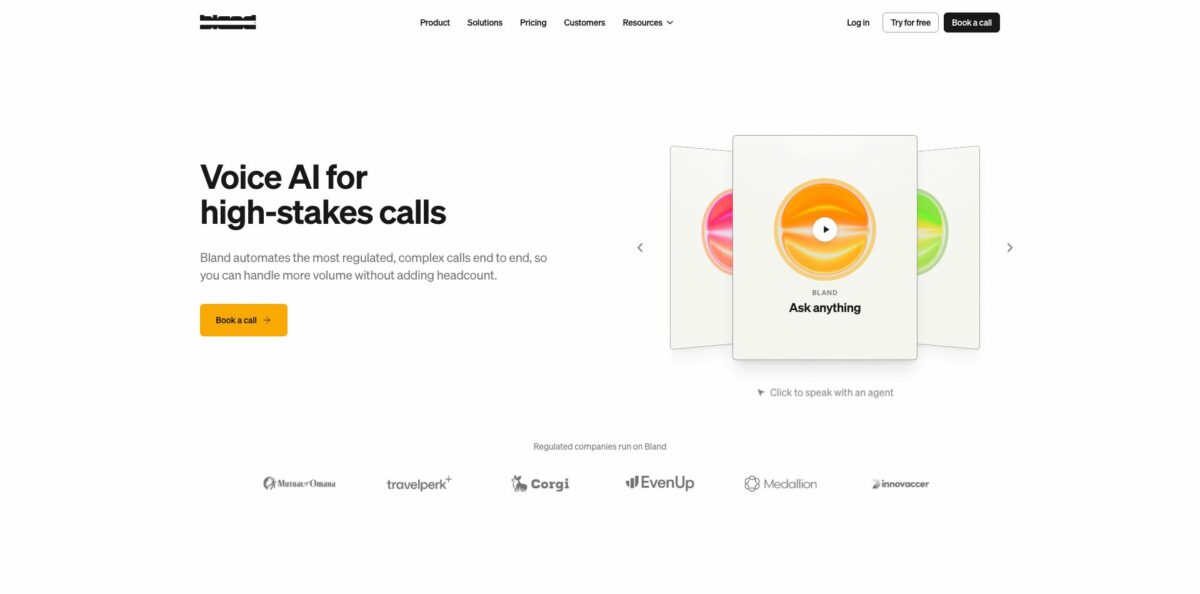
Bland AI is a voice AI platform for building AI phone agents that answer inbound calls, place outbound ones, and carry the same conversation over SMS and web chat. Unlike most rivals, which glue together third-party speech-to-text, language model and text-to-speech vendors, Bland runs its own models for all three layers, so a call never leaves its infrastructure. The target problem is expensive, repetitive call volume in regulated industries: appointment booking, identity checks, IVR replacement, payments and patient follow-ups. The platform supports 40+ languages and holds SOC 2 Type I and II, HIPAA and PCI DSS certifications. The weak spot is accessibility: production agents still need engineering time, many advanced controls sit behind an Enterprise contract, and per-minute bills are hard to forecast. Pick it if you have developers and serious call volume; skip it if you want a turnkey receptionist set up by a non-technical team.
How to start using Bland AI?
Sign up at app.bland.ai on the free Start plan. No card is required, and the account comes with two credits and an inbound phone number that Bland values at $15 a month. That is enough to place real test calls before you commit to a platform fee. If you already pay for Twilio or a SIP trunk, you can connect it later instead of using Bland’s built-in numbers.
Next, build your first agent around one narrow job, such as confirming appointments or answering a single type of support question. You can describe the agent in plain English to Norm, Bland’s AI builder, which generates the pathway, persona, voice and tools for you. Developers can skip the dashboard entirely and create calls through the REST API, the CLI, or the Bland MCP server from Claude Code or Cursor.
The key screen is Conversational Pathways, a node-based editor where you map how the call branches, which variables the agent extracts, and when it calls a webhook to fetch or write data. Attach a knowledge base (PDF, DOCX or JSON sources) so answers come from your own documents. Then use Dispatch to put the published agent into service: attach a phone number, set channel behavior, and run batch calls if the job is outbound.
Before real customers hear it, run test scenarios against the agent. The docs cover Testbed, Scenarios and Evals for scripted test calls, and on Enterprise you can canary a new version against a small slice of live traffic and roll back in seconds. Read the call logs and transcripts of every test, paying attention to interruptions, wrong names and calls that end without an outcome.
Who is it for?
Healthcare operations teams
Scheduling, refills, reminders and post-discharge check-ins eat staff hours every day. Bland offers signed BAAs and HIPAA-eligible deployments, so routine patient calls can move to an agent while nurses keep the complicated ones.
Insurance and financial services contact centers
First notice of loss, payment reminders and account questions follow strict scripts and disclosure rules. Guardrails can force mandatory disclosures and block off-script answers, which lowers compliance risk as you automate.
Companies retiring an old IVR
Callers hate keypad menus, and every menu change needs a vendor ticket. Bland replaces the phone tree with a conversational agent that understands what the caller wants and routes edge cases to humans with context.
Developers building voice products
You want an API, webhooks, an MCP server and a CLI rather than a closed no-code tool. Bland gives you programmatic control over calls, pathways and testing, with LLM, STT and TTS billed in one per-minute rate.
Outbound sales and lead qualification teams
Qualifying inbound leads within minutes is hard with a small SDR team. Batch calling and CRM integrations let an agent make the first call and pass warm leads to reps.
AI agent builders: Personal assistants and autonomous agents increasingly need a real phone number. The Agent Phone Plan gives one agent a dedicated number with unlimited US and Canada calling and texting for a flat monthly fee.
Bland AI pricing
Bland charges a per-minute talk rate that covers the language model, speech-to-text and text-to-speech, with no token charges, plus a monthly platform fee on the paid tier. Call time is prorated to the second. Telephony is billed separately at pass-through cost if you use Bland’s numbers, and bring-your-own-telephony customers pay no transfer fees. Rates became plan-based on December 5, 2025, when the old flat $0.09/min rate was replaced, so older articles quoting that number are out of date.
Includes 10 concurrent calls, 100 calls per day and per hour, 1 voice, 10 knowledge bases, Conversational Pathways, integrations and automations. No card required.
Raises limits to 50 concurrent calls, 2,000 calls per day, 1,000 per hour, 5 voices and 50 knowledge bases.
Custom, contracted to your volume. Adds unlimited caps, on-prem or VPC deployment, forward deployed engineers, BAA, SSO, data residency, warm transfers, guardrails, SMS and web chat, and a Slack channel with the Bland team.
One dedicated number for an autonomous agent with unlimited calling and texting to the US and Canada, capped at 50 calls per day and 1 concurrent call.
Extra charges from the billing docs: $0.015 minimum per outbound attempt or failed call on Bland telephony, $0.02 per SMS in either direction, and $0.01 per agent message in the web widget. Norm, the AI builder, is billed separately on tokens. The docs still list a Scale tier at $499/month and $0.11/min that the public pricing page no longer shows, so ask sales if you need volume between Build and Enterprise.
Bland AI key features
Own speech and language stack: Bland runs its own speech-to-text, LLM and text-to-speech instead of chaining outside vendors. Calls stay on one infrastructure, customer data is not used to train third-party models, and model changes by other companies cannot break your agent overnight. You also get one invoice line instead of four.
Conversational Pathways: A node-based designer for branching, multi-turn phone workflows with state, tool calls and variable extraction. You decide exactly where the agent verifies identity, looks up an account or hands off to a human.
Norm agent builder: Describe the agent in plain English and Norm produces the pathway, persona, voice and tools, which you then edit. It also works as a plugin inside coding agents such as Claude Code and Cursor through the Bland MCP server. Prototypes come together quickly, though Norm usage is billed separately on tokens.
Testing and safe releases: Scenario suites with assertions let you run large batches of simulated calls and back-test against historical ones. On Enterprise, canary releases send a new version to a small share of real calls so you can promote or roll back in seconds. Fewer surprises reach live customers.
Guardrails and observability: Rules can force mandatory disclosures, block off-script medical advice, redact PII in transcripts and escalate on distress signals. Live listening, call replay and outcomes show why the agent made each decision. On the public plan table, guardrails and alarms are Enterprise features.
Integrations and telephony: The integrations page lists 28 connections, including Twilio, SIP, Genesys, Five9, NICE CXone, Amazon Connect, Salesforce, HubSpot, Calendly, Cal.com, Slack, Zapier, Make and Pipedream. Anything else goes through the REST API and webhooks. You can keep your existing contact-center stack and add the agent on top.
Multilingual voices and deployment options: Agents speak 40+ languages with real-time translation in 23, can switch language mid-call, and support custom voice clones. Enterprise customers can run Bland in its cloud, in their own AWS, GCP or Azure VPC, or air-gapped on their own hardware.
Bland AI Pros & Cons
Pros
Bland owns every layer of the voice pipeline, so you are not debugging the hand-off between a transcription vendor, an LLM provider and a voice company. The per-minute rate already includes the model, STT and TTS, which removes token math from your budget. Conversational Pathways give you deterministic control over regulated steps, and the compliance list (SOC 2 Type I and II, HIPAA, PCI DSS, GDPR) is unusually long for a voice startup. Developers get a real API, a CLI and an MCP server, and the free Start plan lets you place test calls without a card. Use the free tier to build one narrow agent and judge voice quality on your own call scripts.
Cons
The self-serve plans are thin on the features regulated teams care about most: warm transfers, guardrails, SMS and web chat, BAA and SSO sit in the Enterprise column of the pricing table. The December 2025 price change raised the entry rate from $0.09 to $0.14 per minute, and transfers, failed-call minimums, SMS and Norm tokens add to the bill. Production agents still need engineering time, and users report a learning curve and limited visibility when a call goes wrong. Budget for a developer and a realistic minutes forecast before you promise savings to your finance team.
Use Bland AI if you want…
- Replace a keypad IVR with a conversational phone agent.
- Automate appointment booking, reminders and rescheduling calls.
- Qualify inbound leads with an agent that calls back fast.
- Run HIPAA-eligible patient calls under a signed BAA.
- Build voice agents through an API, CLI or MCP server.
- Cover nights, weekends and overflow without hiring extra staff.
- Keep call audio inside your own VPC or hardware.
- Give an autonomous AI agent its own phone number.
Bland AI alternatives

Bland AI Reviews
Developer reviews on G2 describe a fast, dependable voice stack with a flexible API and responsive engineering support, but several mention a steep learning curve and say it is hard to see what happens under the hood when a call misbehaves.
An early Product Hunt reviewer was surprised by how low the response latency was, while another reviewer there rejected the whole idea of AI outbound calling as telemarketing nobody asked for.
A reviewer on AlternativeTo praises the realistic voices and the control that comes with self-hosted infrastructure, yet worries that costs climb quickly with call volume and that off-script answers remain a risk.
Community discussions split by role: developers accept the per-minute model for natural-sounding calls and fast deployment, while ops and finance buyers complain that platform fees, minutes, transfers and telephony stack into bills that are hard to predict.
FAQ
Does Bland AI have a free plan?
Yes. The Start plan has no platform fee and needs no card; you get two credits and an inbound number, then pay $0.14 per minute of talk time with caps of 100 calls per day and 10 concurrent calls.
How much does a Bland AI call cost per minute?
Talk time costs $0.14/min on Start and $0.12/min on Build, with transfer time at $0.05 and $0.04 per minute respectively. Enterprise rates are negotiated, and outbound attempts on Bland telephony carry a $0.015 minimum charge.
Is Bland AI HIPAA and SOC 2 compliant?
Bland states it holds SOC 2 Type I and Type II, is HIPAA-eligible with a signed BAA, and complies with GDPR and PCI DSS. BAAs and detailed compliance documentation are tied to the Enterprise plan.
Can I use my own Twilio account or phone system?
Yes. You can connect your own Twilio account or SIP trunks from contact-center providers such as Genesys, Five9 or Amazon Connect. Bring-your-own-telephony customers pay carrier costs directly and no transfer fees.
Does Bland AI have an API?
Yes. Bland offers a REST API, webhooks, a CLI, a web agent SDK and an MCP server that works with Claude Code, Cursor, Codex and Claude Desktop.
What languages does Bland AI support?
Agents support 40+ languages natively, with real-time translation in 23 of them. They can switch languages mid-call, and custom voice clones can be trained per language.
How long does it take to go live?
Most self-serve teams deploy a first agent within a day. Enterprise rollouts with custom integrations and compliance review follow a 28-day framework with Bland’s forward deployed engineers, and complex production agents can take two to six weeks.
Similar tools
 Level AIContact center AI platform that scores every call, chat and email, runs voice and chat virtual agents, and gives live agents real-time
 AiAgent.appNo-code workspace for building AI agents, Autopilots and workflows that act across your business apps, with human approval before external writes.
 MeshPersonal CRM, formerly Clay, that builds contact cards from email, calendar and social apps, with the Nexus AI agent to search and