

Cartesia
Developer ToolsUpdated October 21, 2026
Real-time voice AI platform with Sonic text-to-speech, Ink speech-to-text and managed voice agents for developers building live voice apps.
We may earn a commission when you sign up through our links. It does not affect our reviews.
What is Cartesia?
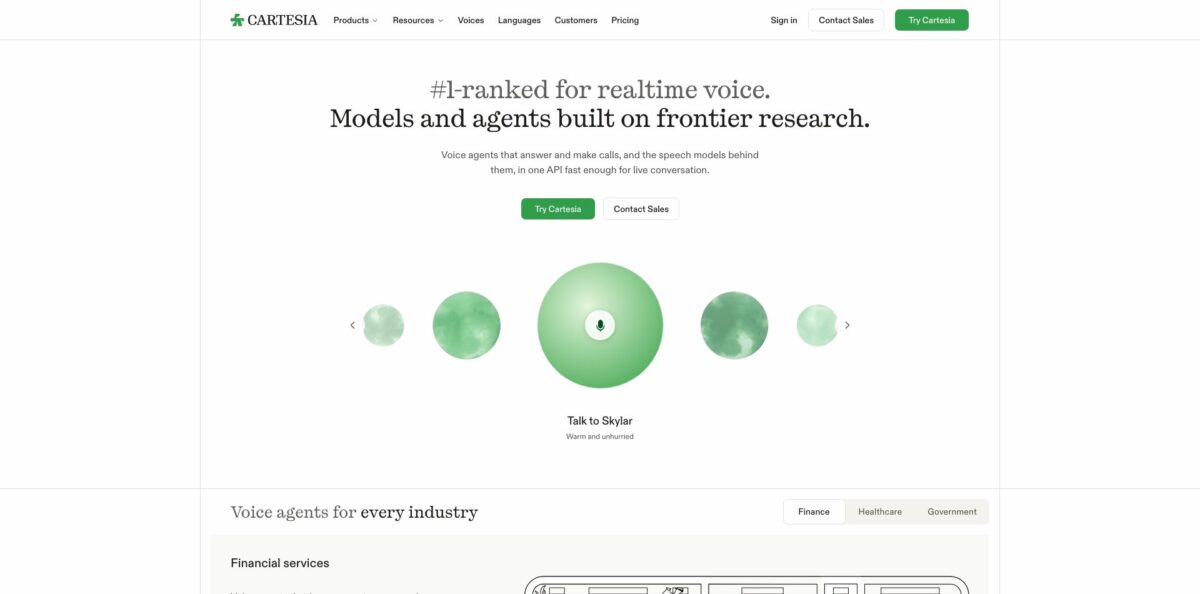
Think of it as the voice layer for apps that have to talk back in real time. Cartesia sells three things through one API: Sonic, a streaming text-to-speech model that returns first audio in under 90ms across 44 languages; Ink, a streaming speech-to-text model with built-in turn detection; and Managed Agents, a hosted runtime that wires Ink, an LLM of your choice and Sonic into a phone or WebSocket voice agent. The models run on State Space Model architecture rather than transformers, which the company credits for its latency and throughput. The problem it removes is the half-second pause that makes most voice bots feel scripted. The weak spots are narrower language coverage than the biggest rivals, Ink-2 handling only five languages, and a developer-first workflow that assumes you can write code. Pick it if you are building live voice agents where response speed decides whether callers stay on the line.
How to start using Cartesia?
Sign up at play.cartesia.ai with the Try Cartesia button. The Free plan needs no payment and gives you 20K credits a month, which is roughly 27 minutes of Sonic speech or close to two hours of Ink-2 transcription. The Playground lets you test every model in the browser, pick a voice from the library, adjust speed, volume and emotion with sliders, and create an API key from the Keys page when you are ready to write code.
Your first real scenario is usually streaming text from an LLM into speech. Install the Python SDK with
pip install ‘cartesia[websockets]’or the JavaScript one withnpm install @cartesia/cartesia-js, exportCARTESIA_API_KEY, and open a WebSocket connection. The official quickstart creates a context withmodel_id=”sonic-3.6”, pushes text in chunks and pipes raw PCM audio straight intoffplay. That chunked pattern is what most voice agents use, because audio starts playing before the full sentence has been generated.The settings that shape output live in the request and the voice. A
generation_configobject controls speed (0.6 to 1.5), volume and emotion per request, and inline tags such as<break>,<spell>and[laughter]give finer control inside the transcript. For a branded voice, open the instant voice clone tab, record or upload 10 to 60 seconds of clean audio, and the clone is ready in seconds. Pronunciation dictionaries fix brand names and medical or legal terms that the default reader gets wrong.To ship a full agent, open the Agents section of the Playground, write the instructions and welcome message, choose a voice and an LLM, and attach tools: system tools such as ending a call, webhook tools that hit your server, or client tools that run in your app. Each agent gets an
agent_idyou reuse for every conversation. Run calls from the browser, connect a Cartesia-provisioned phone number, then use the built-in evaluations and version history to check call quality before you route real traffic.
Who is it for?
Voice agent developers
You are stitching together STT, an LLM and TTS, and every extra vendor adds latency and another bill. Cartesia covers both speech ends with one API key and native turn detection, so you can drop a separate voice activity detector from the stack.
Contact center and CX teams
Callers hang up when an agent pauses or talks over them. Managed Agents handles listening, interruptions and tool calls, and HIPAA eligibility with BAAs, SOC 2 Type II and PCI coverage make it usable for billing and account workflows.
Startups building voice products
An AI interviewer, tutor or companion app lives or dies on how natural the voice sounds and what each minute costs. The $5 Pro plan includes a commercial license and voice cloning, and a startup grants program offers credits to qualifying early-stage companies.
Regulated enterprises and government buyers
Data residency or air-gapped requirements usually rule out a pure cloud API. Sonic-3.6 and Ink-2 can run on-prem, in your own VPC on AWS, GCP or Azure, or embedded through OEM licensing under an enterprise contract.
Platform builders and integrators
If you run a voice agent platform or avatar product, you need a fast TTS engine your customers can select. Cartesia already has official integrations with LiveKit, Pipecat, Twilio and Rasa, plus community connectors for Genesys, Bandwidth and others.
Developers using AI coding agents
The hosted Cartesia MCP server plugs into Cursor or Claude Code, so your agent can list voices, generate speech, transcribe files and manage pronunciation dictionaries without custom scripts.
Cartesia pricing
Pricing mixes two meters. Every plan includes a monthly pool of credits for the speech models, where Sonic text-to-speech costs about 1 credit per character (750 to 800 credits per minute of audio) and Ink-2 transcription costs 3 credits per second. On top of that, each plan includes the same amount in prepaid dollars for Managed Agents, which bill at $0.06 per minute plus $0.014 per minute when you use a Cartesia phone number. Unused credits roll over up to twice your monthly allotment, and failed requests do not consume credits.
20K credits and $1 of agent usage per month, about 27 minutes of TTS or 1 hour 51 minutes of Ink-2 STT, 2 concurrent TTS requests, 1 phone number. Non-commercial evaluation.
100K credits and $5 of agent usage, about 133 TTS minutes or 9 hours 16 minutes of STT, commercial use license and instant voice cloning, 3 concurrent TTS requests, 3 phone numbers. Overage at $65 per 1M credits.
1.25M credits and $49 of agent usage, about 1,667 TTS minutes or 115 hours of STT, 2 Professional Voice Clone slots, organizations, 5 concurrent TTS requests, 5 phone numbers. Overage at $45 per 1M credits.
8M credits and $299 of agent usage, about 10,667 TTS minutes or 740 hours of STT, 4 Professional Voice Clone slots, priority support, 15 concurrent TTS and 60 concurrent STT requests, 10 phone numbers. Overage at $38 per 1M credits.
Custom. Volume pricing, custom concurrency, DPAs and BAAs, SSO, a shared Slack channel, security questionnaires, plus on-prem, VPC and OEM deployment.
LLM usage during calls is free for agents built in the UI for a limited time, and evaluations are also free for now, so model the cost of tokens before you scale an agent workload.
Cartesia key features
Sonic-3.6 streaming TTS: The model streams the first byte of audio in about 90ms over bytes, SSE or WebSocket endpoints, and accepts partial text through contexts and continuations. Your agent can start speaking while the LLM is still writing the reply. It reads alphanumerics like order numbers and adds non-verbal sounds such as laughter on cue.
Ink-2 speech-to-text with turn detection: Ink-2 signals turn.start and turn.end directly from the model and uses semantic endpointing, so a pause mid-thought does not trigger a reply. A turn.eager_end event gives your LLM a head start before the turn is confirmed. Cartesia says it is robust to background noise without Krisp-style filters. It currently supports English, Spanish, French, Hindi and Japanese.
Instant and Professional voice cloning: Instant clones need 10 seconds of audio (up to 60 seconds to hold an accent) and work in the dashboard or through the Clone Voice API. Professional clones train on 30 or more minutes of a speaker for near-exact replicas, with training free and slots included from the Startup plan. Every clone requires verified speaker consent.
Localization into 44 languages: One voice can be localized into other languages and accents while keeping its identity, at 225 credits per added accent. A brand voice recorded in American English can then speak Canadian French or Castilian Spanish. Hinglish code-switching is supported for mixed-language content.
Fine control over delivery: Speed, volume and emotion work through request parameters or inline SSML-style tags, along with break for pauses and spell for character-by-character reading. Custom pronunciation dictionaries handle proper nouns and domain terms. The docs flag emotion tags as beta and treat all controls as guidance rather than strict multipliers.
Managed Agents runtime: The hosted platform combines Ink, a chosen LLM and Sonic, then manages turn-taking, interruptions, tools and telephony. Agents support up to 64 webhook or client tools, versioned configurations you can restore, SIP trunking and built-in evaluation metrics. It removes the infrastructure you would otherwise run with an open-source orchestration framework.
Flexible deployment and compliance: The same models run through regional cloud endpoints, on-prem (including air-gapped), in your VPC or on-device. Cartesia is SOC 2 Type II certified, HIPAA-eligible with BAAs, GDPR compliant and lists PCI, with zero data retention available to enterprise customers.
Cartesia Pros & Cons
Pros
Speed is the main reason teams pick Cartesia, and it holds up in user feedback: builders on Product Hunt describe cutting hundreds of milliseconds from their pipelines and voices that start almost instantly. Having TTS, STT and an agent runtime from one vendor simplifies billing and removes cross-vendor hops, and Ink-2’s built-in turn detection and noise handling mean fewer models in the stack. The entry price is low, with commercial rights and voice cloning on a $5 plan, and each plan adds prepaid agent dollars on top of credits. Enterprise buyers get rare options such as on-prem, VPC and OEM deployment. Start on the Free plan, measure time to first audio from your own region, and compare it with your current provider before committing.
Cons
Language coverage is the clearest gap. Sonic’s 44 languages trail the widest rival catalogs, Ink-2 handles only five, and community threads describe non-English voices sliding into English pronunciation when the language hint is generic. Billing takes some effort to model, since credits, agent dollars, telephony add-ons and LLM tokens all count separately, and free LLM usage in UI-built agents is a limited-time promotion. Some users also find STT pricing less attractive than the TTS side. Emotion tags are still beta, and Professional Voice Clones ignore request-time speed changes. Set an explicit locale such as es-MX for regional accents and test full scripts, not single sentences, before launch.
Use Cartesia if you want…
- Build phone agents that answer without awkward pauses.
- Stream LLM replies into speech as they generate.
- Transcribe live calls with native turn detection.
- Clone a brand voice from a short clip.
- Localize one voice into dozens of languages.
- Fix pronunciation of product names and jargon.
- Run voice models on-prem or in your VPC.
- Replace separate STT and TTS vendors with one API.
Cartesia alternatives

Cartesia Reviews
Builders on Product Hunt credit Sonic with cutting hundreds of milliseconds of latency and praise the streaming interface and Python libraries, with almost no critical notes in the reviews.
A founder of an AI interview app says Sonic matched ElevenLabs on voice quality, started speaking faster and kept costs workable at consumer pricing, with good British voices.
A Hacker News developer calls the TTS amazing but says the speech-to-text pricing irked them enough to look at other STT providers.
A video creator using Sonic on Hacker News cares less about raw speed and more about keeping emotional delivery consistent across dozens of scenes without drift.
A Retell community user reports Spanish voices slipping into English pronunciation for words that exist in both languages, and needed region-specific locale codes to fix it.
FAQ
Does Cartesia have a free plan?
Yes. The Free plan includes 20K credits and $1 of agent usage per month with access to Sonic, Ink, the API and voices, but commercial use requires the Pro plan or higher.
How are credits calculated?
Sonic text-to-speech uses about 1 credit per character, or 750 to 800 credits per minute of audio. Ink-2 transcription uses 3 credits per second, and failed requests do not consume credits.
How many languages does Cartesia support?
Sonic speaks 44 languages with a range of accents. Ink-2 speech-to-text currently supports English, Spanish, French, Hindi and Japanese.
Is Cartesia HIPAA and SOC 2 compliant?
Cartesia is SOC 2 Type II certified, GDPR compliant and HIPAA-eligible, with BAAs, DPAs and zero data retention available for enterprise customers.
Which integrations does Cartesia support?
Official guides cover LiveKit, Pipecat, Twilio, Rasa, Tencent RTC and Thoughtly, with community connectors for Genesys, Bandwidth, TrueFoundry and avatar platforms. There are Python and JavaScript SDKs and a hosted MCP server for Cursor and Claude Code.
Can I deploy Cartesia models on my own servers?
Yes, under an enterprise contract. Sonic and Ink can run on-prem, including air-gapped setups, in your own VPC on AWS, GCP or Azure, or embedded in your product through OEM licensing.
What happens if I run out of credits?
Paid users can enable overages, billed at $65, $45 or $38 per 1M credits depending on the plan. With overages off, new requests are blocked once credits run out.
Can I cancel or downgrade anytime?
Yes. You keep the credits you have already paid for, your account stays on the current tier until the period ends, and then it moves to the plan you selected.
Similar tools
 Novita AIDeveloper cloud with one API for 200+ open-weight AI models, plus GPU instances, dedicated endpoints and isolated sandboxes for AI agents.
 You.comDeveloper platform of web search, content extraction, cited research and model inference APIs that feed AI agents and RAG apps real-time web
 QodoAI code review platform that runs specialized agents on every pull request, enforces team rules and checks changes against tickets and linked