

Cognigy
AI AgentsUpdated October 18, 2026
Enterprise platform from NiCE for building voice and chat AI agents that automate customer service inside existing contact centers.
We may earn a commission when you sign up through our links. It does not affect our reviews.
What is Cognigy?
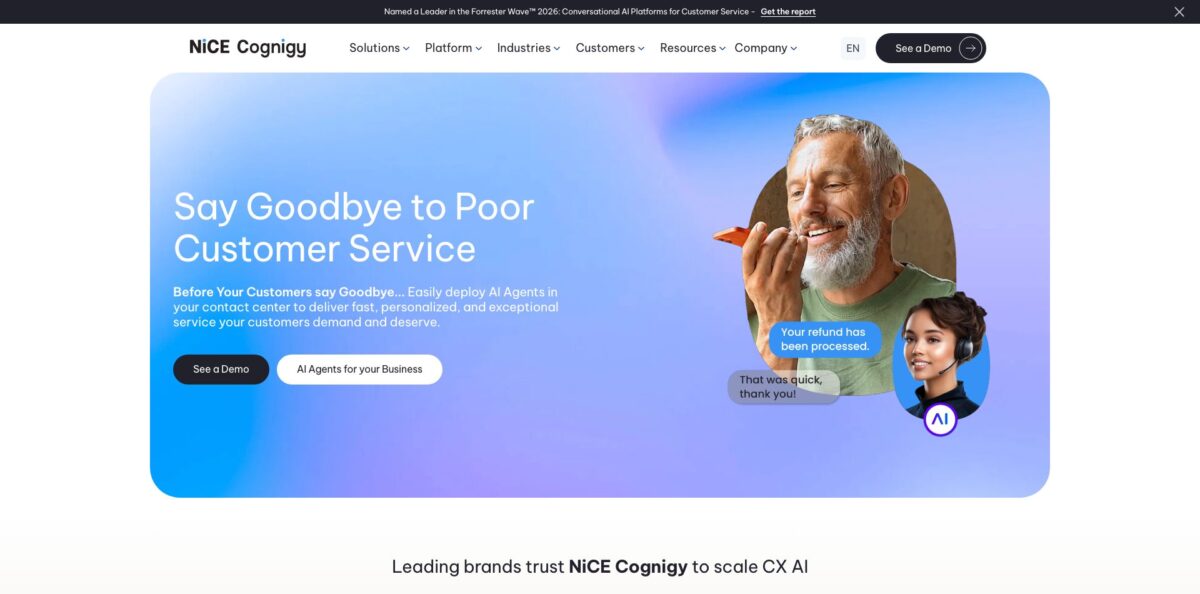
Cognigy is an enterprise platform for building AI agents that answer customers by phone, chat and messaging, sitting on top of the contact center software you already run. Founded in Düsseldorf in 2016 and bought by NiCE in September 2025, it now ships as NiCE Cognigy, sold both inside CXone Mpower and as a standalone product. Its core product, Cognigy.AI, mixes LLM-driven agents with rule-based flows, so a bot can chat freely and then switch to a strict script for payments or identity checks. The problem it solves is scale: deflecting millions of routine calls about rebookings, refunds or parcel status without ripping out Genesys, Avaya or Amazon Connect. The weak spots are price transparency, documentation depth and a learning curve for advanced flows. Pick it if you run a large, multilingual contact center; skip it if you need a quick chatbot for a small website.
How to start using Cognigy?
You have two entry points. For hands-on evaluation, the Cognigy.AI trial signup asks for your name, company, country, a business email and a password, and the vendor states it gives full access to all features with no credit card required. The trial terms limit it to evaluation purposes only. If you are buying for a contact center, the realistic path is the “See a demo” form, where a solutions expert walks you through agents running on your current stack and volumes.
Once inside, the official quickstart starts with prerequisites: connect an LLM for language and one for embeddings (the docs use OpenAI GPT-4o and ada-002 as the example). Then go to Build > AI Agents and create a persona with a name, description, avatar and speaking style. On the Jobs tab you define what the agent does, for example a “Delivery Manager” job with written instructions. Expect most early work to happen here, because the job instructions shape tone and scope more than any other setting.
Next, ground the agent. Upload your documents into Knowledge AI and assign that knowledge to the agent so it answers from approved content. In the Tools section, click Add Tool > Regular Tool to define an action such as track_parcel with a tracking_code parameter, which your backend then fulfils. Memory Handling controls whether the agent injects the customer’s contact profile for long-term personalization. When you need fine control, Advanced Editor opens the full Flow with every Node that drives the agent’s responses.
To check your work, go to Deploy > Endpoints, add an Endpoint linked to your Flow and click Open Demo Webchat. For broader QA, the Simulator generates synthetic conversations from personas, missions and success criteria, and you can schedule runs to catch regressions after each change. Note that the Simulator only covers text, so voice agents still need live call testing through Voice Gateway before you route real traffic.
Who is it for?
Contact center directors
You are handling millions of calls a year and every minute of handle time costs money. Cognigy plugs voice and chat agents into Genesys, Avaya, NiCE CXone, Amazon Connect, 8x8 or Microsoft without replacing your telephony, so automation lands on the queues you already measure.
CX leaders at global brands
Your customers write and call in dozens of languages, and staffing native speakers for each is expensive. The platform advertises support for 100+ languages plus real-time translation for human agents, which lets one agent design serve several markets.
Conversation designers
You need more control than a prompt box but less than a full codebase. The Flow editor lets you combine deterministic Nodes with LLM-driven AI Agent Nodes, so compliance-critical steps stay scripted while open questions get flexible answers.
Enterprise developers and integrators
Your job is wiring bots into CRMs, booking engines and payment systems. You get REST and MCP endpoints, an Extension Framework, Code Nodes and a marketplace of prebuilt integrations, so most backend calls become reusable tools rather than one-off scripts.
Operations and QA teams
Once agents go live, someone has to prove they behave. The Simulator, Insights analytics and the separately licensed Ops Center give you test scenarios, conversation transcripts and operational monitoring in one place.
Existing NiCE CXone customers
You already pay for CXone and want agentic AI without a separate vendor. Cognigy is now available inside CXone Mpower, which keeps contracts and support under one roof.
Cognigy pricing
Cognigy does not publish a price list. There is no pricing page on cognigy.com, and buying runs through a sales demo, so pricing is quote-based. What the official billing documentation does reveal is how usage is metered. Standalone licenses are charged per billable conversation, which covers up to 50 user inputs within a 24-hour window; going past 50 inputs or 24 hours starts a new billable conversation. Voice is sold separately as packages of concurrent lines, with daily overage charges if you exceed them. Knowledge AI is licensed by Knowledge Chunks (a hard cap on ingested data) and Knowledge Queries (with overages). xApps and Ops Center require their own licenses, while the Webchat widget is free of charge.
Full access to Cognigy.AI features for evaluation only, no credit card required. Use it to prototype agents and flows, not to run production traffic.
Billed per conversation under a license agreement; Insights analytics and Agent Copilot are provided together with the platform. Endpoint Transformers that stop a message before any Flow runs add one billable conversation per 50 executions.
Custom. Separate license sold as concurrent-line packages, with reporting on the peak number of lines used each day.
Custom. Packages of chunks and queries; extra chunk packages can be bought when you hit the ingestion limit.
Custom. Customers using Cognigy inside CXone follow a separate NiCE billing model.
Cognigy key features
Agentic AI Agents with Jobs: you create a persona, give it a job description, tools and knowledge, and the LLM plans how to reach the goal in each conversation. Agents can hand over to other specialist agents or to humans while sharing memory across the handoff. You can also hire prebuilt agents from the Job Market instead of starting from scratch.
Composite AI flows: the Flow editor lets one conversation move between free LLM dialogue and deterministic, rule-based steps without the customer noticing. That matters for authentication, payments or regulated disclosures where the wording must be exact. Expect to use this hybrid model for most production agents.
Bring-your-own LLM: the docs list providers including OpenAI, Azure OpenAI, Anthropic, Google Gemini and Vertex, Amazon Bedrock, Mistral and any OpenAI-compatible endpoint, plus a proprietary Cognigy Nexus LLM. You can swap the model behind a specific job without rebuilding the agent.
Voice Gateway: native telephony connectivity with barge-in, DTMF, call recording, agent handoff and outbound calling with answering machine detection. The vendor states it supports 25K+ concurrent conversations and 1000+ synthetic voices from speech vendors such as AWS, Microsoft, Google, Deepgram and ElevenLabs. Voice is the main reason large contact centers shortlist the product.
Knowledge AI: upload documents, PDFs, slide decks, images and web content, and agents answer with retrieval-augmented generation grounded in that material. Answers can be traced back to their source, and you can filter search scope to resolve conflicting content. It is licensed separately, so budget for it if you want document-based answers.
Channels and contact center connectors: the platform advertises 30+ omnichannel connectors and 110+ prebuilt tools and integrations. Endpoints in the docs cover Webchat, WhatsApp, Microsoft Teams, Slack, Messenger, LINE, Genesys, NiCE CXone, 8x8, Amazon Lex, REST, an MCP Server and an A2A Server. One agent can therefore serve web, phone and messaging from a single build.
Simulator and testing: LLM-generated test conversations based on personas, missions and success criteria, with a dashboard of results and scheduled runs. It complements the Interaction Panel for manual debugging.
Cognigy Pros & Cons
Pros
Cognigy is built for the hard part of customer service automation: connecting AI agents to real telephony and real contact center platforms at enterprise volume. The vendor reports more than a billion annual interactions across customers such as Lufthansa, Toyota and DHL. The composite model lets you keep regulated steps deterministic while still giving customers natural LLM conversations, and the open model layer means you can choose between OpenAI, Anthropic, Google, Bedrock and others per job. Reviewers on Gartner Peer Insights and Capterra consistently praise the low-code interface and responsive support, and some describe the platform as stable with little maintenance. Use it when you need voice and chat agents inside an existing contact center rather than a standalone widget.
Cons
Pricing is opaque, and core pieces such as Voice Gateway, Knowledge AI, xApps and Ops Center each need their own license, so the total cost is hard to estimate early. Capterra reviewers repeatedly mention documentation that is hard to navigate and advanced features that take time to learn, while G2 reviewers point to limited analytics. Smaller companies describe the pricing as too high for SMBs. On-premises installation is no longer offered to new customers, which may rule it out for some regulated buyers. Since the NiCE acquisition, some customers also say the long-term product direction is not yet clear. Ask for a written roadmap and an itemized license breakdown before you sign.
Use Cognigy if you want…
- Automate high-volume phone calls with voice AI agents.
- Add AI agents to Genesys, Avaya or Amazon Connect.
- Combine scripted compliance steps with free LLM conversation.
- Serve customers in many languages from one agent build.
- Ground agent answers in your approved enterprise documents.
- Swap LLM providers without rebuilding your customer service agents.
- Give human agents real-time AI assistance and translation.
- Test agent behavior with simulated customer conversations.
Cognigy alternatives


Cognigy Reviews
Reviewers on Gartner Peer Insights say building AI agents is quick and does not need much IT expertise, and they like running deterministic and agentic approaches side by side. One complaint is that the Ops Center requires separate licensing.
Capterra users describe the web interface as easy to pick up yet powerful and call the support team responsive. The most common gripe is documentation: some features are hard to find and examples can be vague.
On G2, non-coders appreciate the drag-and-drop flow builder and built-in intent tools for getting bots live fast. Analytics are seen as limited, and some want more options for advanced chat flows and ready-made templates.
Several Capterra reviewers praise integration with back-end systems and many channels, but smaller firms find the pricing too expensive and miss a way to roll bots back to earlier versions.
Long-time customers on Gartner Peer Insights call the platform stable in operation and flexible with APIs, though some say that after the NiCE acquisition it is not yet clear what the target product lineup will look like.
FAQ
Is Cognigy still a separate product after the NiCE acquisition?
Yes. NiCE closed the deal in September 2025 and markets the product as NiCE Cognigy, available both inside CXone Mpower and as a standalone offering at cognigy.com.
Does Cognigy have a free plan or free trial?
There is no free plan, but there is a free trial of Cognigy.AI that requires no credit card and is meant for evaluation only. Production use requires a license agreement.
How much does Cognigy cost?
Pricing is quote-based and not published. Licenses are metered by billable conversations (up to 50 user inputs within 24 hours), concurrent voice lines and Knowledge AI chunks and queries.
Which LLMs can I use with Cognigy?
The docs list OpenAI, Azure OpenAI, Anthropic, Google Gemini and Vertex, Amazon Bedrock, Mistral, Aleph Alpha, OpenAI-compatible providers and Cognigy’s own Nexus LLM. You add credentials per provider and assign models per agent job.
Which contact center platforms does Cognigy integrate with?
Official integration pages cover Genesys, Avaya, NiCE CXone, Amazon Connect, 8x8 and Microsoft, and the docs add endpoints for channels like WhatsApp, Teams, Slack, Messenger and REST.
Can I host Cognigy on-premises?
Not as a new customer. Cognigy is offered as SaaS, usually in a shared cloud environment, and existing on-premises installations continue to receive updates.
How many languages does Cognigy support?
The vendor states support for 100+ languages, along with built-in machine translation for voice agents and real-time translation for human agents.
Does Cognigy offer an API?
Yes. There is a documented REST API, a REST Endpoint for connecting agents to custom front ends, and MCP and A2A server endpoints for agent-to-agent and tool integrations.
Similar tools
 Level AIContact center AI platform that scores every call, chat and email, runs voice and chat virtual agents, and gives live agents real-time
 AiAgent.appNo-code workspace for building AI agents, Autopilots and workflows that act across your business apps, with human approval before external writes.
 MeshPersonal CRM, formerly Clay, that builds contact cards from email, calendar and social apps, with the Nexus AI agent to search and