
Delve AI
Data AnalysisUpdated November 10, 2026
AI market research platform that builds personas from analytics, CRM and social data, then lets you chat with them or run synthetic surveys.
We may earn a commission when you sign up through our links. It does not affect our reviews.
What is Delve AI?
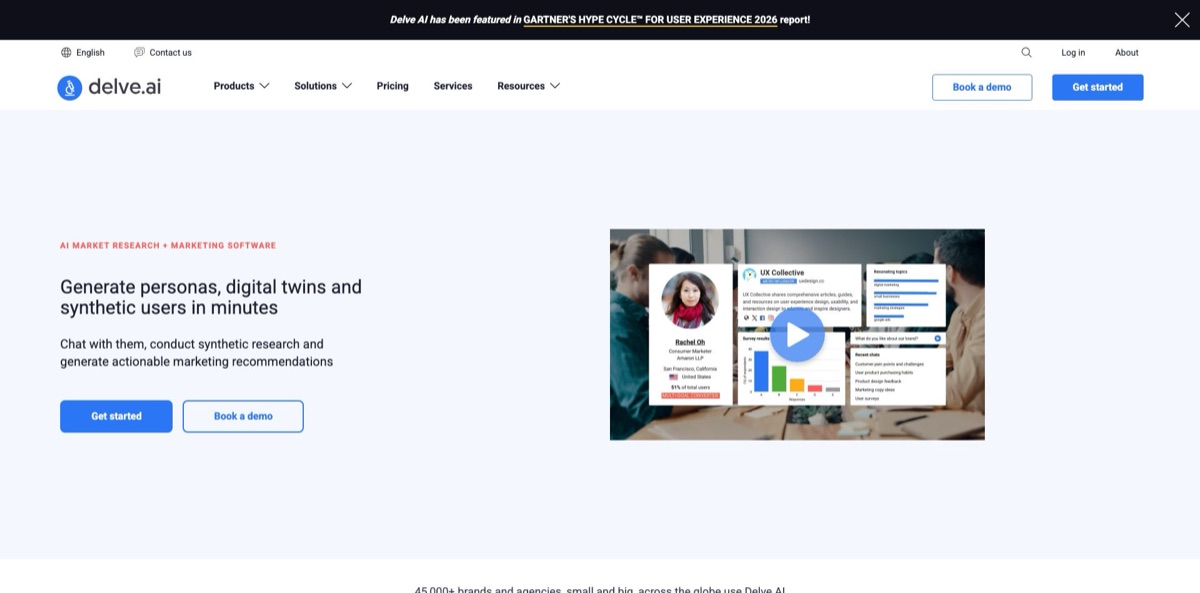
Think of it as an automated persona factory with a chat window attached. The platform pulls aggregated data from Google Analytics 4, Search Console, your CRM, public social profiles and Similarweb traffic estimates, clusters visitors and buyers into segments, and writes a persona for each one, refreshed monthly. Those personas then become digital twins you can question in the dashboard or in Slack, and synthetic users you can put through surveys, interviews and focus groups. The problem it removes is the slow, anecdotal persona workshop that ends in a PDF nobody updates. The weak spots: pricing is split across many separate products, competitor personas rest on third-party estimates, and synthetic answers are simulations rather than customers. Pick it if you already have real traffic or CRM data to feed it; without either, you mostly pay for informed guesses.
How to start using Delve AI?
Sign up for a free account on the Delve AI website; the free tier needs no credit card. Every workspace starts with 50 chat credits, which the company says covers two or three questions, plus one free Audience Persona and one Website Persona built from at least three days of analytics history. Paid Website Persona plans are assigned automatically from your monthly traffic, so check your GA4 visitor numbers before you start and the upgrade prompt will not surprise you.
For a first real scenario, build a persona with no integrations at all. Go to Personas > Audience Persona, describe your target audience in plain text or upload a SparkToro audience report, and click Generate persona. When it is ready, click Chat in the persona overview to open its digital twin and ask it to react to a landing page headline or an email subject line. Keep questions short: every message and every reply spends credits, and attached images or files cost more.
The screen that matters most is the data connection. Log in with your Google account, pick your GA4 property and grant access. Viewer rights are enough to generate personas, while organization tracking for B2B sites needs Editor rights because the platform creates custom dimensions in GA4; Universal Analytics is no longer supported. Before chatting at scale, open Settings > Brand Voice and fill in the Summary, Do and Don’t fields so twin answers match your tone, then set the chat language under Account > User Profile or choose Auto-detect.
Before you share anything, check the segments against what you already know. The free Lite plan opens every feature for Segment 1, your largest segment, including up to three sample user journeys, so compare that persona with your own customer interviews or sales notes. The vendor’s own guide suggests asking a twin the same question two different ways and treating inconsistent answers as weak. Once the output holds up, connect Slack under Settings > Notifications so the team can query personas with the /ask-persona command.
Spend the 50 free credits on two or three pointed questions about a real asset, such as your pricing page, before you connect GA4 or buy anything.
Who is it for?
E-commerce marketers
You have Shopify orders, Klaviyo lists and GA4 data, yet segments still come from gut feel. Customer Persona and Website Persona cluster real buyers by behavior, spend and interests, then list the channels, keywords and influencers each segment follows. Campaign targeting starts from data you already own instead of a brainstorm.
B2B SaaS teams
Anonymous traffic tells you little about which companies are evaluating you. With organization tracking switched on, OrgInfo data names the visiting organizations, and the Suggested contacts add-on returns people at those companies. Comparing converting and non-converting segments gives you a sharper ideal customer profile.
Marketing agencies
Building personas by hand for every client does not scale. Agency plans cover several websites at once, let you switch each site between one-time generation and monthly updates, and produce white-labeled reports. You hand clients a data-backed audience profile without hiring a research team.
UX and market researchers
Recruiting niche respondents takes weeks and budget you rarely have for an early concept. Research Persona turns your transcripts and survey data into personas, and synthetic users let you run surveys, interviews and focus groups in minutes. Treat the results as hypotheses that tell you what to test with real people.
Product marketers and copywriters
You need quick reactions to a headline, ad or pricing page before launch. Digital twins answer in chat or Slack, accept images and files, and can share a group chat so you compare how segments respond to the same draft. Weak messages get cut before media budget is spent.
HR and people teams
Engagement surveys produce averages, not people. Employee Persona builds workplace personas from employee profiles and reviews, covering aspirations, challenges and internal influencers. Programs can then target real groups rather than the whole company.
Delve AI pricing
There is no single subscription here. Each persona type is sold as its own monthly or yearly plan, with volume tiers by website traffic, CRM records, research segments, social brands or headcount, while digital twin chat and synthetic users run on prepaid credit packs that recharge automatically. Annual billing takes 20% off, and the combo bundles cut up to 40% off the combined product prices. All prices are in US dollars, and payment is by Visa, Mastercard, Discover or American Express only; PayPal is not accepted.
One Audience Persona, one Website Persona from three or more days of data with full access to the largest segment, and 50 digital twin chat credits. Competitor Persona has no free option, because the traffic data behind it is bought from partners.
One website with up to 15,000 monthly visits, 2 competitor domains and up to 3 team members. Tiers step up to 5 million monthly visits, and the platform picks yours from actual traffic.
Up to 3 segments and 10 MB of uploaded research data, with larger 5, 10 and 25-segment tiers.
$199/month, or $159/month billed yearly ($1,908/year), for one brand across the major social networks.
The yearly plan is listed at $1,128/year, but annual customer personas refresh quarterly rather than monthly.
$250/month for up to 500 employees, or $600/year on annual billing, again with quarterly updates.
Packs recharge automatically when they run out and stay valid for 12 months.
$99 per 100 users, recharged automatically; surveys and interviews run on usage-based pricing.
Research Essential $317/month ($254/month billed yearly), Marketing Essential $877/month ($702/month yearly), Complete $2,499/month ($1,999/month yearly). Complete covers 5,000 customer records, a website up to 1 million monthly visits, 6 competitors, 1,000 synthetic users and 10,000 chat credits.
from $299/month for 5 websites with 75,000 cumulative monthly visits, 5 competitor domains, 3 agency plus 3 business members and white-label reports.
extra competitors $49/month each, filters $39/month, API access $99/month, suggested contacts $99/month; larger requirements are quoted on request.
Delve AI key features
Website and competitor personas
Connect GA4 and Search Console, and the platform segments visitors by demographics, psychographics, behavior and transactions, then writes a persona with sample journeys, preferred channels, keywords and influential websites for each segment. Competitor Persona does the same for any rival domain using Similarweb traffic intelligence and Moz link data.
CRM and research personas
Customer Persona reads HubSpot or Klaviyo through native integrations, or Shopify orders, Salesforce, Stripe and CSV uploads, and enriches the records before segmenting them. For HubSpot, it prioritizes contacts marked as customers and weights them by revenue and deals. Research Persona builds user personas from interview transcripts and survey data you upload, so the profiles reflect who actually bought or answered, not just who browsed.
Social Persona
Enter a domain, and the platform finds the linked handles on Instagram, LinkedIn, X, YouTube, TikTok, Pinterest and Facebook, then profiles the audiences around them. Each segment shows demographics, interests, hashtags, podcasts and YouTube channels in aggregate form, without contact details. A segment needs at least 200 public profiles, so very small brands may not qualify.
Digital twins
Every persona can be questioned from the dashboard or through the /ask-persona command in Slack, in 15 languages including Spanish, German, Japanese and Arabic. You can attach ads, landing pages or videos, set a brand voice, and build group chats that put several segments in front of the same question.
Synthetic research
Pick a persona segment, choose how many synthetic users to generate and filter them by attributes such as gender or location. Then select a survey, interview or focus group, upload your questionnaire and set goals; the dashboard returns transcripts, analytics, themes and a summary report you can question further. Pre-built studies cover image, video and email creative testing plus influencer ranking.
Alerts, integrations and API
Slack and email deliver persona updates, real-time visit alerts and daily, weekly or monthly summaries. OrgInfo and a Google Tag Manager integration identify companies visiting a B2B site, and OpenWeatherMap data checks whether activity follows the weather or seasons. The API add-on returns persona attributes and segments as JSON, but it is switched on by request and has no public developer portal yet.
Delve AI Pros & Cons
Pros
Delve AI turns data you already collect into segmented personas without commissioning a research project. GA4, Search Console, HubSpot, Klaviyo, Shopify, Stripe and CSV files all feed the same engine, and personas refresh monthly instead of aging in a slide deck. The free tier is usable for a first look, and moving from a static profile to a twin you can question in Slack makes the output something teams actually consult. G2 reviewers rate it 4.8 out of 5 and mention realistic personas and responsive support. Agencies get white-label reports and per-site toggles that keep costs in check. Start with your largest GA4 segment and judge it against what your sales team already knows.
Cons
Pricing is fragmented: website, customer, social, research and employee personas, chat credits and synthetic users are each billed separately, and a full setup quickly reaches hundreds of dollars a month. Competitor and social insights rest on third-party estimates and public profiles, and some AppSumo reviewers found outputs too generic for niche markets. Synthetic respondents are language-model simulations, so they cannot replace real customers for pricing or launch decisions, which the vendor’s own guide states plainly. Most Marketing Advisor modules, from PPC to email, are still marked as coming soon, and partial months are not refunded. Map exactly which persona products you need before buying, and confirm twin findings with a small real sample.
Use Delve AI if you want…
- Build buyer personas from your GA4 and CRM data.
- Profile the audiences behind your competitors’ websites.
- Test ad copy against digital twins before launch.
- Run synthetic surveys and interviews in minutes, not weeks.
- Identify which companies visit your B2B website.
- Query customer personas directly from your Slack workspace.
- Deliver white-label persona reports to agency clients.
- Map social audiences across Instagram, TikTok and LinkedIn.
- Keep personas updated automatically as your traffic changes.
Delve AI alternatives

Delve AI Reviews
G2 reviewers, who rate it 4.8 out of 5 across 22 reviews, describe the personas as realistic and close to their real audience and call the tool easy to use, though one found the volume of insights overwhelming until they worked out which reports matter day to day.
Some G2 users say it helped them validate their target-market assumptions; another wanted crisper personas and more detail on exactly who was visiting the site.
Buyers of the 2022 AppSumo deal praise the competitor personas for showing which rival pages and topics gain traction, along with real-time alerts on company visits; one said it cut their research time roughly in half.
A four-star AppSumo review found competitor personas too broad for a niche mortgage client and the reports hard to share without explanations or recommendations; the founder later replied that bulk export and scheduled report emails had been added.
FAQ
Is there a free plan for Delve AI?
Yes, a free tier rather than a time-limited trial, with no credit card required. It includes one Audience Persona, one Website Persona built from three or more days of data with full access to the largest segment, and 50 digital twin chat credits.
What data does Delve AI need to build personas?
Website Persona uses GA4 and Search Console, Customer Persona uses HubSpot, Klaviyo, Shopify, Salesforce, Stripe or a CSV file, and Competitor and Social Persona only need a domain. The free Audience Persona works from a plain-text description of your target audience.
Is my data used to train Delve AI’s models?
The FAQ says your web analytics and CRM data are used only for persona generation, but data from free-tier accounts older than 30 days may be anonymized and aggregated to improve internal models and benchmarks. Personas show group-level insights rather than individual contact details.
Which languages does Delve AI support?
Websites should preferably be in English, with built-in translation for major languages. Digital twins chat in 15 languages, including Arabic, Chinese, French, German, Hindi, Japanese, Korean, Portuguese, Spanish and Turkish, or you can pick Auto-detect.
Does Delve AI have an API?
Yes, as a $99/month add-on that returns persona attributes and segments as JSON, excluding sample user journeys. The team activates it on request and sends credentials directly, since there is no public developer portal yet.
What happens if my website traffic exceeds my plan?
If monthly visitors significantly exceed your plan limit, access to paid features is restricted until you move to the matching tier. The company says it does not throttle accounts or stop processing data because of traffic spikes.
Can I cancel Delve AI and get a refund?
The billing owner can cancel anytime under Billing > Subscriptions, with no cancellation fee, and the plan stays active until the next billing date. Refunds are not given for partial use except for platform-caused problems, and the business drops to the free tier with limited access to past data.
Is Delve AI available in every country?
The platform supports businesses in more than 230 countries but not in Russia, Iran, Cuba, North Korea, Syria, Venezuela and a few other territories. Adult, tobacco and gun-related businesses are also not supported.
Similar tools
 HexCollaborative analytics workspace that mixes SQL, Python and AI agents in notebooks, then publishes results as data apps and plain-language answers.
 WindwardMaritime AI platform that fuses AIS, satellite and ownership data into vessel risk scores, sanctions screening, alerts and container ETAs.
 Speak AIConversation intelligence platform that transcribes interviews, calls and meetings in 100+ languages and turns them into themes, scores and structured data.