
Detecting AI
AI AssistantsUpdated October 26, 2026
AI text detector with sentence-level highlights, bundled with an AI humanizer, web plagiarism checker, fact checker, REST API and MCP server.
We may earn a commission when you sign up through our links. It does not affect our reviews.
What is Detecting AI?
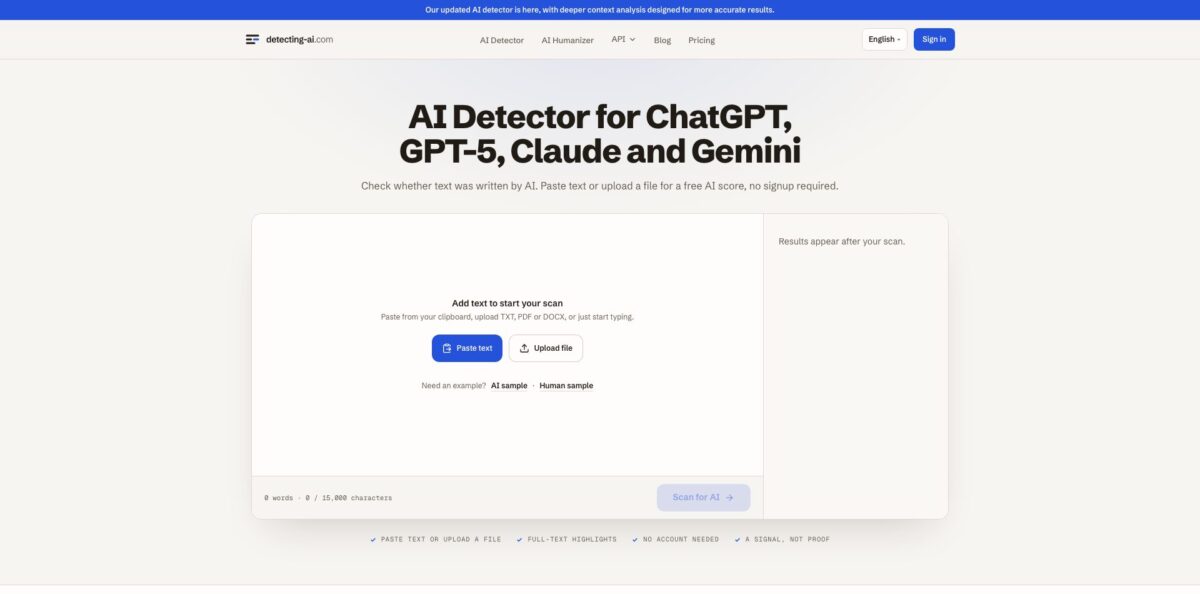
Detecting AI is a web toolkit for judging whether a piece of writing came from a language model. Its core is a detector that returns an overall AI score plus highlighted passages inside your original text, so you can see which sentences pushed the number up. Around it sit an AI Humanizer, a web plagiarism checker, a claim-level Fact Checker, an essay grader and a proofreader, all on one subscription, and developers get REST APIs and a remote MCP server. The free detector needs no account and takes up to 15,000 characters per scan. The vendor claims 99% accuracy with under 1% false positives, but independent tests are mixed and several have caught it flagging human writing as AI. Pick it if you want cheap, readable detection with sentence-level evidence, and treat every score as a reason to look closer rather than a verdict.
How to start using Detecting AI?
Open detecting-ai.com and the detector sits at the top of the homepage. Paste text, type it in, or upload a TXT, PDF or DOCX file; the file is parsed inside your browser and nothing is sent until you press Scan for AI. Anonymous visitors can run up to 300 checks a day at 15,000 characters each, so you can evaluate it before signing up. Scanned PDFs without selectable text are not supported yet, so run OCR first if your document is an image.
Start with samples you already know the origin of. Use the built-in AI sample and Human sample links, or paste a ChatGPT draft next to a paragraph you wrote yourself. The report shows an overall AI score, then highlights passages in the full text in three bands: 75–100 for a strong AI signal, 30–74 for a possible signal and 0–29 for a low one. Select a highlighted passage to see its individual score. Comparing the two shows how it treats your kind of writing.
If a draft scores high and you wrote it with AI help, the AI Humanizer is the next step. Choose Cognia for a fast rewrite or Huma for a deeper, slower one; both accept 150 words per free rewrite, and a free account adds 1,000 words a month. The original stays editable beside the result and only changed wording is highlighted, so you can reject edits that shift your meaning. Pro and Scholar subscribers also get Humanizer Autopilot, which rewrites each section and re-checks it against the detector for documents up to 15,000 words.
Before you publish or submit, run the other checks. The Plagiarism Checker (paid plans only, up to 3,000 words per scan) splits your text into sentences, links each strong or similar match to the closest public web page and copies APA, MLA or Chicago citations. The Fact Checker labels extracted claims as appearing supported, appearing contradicted or needing context. Developers can skip the web tool entirely: create a key in the dashboard, buy an API plan and POST text to api.detecting-ai.com with the detector version pinned to v3.
Who is it for?
Teachers and teaching assistants
You suspect parts of an essay were generated but need more than one number before raising it with a student. The highlighted passages show which sentences drove the score, and the vendor’s own methodology page tells you to weigh drafts, sources and revision history before deciding anything. Use it to open a conversation, not to issue a penalty.
Students checking their own work
A false flag on an honest essay is a real worry. The free detector lets you scan a draft without signing up, see which lines read as formulaic and revise them, while the plagiarism checker catches missing citations before you submit. A low score here does not predict what your university’s own tool will report.
Editors and content managers
Contributed articles arrive faster than anyone can read them closely. Running each draft through the detector and the plagiarism checker gives you a triage order, so you read flagged passages first. The Zapier app can push results into Slack or a table for a reviewer.
Freelance writers and agencies
Clients increasingly run deliverables through detectors themselves. Checking your copy first, and humanizing AI-assisted passages with visible edits, reduces disputes after delivery. The Scholar plan’s unlimited humanizer words suit writers who rework long documents every week.
Developers building review features
If your LMS, CMS or marketplace accepts text from users, the REST API returns sentence-level labels with character offsets so you can highlight passages in your own interface. Plans start at $15 a month for 100,000 words, and the MCP server lets Claude, ChatGPT, Codex or Claude Code call the detector mid-conversation.
Test-prep learners
The Essay Grader estimates a score against SAT-style, GRE, IELTS or TOEFL Academic Discussion rubrics with a free account. It gives you a revision checklist between practice sessions, though it never sees the original prompt and its score is not official.
Detecting AI pricing
Web plans are flat subscriptions billed through Paddle, which acts as merchant of record and adds any local tax at checkout. Every plan uses the same detector; what changes is the size of each check, the monthly humanizer word allowance and the number of plagiarism credits, where one credit covers up to two sentences. The official pricing page lists prices in USD. Yearly billing works out to roughly four months free compared with paying monthly.
No account needed for up to 300 detections per day at 15,000 characters each, 150 words per humanizer rewrite (plus 1,000 words a month with a free account) and Fact Checker requests up to 125 words. Plagiarism checking, Autopilot and premium support are not included.
Unlimited detection at up to 1,000,000 characters per check, 15,000 humanizer words a month, 300 plagiarism credits a month (3,600 up front on the yearly plan), Fact Checker requests up to 5,000 characters and premium support.
Everything in Writer with 60,000 humanizer words a month, 1,000 plagiarism credits a month (12,000 a year) and Humanizer Autopilot for documents up to 15,000 words.
Unlimited humanizer words, 3,000 plagiarism credits a month (36,000 a year) and Autopilot.
The API Bundle costs $35/month with 100,000 words for each of the three. Creating a key gives no free usage, and no annual or volume discount is listed.
If you run out of humanizer words, a 10,000-word top-up that never expires is available, though its price is not shown publicly. “Unlimited” detection means no daily cap for normal human use, not permission for bulk automated extraction. Paid plans renew until cancelled, and refunds follow Paddle’s checkout terms and consumer law.
Detecting AI key features
Sentence-level AI detection: eligible sentences are scored separately, and the report shows the overall AI score next to highlighted passages in your full text, grouped into strong, possible and low bands. According to the vendor, a feature-based classifier and a fine-tuned transformer are calibrated into one score, designed for text from GPT-5 and earlier GPT models, Claude, Gemini and mixed human-edited drafts. You see why a document scored high instead of arguing over one percentage.
AI Humanizer with visible edits: two web modes, Cognia (fast) and Huma (deeper and slower), rewrite phrasing, rhythm and transitions while the original stays editable beside the result. Every changed phrase is highlighted, and non-English text is routed to a multilingual rewrite path. The company itself says a humanized draft is not guaranteed a low score on any detector.
Web plagiarism checker: each scan of up to 3,000 words is split into sentences and compared with candidate pages on the public web. Matches of 80–100% similarity count as strong and 60–79% as similar, at half weight in the overall score. You can ignore quoted passages or stop before a bibliography, and copy a citation for any matched source. It searches the open web only, so percentages will not match Turnitin.
Fact Checker and essay tools: the Fact Checker extracts claims and labels each one as appearing supported, appearing contradicted or needing context, with an explanation to verify against primary sources. The Essay Grader estimates scores on SAT-style, GRE, IELTS and TOEFL rubrics, and the free Essay Checker proofreads up to 10,000 characters for grammar, spelling and punctuation, letting you accept each correction individually.
REST API: POST text to /api/detect/ with version v1, v2 or v3 and get back ai_percentage plus sentence chunks with character offsets, an AI or Human label and a 0 to 1 confidence score. Requests take up to 160,000 characters, usage is counted in input words, and an Idempotency-Key makes an exact retry within 24 hours return the stored result without charging again.
MCP server and Zapier app: one remote MCP endpoint exposes detect_ai_text and humanize_text, with OAuth for hosted Claude and ChatGPT connectors and a bearer key for Codex or Claude Code. The official Zapier app offers three actions (detect, humanize, plagiarism) but no trigger. Moodle connections are scoped per institution through the API rather than offered as a self-install plugin.
Privacy defaults: nothing is sent while you type, TXT, PDF and DOCX files are read in your browser, and anonymous checks are not intentionally saved to history. The company says it does not train general-purpose models on your content without separate consent, while Autopilot jobs are stored privately for seven days.
Detecting AI Pros & Cons
Pros
The report is built for reading rather than for a headline number: you get passage highlights in three bands, individual sentence scores and repeated reminders that a score is not proof of authorship. The free tier is generous, with no sign-up, 300 checks a day and 15,000 characters per scan, and paid plans start at $6 a month on yearly billing with unlimited detection. One subscription also covers a humanizer with side-by-side edits, web plagiarism checks with citations, a fact checker and essay tools. Developers get a small REST contract, safe retries and an MCP server from $15 a month. Start on the free detector and upgrade only when you need plagiarism credits or longer documents.
Cons
Accuracy outside the vendor’s own benchmarks is uneven. Pangram, a competing detector, ran the earlier V2 model in January 2026 and saw it pass 7 of 9 AI texts but only 2 of 3 human ones, and bloggers have reported their own human-written articles scored at 26.9%, 63% and 72.1% AI. In one comparison a twice-humanized passage dropped to 7% AI. The 99% accuracy and under 1% false positive figures come from the company. Stanford researchers found that detectors in general misclassify non-native English writing as AI, and Detecting AI does not publish which languages its detector supports. Never act on a single score; compare drafts, sources and a second detector first.
Use Detecting AI if you want…
- Check essays for AI writing without creating an account.
- See which sentences drive an AI score.
- Humanize AI-assisted drafts with every edit highlighted.
- Scan articles for passages copied from the open web.
- Flag questionable factual claims before publishing a draft.
- Practice IELTS, GRE or TOEFL essays against scoring rubrics.
- Add AI detection to your LMS or CMS via API.
- Run AI checks from Claude or ChatGPT through MCP.
- Route detection results into Slack with Zapier.
Detecting AI alternatives


Detecting AI Reviews
A Chrome Web Store reviewer calls it the only tool they use both to check content for AI and to humanize it, though the extension has just one rating and about a hundred users.
A freelance blogger who bought the monthly plan saw a ChatGPT article flagged at 95.2% AI, but two pieces of their own human writing came back at 72.1% and 63%, with little difference between free and paid results.
A comparison of eight detectors against a humanizer found it rated a rewritten passage 67% AI after the first pass, then only 7% once the same text was humanized again.
A Clideo writer who ran their own article through three checkers found Detecting AI the most lenient at 26.9% AI, below Sapling and StealthWriter, yet still short of a clean human result.
FAQ
Is Detecting AI free?
Yes. The AI detector works without an account for up to 300 checks a day at 15,000 characters each, and the humanizer, Fact Checker and Essay Checker have free limits too. Plagiarism checking needs a paid plan, which starts at $9.99 a month or $72 a year.
How accurate is the Detecting AI detector?
The company reports 99% accuracy and a false positive rate under 1%, which are its own benchmark figures. Independent comparisons have been mixed, including human-written articles scored as partly AI, and the vendor itself advises treating results as a review signal rather than proof.
Which AI models can it detect?
It is designed to review text typical of ChatGPT (GPT-5, GPT-4o and earlier), Claude and Gemini, including human-edited and mixed drafts. It does not tell you which specific model wrote a passage.
Does it support languages other than English?
The interface is available in English, French, Dutch, Russian, German, Brazilian Portuguese, Spanish, Arabic and Uzbek. The detector asks you to check text in its original language and reports detected languages when available, but the company does not publish a list of supported detection languages.
What happens to the text I submit?
Text is sent only when you start a check, and files are read in your browser. Anonymous checks are not intentionally saved, signed-in checks may be kept in account history, and the company says it does not train general-purpose models on your content without separate consent. The service is run by TEMURIYDEVS LTD, a company registered in England and Wales.
Is there an API or MCP server?
Yes. REST APIs for detection, humanization and plagiarism cost $15 a month each for 100,000 words, or $35 a month for all three. A remote MCP server at api.detecting-ai.com exposes the detection and humanization tools to Claude, ChatGPT, Codex and Claude Code.
Is there a browser extension?
Yes. A Chrome extension from the same publisher lets you highlight text on any page to detect, humanize, fact-check or scan it for plagiarism. Its listing shows version 1.0, last updated in March 2025.
Can I cancel a paid plan?
Yes. Plans renew until you cancel from your account, and cancellation normally takes effect at the end of the paid period. Refunds follow Paddle’s checkout terms and applicable consumer law.
Similar tools
 FreedomGPTMulti-model AI app that puts hundreds of chat, image and video models, including its own censor-free Liberty models, behind one credit balance.
 ElephasPrivate desktop AI for Mac and Windows that answers questions from your own documents with page-level citations and hides personal details first.
 MagaiPaid AI workspace that puts ChatGPT, Claude, Gemini, Grok and dozens of image and video models in one chat, with memory and