

DomoAI
Art GenerationUpdated October 26, 2026
AI animation platform that restyles footage into anime and 40+ art styles, animates still images and builds talking avatars on the web.
We may earn a commission when you sign up through our links. It does not affect our reviews.
What is DomoAI?
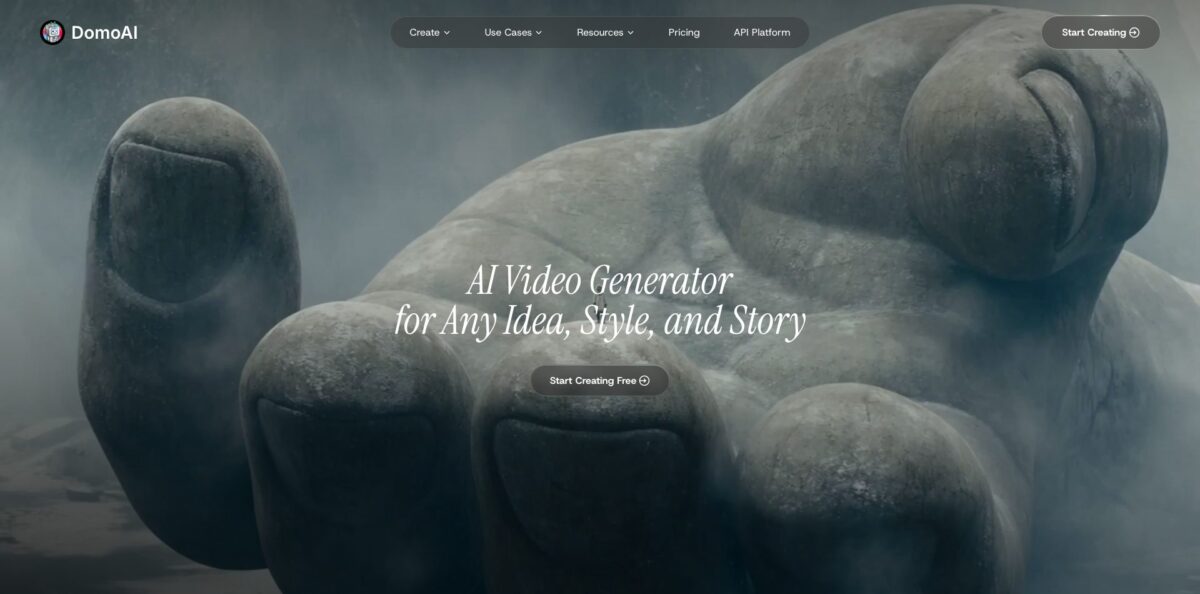
Singapore-based DomoAI started in 2023 as a Discord bot that turned short clips into anime and has since grown into a browser studio for stylized video. Its core trick is video-to-video restyling: you upload footage, pick one of 40+ presets (more than 20 of them anime looks, plus watercolor, oil painting and pencil sketch) and the model redraws each frame while keeping the original motion and audio. Around that sit image-to-video, text-to-video, keyframe interpolation, character replacement, talking avatars, lip sync and upscaling to 4K video or 6K images, powered by its own DomoAI 2.5 model alongside Seedance, MiniMax, GPT Image and Nano Banana. You get a stylized clip without rotoscoping or a 3D pipeline. The weak spots are a strict content filter, short clip limits and credits that drain fast on long or premium runs. It fits anime creators, short-form video makers and marketers who want a distinctive look quickly.
How to start using DomoAI?
Go to domoai.app and sign in. The platform supports two login methods, Google and Discord, so there is no separate password to manage. New accounts start on a free plan with a small credit balance, enough to try a few generations; free outputs carry a watermark, which paid plans remove. If you came from the Discord era, the same account links to the DomoAI server, which the company says ranks among the largest AI servers and hosts its support team.
The easiest first project, according to the help center’s own quick-start guide, is animating a photo. Open Image to Video, upload a still, describe the motion you want and generate several versions with different prompts so you can keep the best one. Image to Video produces clips of roughly 4 to 15 seconds depending on the model you choose (DomoAI 2.5, DomoAI 2.4.1 or Seedance 2.0). This teaches you how prompts, duration and credit cost relate before you commit real footage.
The screen most people come for is Restyle Video, the video-to-video tool. Upload an MP4, MOV or AVI file (the help center recommends 3 to 10 seconds), then browse the style categories grouped by model version, from V1.0 to V6.0. V6 is tuned for half-body and close-up portraits, so pick an older or different preset for full-body dance clips. If no preset matches, the Fusion style model takes either a text description or a reference image and applies that look to your clip. Set the aspect ratio (16:9, 9:16, 1:1 or custom) and toggle Lip Sync, Screen Keying or Subject Only as needed.
Click Generate and review the preview before downloading. Check that the style holds across the whole clip, that faces and hands stay intact and that the audio survived. If something breaks, try a different preset or shorten the clip and regenerate. Finished results can be saved to Assets, sent to the Talking Avatar tool to add a voice, or upscaled before you export.
Start with a short, well-lit clip of a single subject and a steady camera; DomoAI’s own guidance says that is where restyling holds up best.
Who is it for?
Anime and fan-art creators
You want your own footage or original characters in a hand-drawn anime look without frame-by-frame drawing. The 20+ anime presets and Character to Video let you map a character image onto a reference performance, and the result keeps the movement of the source clip.
Short-form video creators
TikTok, Reels and Shorts reward a recognizable visual hook. DomoAI turns an ordinary vertical clip into a cartoon, watercolor or ukiyo-e style piece in minutes, and templates such as AI Hug, 360 View and Loop Animation give you ready-made formats to remix.
Marketers and UGC ad producers
You need product or presenter videos in volume. Talking Avatar gives an image or video a voice with built-in text to speech, voice cloning and multiple languages, and the platform states that generated content can be used commercially.
Music video and storyboard makers
Frames to Video takes 2 to 8 keyframes and generates transitions between them, which helps you block out a sequence before spending on full shots. Omni Reference combines image, video and audio references in one generation for more consistent scenes.
Game and VTuber creators
Character to Video swaps the person in a motion clip for your character image, up to 30 seconds per generation, while Subject Only keeps the original background. That gives quick animated previews of characters without rigging.
Developers building video features
The DomoAI Enterprise API exposes text-to-video, image-to-video, template, talking avatar and video-to-video endpoints with task callbacks. You can add anime restyling to an app without training your own models.
DomoAI pricing
DomoAI runs on monthly credits. Every Fast mode generation, upscale or long clip spends credits, while Relax mode on the Standard, Pro and Team plans generates on supported models without consuming credits, at the cost of waiting in a queue. Subscription credits reset each billing cycle and do not roll over. Extra credit packs can be bought only with an active subscription, but those paid credits never expire. Annual billing saves 30% or more; the prices below are per month billed annually, with the month-to-month price shown crossed out on the pricing page in brackets.
A starter credit allowance to test the tools, with watermarked outputs.
600 credits per month (about $0.015 per credit), 50+ style templates, Character to Video at 5 and 10 seconds, Talking Avatar up to 20 seconds, 4K video and 6K image upscaling, up to 8 active tasks, no watermark. No Relax mode.
2,200 credits per month, unlimited Relax generations on supported models such as DomoAI 2.5, GPT Image 2 and Nano Banana Pro, up to 12 active tasks. Seedance and MiniMax models run in Fast mode only.
8,000 credits per month, with larger 16,000 and 24,000 credit options selectable on the plan card. Adds Character to Video and Video to Video at 20 and 30 seconds, Talking Avatar up to 60 seconds, 20 active tasks and priority support.
24,000 shared credits, a dedicated team workspace, all Pro models and up to 32 active tasks per workspace.
Image-to-video and text-to-video cost $0.04 to $0.10 per second depending on the model, talking avatar $0.06 per second and video-to-video $0.10 per second.
Refunds are narrow: monthly plans are refundable only if you have not used the service, and yearly plans are refunded minus one month at the standard monthly rate if you ask within the first month.
DomoAI key features
Video to Video restyling redraws existing footage in 40+ preset styles, including 20+ anime looks, while preserving the source motion and audio. The Fusion style model accepts a text description or a reference image when no preset fits. You get a stylized clip from phone footage instead of drawing or compositing it by hand.
Character to Video replaces the person in a motion clip with any character image you upload (JPEG or PNG up to 10MB), keeping the original performance. Clips run up to 30 seconds per generation on Pro. This lets you animate an original character with a real dance or acting take rather than a generic motion preset.
Image to Video and Frames to Video animate stills
The first turns one image into a short clip with prompt-driven motion; the second takes 2 to 8 keyframes and generates smooth transitions between them. Together they cover quick social loops and simple storyboard animatics without a timeline editor.
Talking Avatar and Lip Sync give any image or video a voice
You can type a script for built-in text to speech, clone a voice or upload audio, and Lip Sync matches mouth movement to the track in restyled clips. Avatars run up to 20 seconds on Basic and Standard and up to 60 seconds on Pro.
Screen Keying and Subject Only handle the masking work during restyling
Screen Keying isolates the subject and removes or replaces the background without a green screen, while Subject Only stylizes the main character and leaves the background untouched. That saves a trip to a separate compositing tool for many social edits.
A multi-model lineup sits behind one account
Besides DomoAI 2.5 and 2.4.1, the platform integrates Seedance 2.5 and 2.0, MiniMax H3, GPT Image 2.5 and 2, and the Nano Banana family for image generation and editing up to 4K. You can compare outputs without paying for several separate subscriptions.
Upscaling and an Enterprise API round out the pipeline
The built-in upscalers export video at up to 4K and images at up to 6K, and the REST API exposes the main video tools with file uploads and callbacks for apps that need generation at scale.
DomoAI Pros & Cons
Pros
DomoAI’s anime and artistic restyling is the reason it built a large following, and that strength is still central to the product. The style library is deep, the Fusion model covers custom looks, and motion from the source clip carries through, so performances stay natural. Lip Sync, Screen Keying and Subject Only are built into the same screen rather than sold as extra tools. Relax mode on Standard and above means you can iterate on supported models without watching your balance, and paid credits never expire. Commercial use is allowed on generated content, and the company states it does not train on your uploads unless you permit it. Use the free tier to test a few of your real clips before picking a plan.
Cons
The content filter is strict, and Trustpilot reviewers report that harmless prompts such as battle scenes get rejected, sometimes after credits are deducted. Video-to-video clips are short: the help center recommends 3 to 10 seconds, and 20 to 30 second runs require Pro in Fast mode. Long or premium generations burn credits quickly, and Basic has no Relax mode at all. Refunds are limited once you have used the service, and several reviewers describe slow responses on refund requests. The product line has also widened into a general video generator, so the interface carries many tools you may never touch. Start on monthly billing until you know how many credits your typical clip consumes.
Use DomoAI if you want…
- Turn ordinary video clips into anime-style animation.
- Apply watercolor, oil painting or sketch styles to footage.
- Animate a character image with a real motion reference.
- Bring still photos to life with short animated clips.
- Create talking avatars from a photo and script.
- Remove video backgrounds without a green screen.
- Upscale finished clips to 4K before posting.
- Add anime video restyling to your app through an API.
DomoAI alternatives
 RunwayRead review →
 PikaRead review →
 Kling AIRead review →
 PixVerseRead review →
 KreaRead review →
 Leonardo.aiRead review →
 Vidu AIRead review →
DomoAI Reviews
Positive reviewers on Trustpilot single out style transfer and lip-synced avatars as fast and clean, and say the output is good enough for commercial posts.
Some users value Relax mode as effectively free generation on higher plans, while others call Relax results random and inconsistent even with simple prompts and references.
A recurring complaint is the content filter: users report prompts rejected as violations, including ordinary action scenes, with credits still taken for the failed attempt.
Several reviewers like the quality but find credits expensive, noting that a single longer clip can consume a large share of a plan’s monthly balance.
Billing friction shows up often, from missing PayPal support to refunds that took longer than promised, though the company does reply to many complaints on the page.
FAQ
Is DomoAI free to use?
Yes, there is a free plan with starter credits so you can try the video and image tools. Free outputs carry a watermark, and paid plans start at $9 per month billed annually.
Can I use DomoAI videos commercially?
DomoAI states that content you generate can be used for commercial purposes, including ads, social media and client projects. Check the terms of service for specific restrictions.
How long can a DomoAI video be?
The help center recommends 3 to 10 second clips for video-to-video. Pro plans add 20 and 30 second Character to Video and Video to Video runs in Fast mode, and talking avatars up to 60 seconds.
What is Relax mode?
Relax mode generates on supported models without using credits, but jobs wait in a queue when demand is high. It is included on Standard, Pro and Team plans and is not available on Basic.
Does DomoAI still work on Discord?
DomoAI began on Discord and still runs a large server for community and support, and you can sign in to the web app with your Discord account. Most creation now happens in the browser studio at domoai.app.
Does DomoAI use my uploads to train its models?
The company says it does not use your data for training unless you explicitly allow it, and that uploaded content is not stored after processing.
Does DomoAI have an API?
Yes, the DomoAI Enterprise API offers text-to-video, image-to-video, template, talking avatar and video-to-video endpoints. Credits cost $0.02 each and do not expire.
How do I cancel my subscription?
On the website, click your avatar, open Profile, then Billing and choose Cancel Plan. Cancellation takes effect at the end of the current billing cycle.
Similar tools
 CustomuseAI 3D creation platform that chains image, video and 3D models into node workflows for game-ready assets, Roblox items and scenes.
 VisualGPTCredit-based AI image and video studio that runs Nano Banana, GPT Image, Seedream, Flux and Kling for product photos, photo edits and
 LovartAI design agent that turns a chat brief into logos, social posts, product shots, slides and videos on one editable infinite canvas.