

Elicit
Data AnalysisUpdated October 19, 2026
AI research assistant that searches 138 million papers, screens studies, extracts data into tables and writes cited reports and systematic reviews.
We may earn a commission when you sign up through our links. It does not affect our reviews.
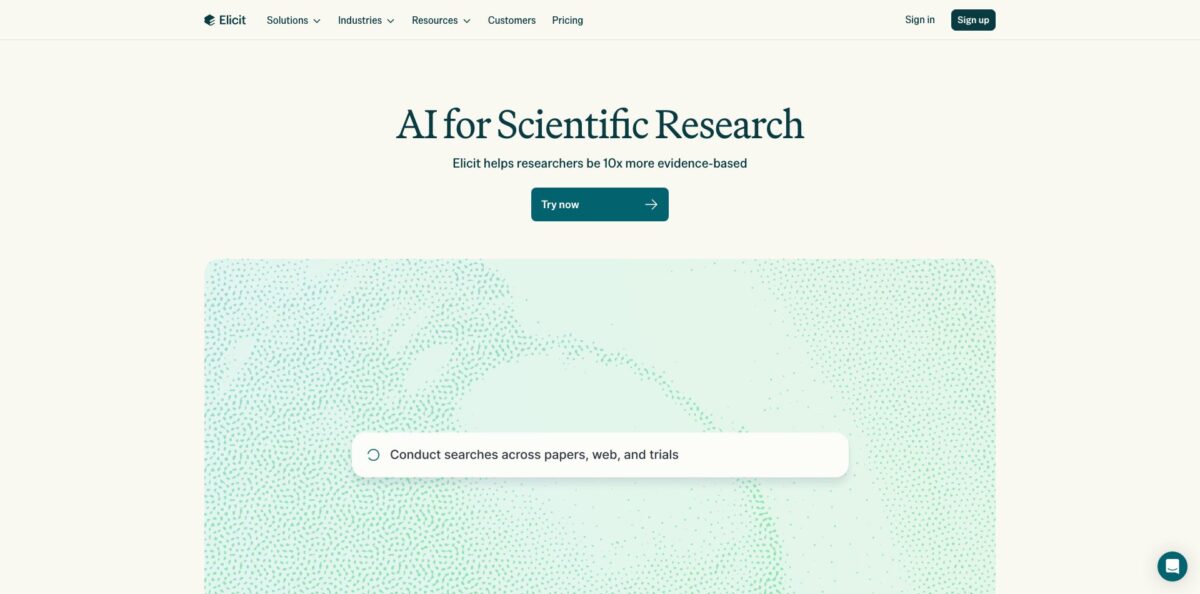
What is Elicit?
Elicit is an AI research workspace built on top of an index of more than 138 million academic papers and 545,000 clinical trials. You ask a research question, and its Research Agent finds relevant studies, pulls numbers and findings into tables, and writes reports where every claim links back to a sentence, table or figure in the source. Pro and higher plans add a guided systematic review flow that screens thousands of papers against your criteria and produces a PRISMA-style report. The point is to cut the weeks of manual searching, screening and spreadsheet work behind a literature review. The weak spot is recall: an independent 2025 study found Elicit missed many studies that traditional database searches caught, so it works best alongside PubMed or Scopus rather than instead of them. Pick it if you read empirical research for a living and need traceable evidence fast.
How to start using Elicit?
Sign up at elicit.com with an email or Google account. The free Basic plan opens straight away, and the plan selection screen also lets you skip to the app. If you work at a university or nonprofit, choose “Academic” in the dropdown on the pricing page before you subscribe, because the academic prices are much lower than the industry ones and nobody hands them out automatically.
The home page offers three starting points: a Research Agent session, a Research Report, or a Systematic Review. Most work starts in the Agent. Type a concrete question, such as the effect of a specific intervention on a specific outcome, and the Agent plans its approach, runs its Find Papers skill across the corpus and the web, and shows you which sources it is reading. Each session accepts up to 20 uploaded files, including PDFs, DOCX, XLSX, PPTX and images, so you can mix your own papers or datasets with what Elicit finds.
The table view is where the real time savings happen. Ask the Agent to extract sample size, study design, population or effect size from every paper, and each value arrives with a supporting quote. Plus lets you add 5 columns at a time, Pro 20 and Scale 30. For a formal review on Pro or above, open the Systematic Review workflow instead: gather papers from Elicit search, PubMed, ClinicalTrials.gov or imports, set screening criteria, then define extraction columns.
Before you rely on anything, open the citations. Click through the quotes behind key numbers, re-run important searches in a traditional database, and export the results (RIS, CSV, BIB, PDF or DOCX on paid plans) to your reference manager. Reports and Agent outputs can also be shared with teammates on Scale.
Who is it for?
PhD students and postdocs
A literature review chapter means hundreds of abstracts and a spreadsheet you fill in by hand. Elicit drafts that table for you with quotes attached, so your time goes into judging studies rather than copying numbers. The academic Plus plan keeps the cost close to a streaming subscription.
Systematic reviewers and evidence synthesis teams
Screening and data extraction eat most of a review’s budget. The Systematic Review workflow screens papers with per-criterion scores and exclusion reasons, supports dual review with AI as the second reviewer, and exports each stage, which keeps the process auditable.
Pharma and biotech researchers
Target and competitor questions need papers, trials, patents and regulatory documents in one place. The Research Agent reaches structured sources such as Open Targets, ChEMBL, FDA, EMA and USPTO data, and Routines can keep a landscape summary current every week.
Medtech and regulatory writers
Clinical evaluation reports demand traceable evidence. Sentence-level citations and exportable extraction tables give you a defensible paper trail that a reviewer can follow back to each source.
Policy analysts and consultants
Clients want to know what the evidence actually says, not what a chatbot remembers. Elicit grounds answers in scholarly papers and selected public data sources and shows its reasoning, which makes briefs easier to defend in a meeting.
Developers building research agents
The Search, Reports and Systematic Review APIs plus an MCP server let you plug Elicit into your own pipelines or into Claude and ChatGPT. Access starts on the Pro plan.
Elicit pricing
Elicit charges per user, with a separate price list for academic and industry customers and roughly a 35 to 43 percent discount for annual billing. Since mid-2026, every plan includes one monthly usage pool shared across the Research Agent, Reports and Systematic Reviews instead of fixed workflow counts. Heavier tasks, such as long Agent sessions, figure extraction or Premium PDF parsing, burn through the pool faster, and unused usage does not roll over. Prices below come from the official pricing page as of October 2026.
Limited usage for the Research Agent and Research Reports, unlimited search across 138 million papers, unlimited summaries, chat with full-text papers, source viewing and Zotero import.
Adds export to RIS, CSV, BIB, PDF and DOCX, 5 table columns at a time, search across clinical trials, and standard usage that includes Systematic Literature Reviews.
Academic $69/month billed monthly or $39/month billed as $468 per year; industry $75/month billed monthly or $49/month billed as $588 per year. Adds the dedicated Systematic Review workflow that screens 5,000 papers, 20 columns at a time, reports drawing on up to 135 data sources, Routines, custom extractions from uploaded papers, multiple output templates and API access. Academic Pro gets 5x the Plus usage.
Academic $149/month billed monthly or $89/month billed as $1,068 per year; industry $279/month billed monthly or $169/month billed as $2,028 per year. Adds figure extraction, live collaboration, reports from up to 200 data sources, 30 columns at a time and an admin panel with seat management.
Custom. Screening of up to 40,000 papers and 40 extraction columns, no training on your data by default, SSO and SAML, single-tenant deployment options, unlimited API access and a dedicated success team.
Pro and Scale subscribers can switch on extra usage once the pool runs out. It is billed in $100 increments up to a monthly spend limit you set. Cancel any time by downgrading to Basic; the plan stays active until the end of the billing period, and account deletion brings no partial refund.
Elicit key features
Research Agent
You describe the question in plain language, and the agent plans the work, searches papers, clinical trials and the web, reads uploaded files and builds reports, tables, figures or slides. Every claim links to the exact supporting passage, table or figure. Since September 2026 the old Find Papers, Extract Data and Chat with Papers tools run as skills inside the Agent, so one session can go from search to synthesis.
Semantic paper search
The corpus covers more than 138 million papers from sources including OpenAlex, PubMed, Semantic Scholar and Springer, plus over 545,000 trials from ClinicalTrials.gov. Semantic matching means you do not need the perfect keyword string to surface relevant work. Elicit’s own BioASQ benchmark put its search ahead of five other systems, though independent tests show lower recall than expert database searches.
Data extraction tables
Each paper becomes a row and each question becomes a column, with values supported by quotes or figures from the source. Elicit reports 96 percent extraction accuracy in its own evaluation. You get a structured evidence table in minutes instead of days of copy-paste.
Systematic Review workflow
Available from Pro, it guides you through protocol, gathering sources, screening, extraction and a PRISMA-style report with flow diagrams. Screening suggests criteria, records exclusion reasons and per-criterion scores, and claims up to 99.5 percent recall. Each stage exports to CSV or XLSX for an auditable trail.
Domain data sources
Beyond papers, the Agent can query bio databases (Open Targets, ChEMBL, DepMap), regulators (FDA, EMA, NICE), patent offices (USPTO, EPO, WIPO), conference abstracts and biopharma trade press. That turns a literature tool into a competitive intelligence tool for life sciences teams.
Routines
Tell the Agent what to keep current, for example a weekly update on new CAR-T evidence, and it runs on a daily or weekly schedule, updates your artifact and summarizes what changed. You can edit instructions, pause a Routine or trigger it early.
API and MCP server
Search, Reports and Systematic Review endpoints let you run evidence synthesis inside your own systems, and the MCP server connects Elicit to Claude, ChatGPT and other MCP clients. Reports return as markdown, PDF or DOCX.
Elicit Pros & Cons
Pros
Elicit is grounded in scholarly sources instead of general web text, and it shows exactly where each claim comes from, down to the sentence, table or figure. The extraction table turns a pile of PDFs into structured data that you can sort, filter and export, which is the most tedious part of any review. Coverage of 138 million papers and clinical trials, plus patents and regulatory data on the Agent, is wide for a single tool. Academic pricing is genuinely affordable, and the free Basic plan is enough to judge search quality. Use the free plan on a topic you already know well, so you can spot misses and errors yourself.
Cons
Recall is the biggest risk. A 2025 study in Cochrane Evidence Synthesis and Methods found Elicit’s searches caught on average about 40 percent of the studies included in four published evidence syntheses, so it cannot replace a full database search. Summaries can blur fine distinctions between compounds or outcomes, and the tool treats weak studies much like strong ones. Industry pricing climbs quickly, the usage pool is hard to predict for heavy agent work, and the corpus leans toward English-language empirical research. Run critical searches in PubMed or Scopus as well, and keep figure extraction off unless you need it.
Use Elicit if you want…
- Find relevant papers without perfect search keywords.
- Extract study data into tables with supporting quotes.
- Screen thousands of abstracts against explicit inclusion criteria.
- Draft cited research reports in minutes, not weeks.
- Track new evidence on a topic every week.
- Search clinical trials, patents and regulatory documents together.
- Export review data to Zotero, CSV or Word.
- Connect evidence search to your own AI agents.
Elicit alternatives



Elicit Reviews
Researchers on Hacker News call it an excellent paper-focused assistant that should be better known, mainly because it sticks to scientific papers as sources instead of the open web.
Some users say it changed how they handle literature and that going back to manual paper hunting feels hard, especially when paired with a good PDF reader.
A critical user found a summary that confused two different molecules mentioned in an abstract, a reminder that extracted claims still need a check against the original text.
Independent reviewers praise how quickly it sources and tabulates papers and helps spot gaps, but note it can miss relevant studies, works mostly with English-language literature and falls short of human judgment on complex analysis.
Early adopters on Product Hunt highlight that the team ships useful features for the research community at a steady pace.
FAQ
Is Elicit free?
Yes. The Basic plan costs nothing and includes unlimited paper search, unlimited summaries, chat with full-text papers and limited Research Agent and Report usage. Exports, more table columns and systematic reviews require a paid plan.
Does Elicit offer student or academic discounts?
Yes. Select “Academic” in the dropdown on the pricing page to see discounted plans, for example Plus at $11/month billed annually. There is no separate nonprofit discount, but nonprofits can use the academic plans.
Can Elicit replace a database search for a systematic review?
Not on its own. Independent research found its search sensitivity well below traditional searches, so use it to speed up screening and extraction and as a supplementary search alongside PubMed, Embase or Scopus.
Are the papers I upload private?
Uploaded PDFs are encrypted, stay private to your account and are not added to Elicit’s corpus. Enterprise plans add no training on your data by default, SSO and custom deployment options.
What happens when I run out of usage?
On every plan you can still use the Find Papers skill until your monthly pool resets. Pro and Scale users can turn on extra usage, billed in $100 increments up to a spend limit they set.
Does Elicit have an API?
Yes. Pro and higher plans get API access to Search, Reports and Systematic Review endpoints, plus an MCP server that connects Elicit to Claude, ChatGPT and other MCP-compatible clients.
Which file types can I upload?
Research Agent sessions accept up to 20 files, including PDF, DOCX, XLSX, CSV, PPTX and images, and also specialist formats such as PDB or FCS. You can import references from Zotero, BibTeX, EndNote and Mendeley.
How do I cancel my subscription?
Go to Account settings, open Subscription & Billing and click “Downgrade to Basic”. Your paid features stay active until the end of the billing period, and Elicit does not issue partial refunds.
Similar tools
 HexCollaborative analytics workspace that mixes SQL, Python and AI agents in notebooks, then publishes results as data apps and plain-language answers.
 WindwardMaritime AI platform that fuses AIS, satellite and ownership data into vessel risk scores, sanctions screening, alerts and container ETAs.
 Delve AIAI market research platform that builds personas from analytics, CRM and social data, then lets you chat with them or run synthetic