

Emergence AI
AI AgentsUpdated October 19, 2026
Enterprise agent platform whose CRAFT agents profile, govern and query company data under verified controls, deployed on your own Kubernetes.
We may earn a commission when you sign up through our links. It does not affect our reviews.
What is Emergence AI?
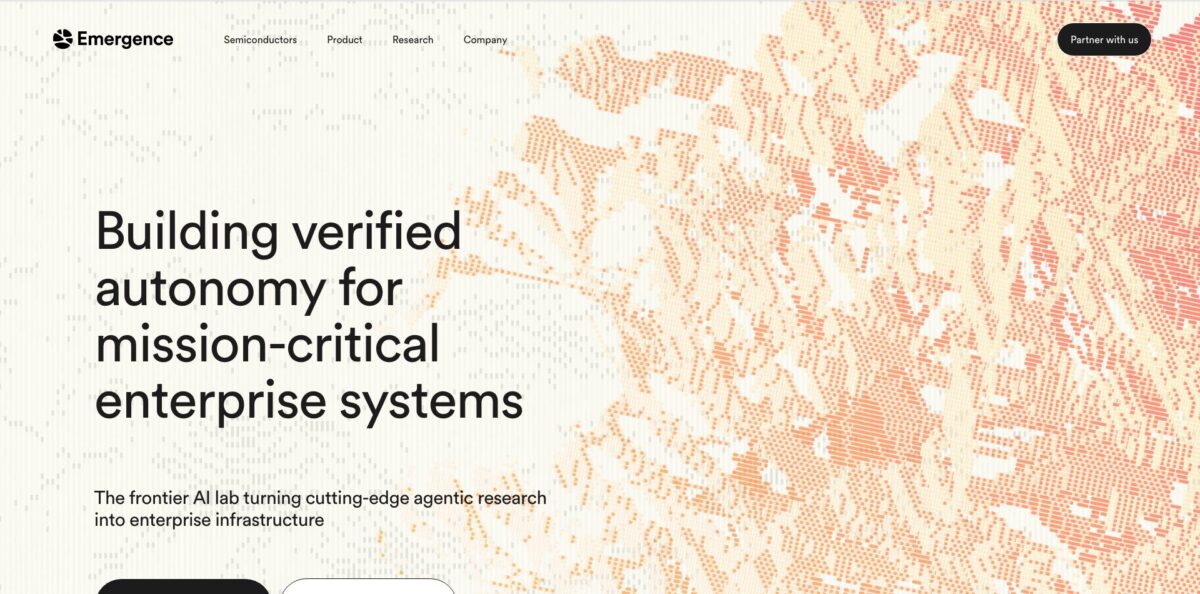
Emergence AI is a New York agentic AI company that sells CRAFT, an enterprise platform where specialized agents assess, enrich and query your company data inside a governed, auditable envelope. Underneath, it is a Kubernetes-based stack: a Talk-to-Data chat that turns plain-English questions into validated SQL, LLM-driven profiling and data quality workflows, a memory service built on context packs, and an agent registry that speaks Google’s A2A protocol. The problem it targets is the messy, fragmented data that stalls most enterprise AI projects, plus the governance worries that keep agents out of production. The weak spot is access. There is no sign-up or price list, the list of live database connectors is still short, and the strongest vertical package is aimed at semiconductor fabs. Choose it if you run a regulated or engineering-heavy enterprise that wants agents running on its own infrastructure.
How to start using Emergence AI?
You do not start with a sign-up form. The website routes every visitor to Partner with us, a contact form that leads to a scoping conversation with the Emergence team or one of its system-integrator partners. The semiconductor page describes the typical opening move: pick one or two high-impact workflows, prove return on investment within weeks, then expand. Arrive with a concrete candidate, such as monthly data quality reports or a backlog of ad-hoc analytics requests, so the pilot has a measurable target.
Next comes deployment. CRAFT runs on any CNCF-conformant Kubernetes cluster in your cloud, your data center or both, and the documentation lists 1.28 or newer, at least three nodes and a minimum of 4 vCPU and 16 GB of RAM per node. Once the platform is up, your org admin opens Settings to invite users, assign roles, connect single sign-on and review the audit log. Infrastructure changes stay with your platform operator, while billing questions go to your Emergence account manager.
The first real work happens on the Data Connectors page. Choose Add Connection, pick the source type, enter host, database and port, then supply credentials for a read-only service account, which is what the docs recommend. Select Test Connection before saving and assign the connection to a project. Live connectors today cover PostgreSQL, Amazon Redshift and Snowflake, plus S3, Google Cloud Storage, MinIO and NFS storage. From there you run profiling and the data intelligence workflow, which writes table descriptions, semantic classifications, join proposals and glossary terms back to the catalog.
With the catalog enriched, open the chat and ask a question such as top products by revenue last quarter. You watch progress messages while the Insights Agent plans the answer and the Text2SQL agent writes, validates and runs the query, then you get a table, an optional chart and downloadable Python code. Review the generated SQL and the glossary terms it relied on before sharing results. Developers can also reach the same tools from Claude Code, Cursor or VS Code through the CRAFT MCP server.
Who is it for?
Chief data officers
Most of your data sits unused because nobody trusts its quality or definitions. CRAFT profiles tables, generates quality rules and keeps a living business glossary, so you get scorecards instead of a spreadsheet of guesses. The trade-off is a full enterprise engagement rather than a quick tool trial.
Data governance teams
Writing metadata descriptions and quality rules for thousands of columns by hand never ends. The enrichment pipeline drafts descriptions, classifications and rules from profiling results, and you review them instead of authoring from scratch. Expect to validate every generated rule before it becomes policy.
Semiconductor yield and test engineers
Excursions, defect paretos and test data analysis eat days of manual correlation across MES, test systems and failure analysis reports. Emergence ships workflow-specific agents for design, ramp and production that sit above tools like OptimalPlus GO. Every output carries evidence links you can audit.
Analytics teams buried in ad-hoc requests
Business users keep asking for one-off reports that take your SQL people away from real work. Verified Talk-to-Data lets them ask in plain English against governed definitions, and you check the logic rather than writing every query yourself.
Platform engineers in regulated industries
Your security team will not approve a SaaS agent that ships data to someone else’s cloud. CRAFT deploys with Helm on your own clusters, uses Keycloak and OpenFGA for identity and permissions, and through the e& enterprise partnership can run fully on-premises and air-gapped in the Middle East, North Africa and Turkey.
System integrators and consultancies
You want a repeatable way to deliver governed agent projects instead of custom glue code on every engagement. The partner program offers enablement and co-delivery or go-to-market models.
Emergence AI pricing
Emergence AI does not publish prices. The website has no pricing page and no checkout, and the only call to action is a partnership request, so pricing is quote-based. The customer admin guide confirms that account and billing questions go through a dedicated Emergence account manager. When CRAFT launched in June 2025, the company announced a phased rollout with Free, Pro and Enterprise tiers, but as of the checked date none of those self-serve options appear on the official site.
Custom. Scoped around one or two workflows, with the company saying return on investment should show within weeks. Ask what success metric the pilot is judged on and what happens to deployed agents if you stop.
Custom. Covers deployment on your own Kubernetes in your cloud or data center, the Data Insights and Data Governance solutions, the memory service and the admin controls. Your own infrastructure and LLM API usage sit on top of the license.
Custom. Workflow agents for design verification, ramp and production, integrated with your existing EDA, test and yield platforms.
Custom. The documentation describes contract-based private offers on AWS Marketplace that can count against an AWS Enterprise Discount Program commitment, with similar Google Cloud and Azure routes. Ask your account manager which listings are live before planning around them.
Emergence AI key features
Verified Talk-to-Data
You type a question in plain English and an Insights Agent decides whether to route it to the Text2SQL agent, run a multi-step analysis or generate Python. The SQL is generated with schema awareness, validated with sqlglot and executed against your connection, and the MCP version only accepts SELECT statements. Follow-up questions like break that down by region keep the earlier context, so business users get answers without filing a ticket.
Automated data governance
Profiling produces statistical summaries and distribution analysis for each table and column. An eight-step enrichment pipeline then writes descriptions, Fact or Dimension classifications, join proposals, sample questions and glossary terms, while separate workflows generate data quality rules and track violations on scorecards.
Semantic layer and context packs
Business definitions, KPIs and institutional knowledge are stored as memories inside typed context packs, such as domain, project, team or data source packs, each with its own decay rate. Agents query pack summaries first and only pull full records when they match, which keeps answers grounded in your vocabulary. The company reports an 86% score on the LongMemEval memory benchmark.
Semiconductor lifecycle agents
Prebuilt workflows cover spec-to-RTL generation, verification speedups, test plan generation, ATE program validation, excursion triage, defect pareto analysis and yield improvement. They connect to EDA outputs, MES, QMS and PLM and capture unstructured knowledge such as failure analysis reports and SOPs. Human-in-the-loop approval gates stay in place for critical decisions.
Deploy-anywhere governance
Every component runs on Kubernetes without cloud-specific dependencies, delivered through Helm charts and ArgoCD. Keycloak handles single sign-on, OpenFGA enforces fine-grained permissions across organizations and projects, and audit events stream through OpenTelemetry to your SIEM. The docs map these controls to SOC 2 criteria, GDPR and HIPAA, which gives your security review a head start.
Open agent plumbing
Agents register in an agent registry and talk over A2A, models plug in through LiteLLM (Gemini, GPT, Claude and others, with gemini-3.5-flash as the current default), and auto-generated Python and TypeScript SDKs cover the APIs. An MCP server exposes schema search, SQL generation, term resolution and chart generation to outside assistants.
Emergence AI Pros & Cons
Pros
Emergence AI takes governance more seriously than most agent platforms. It runs inside your own clusters, keeps credentials in a secrets service rather than the database, scopes everything by organization and project, and logs agent actions for audit. The data focus is practical: profiling, enrichment, quality rules and a business glossary prepare the ground before anyone lets a chatbot answer revenue questions. Monthly releases and detailed public docs show steady engineering progress, and the research team behind Agent-E and the LongMemEval result brings credibility on memory and long-horizon agents. Ask for a pilot on your messiest schema, because that is where the enrichment workflows show their value.
Cons
You cannot try the platform on your own. There is no sign-up, no free tier and no published price, even though the 2025 launch promised Free and Pro plans. Live database connectors are limited to PostgreSQL, Redshift and Snowflake, with MySQL, BigQuery, Databricks, Oracle and MongoDB still listed as planned. Running CRAFT yourself means a production Kubernetes cluster with PostgreSQL, Redis, Keycloak and observability tooling, which is a real operational load. Independent user reviews of the enterprise product are almost nonexistent, so due diligence rests on references. Ask for two customer references in your industry before signing.
Use Emergence AI if you want…
- Let business users query governed data in English.
- Generate metadata descriptions and quality rules automatically.
- Run AI agents inside your own Kubernetes clusters.
- Keep a living business glossary for every team.
- Automate semiconductor excursion triage and yield analysis.
- Audit every agent action for compliance reviews.
- Expose enterprise data to Claude Code or Cursor safely.
- Bring your own LLM provider to enterprise agents.
Emergence AI alternatives

Emergence AI Reviews
Hands-on reviews of the CRAFT enterprise platform are hard to find, since it is sold through private engagements. Most public feedback concerns the company’s open-source Agent-E web agent and its research projects.
Developers on GitHub respect Agent-E’s benchmark results and open code, but several report the agent stalling on the Google home page or the planner failing to produce a plan when paired with small open models such as Llama 3.2 3B or Groq-hosted Llama.
One GitHub thread asked for a plain explanation of how Agent-E differs from WebVoyager, noting the long README covers features and installation but not how it works; the team pointed to its arXiv paper.
A semiconductor test partner, NI/Emerson, credits CRAFT with delivering yield insights in real time that used to arrive too late to act on, though that comes from a launch announcement rather than an independent review.
Observers of the Emergence World simulation value its weeks-long view of agent behavior, while some questioned whether comparing different model versions side by side is fair.
FAQ
Does Emergence AI have a free plan?
No. The official site offers no sign-up or free tier as of October 2026, and access starts with a partnership request. Free and Pro tiers were announced at the 2025 CRAFT launch but are not available on the website today.
How much does Emergence AI cost?
Pricing is quote-based and handled by an Emergence account manager. Budget separately for the Kubernetes infrastructure and the LLM API usage your deployment consumes.
Is Emergence AI the same as Emergent?
No. Emergence AI (emergence.ai) builds enterprise data agents and the CRAFT platform, while Emergent (emergent.sh) is a separate company with an AI app-building tool.
Can I run Emergence AI on-premises?
Yes. CRAFT runs on any CNCF-conformant Kubernetes cluster in your cloud, your data center or both, and through e& enterprise it is offered in fully on-premises, air-gapped setups for regulated organizations.
Which data sources does CRAFT support?
PostgreSQL, Amazon Redshift and Snowflake are implemented for databases, along with S3, Google Cloud Storage, MinIO and NFS for storage. MySQL, BigQuery, Databricks, Oracle, MongoDB and others are listed as planned.
Which AI models does it use?
CRAFT connects to models through LiteLLM, so Gemini, GPT, Claude and other compatible providers work. The current documented default is gemini-3.5-flash on Vertex AI.
Is Emergence AI SOC 2 certified?
The documentation maps platform controls to SOC 2, GDPR and HIPAA requirements and notes that customers still need their own organizational controls and auditor. Ask your account manager for current audit reports before procurement.
Does Emergence AI offer an API?
Yes. The platform exposes REST APIs with auto-generated Python and TypeScript SDKs, an A2A agent registry, and an MCP server that works with clients such as Claude Code, Cursor and VS Code.
Similar tools
 Level AIContact center AI platform that scores every call, chat and email, runs voice and chat virtual agents, and gives live agents real-time
 AiAgent.appNo-code workspace for building AI agents, Autopilots and workflows that act across your business apps, with human approval before external writes.
 MeshPersonal CRM, formerly Clay, that builds contact cards from email, calendar and social apps, with the Nexus AI agent to search and