

fal
Image GenerationUpdated October 27, 2026
Generative media platform with one API for 1,500+ image, video, audio and 3D models, plus serverless GPUs to deploy your own models.
We may earn a commission when you sign up through our links. It does not affect our reviews.
What is fal?
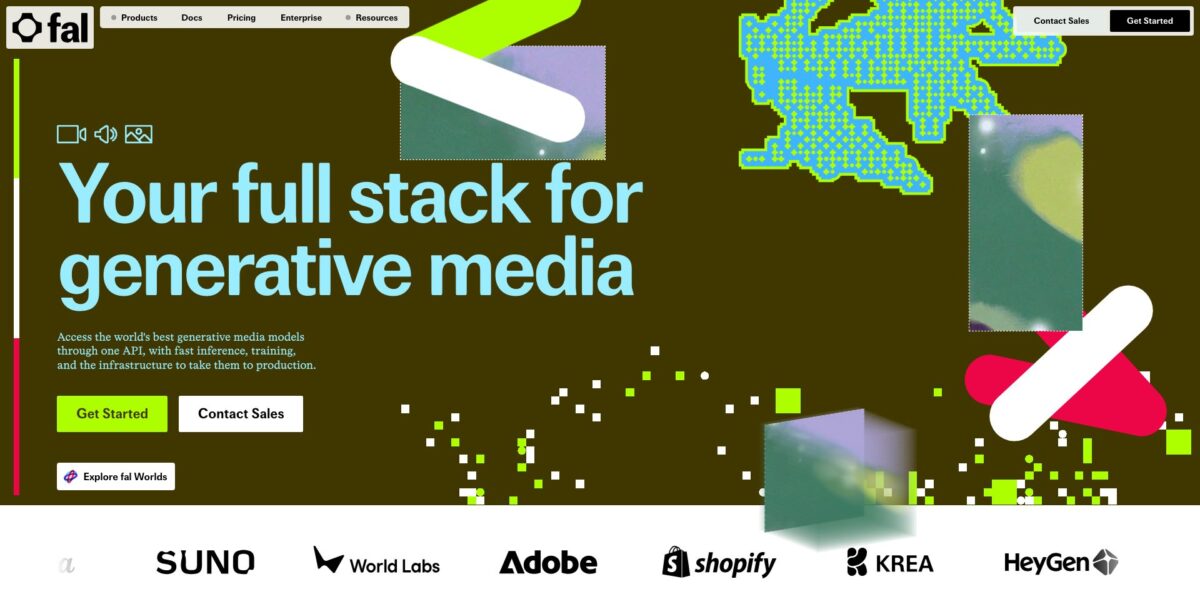
fal (often called fal.ai after its domain) is a generative media platform for developers: one API key and one client SDK give you access to more than 1,500 image, video, audio and 3D models, from FLUX and Nano Banana to GPT Image, Seedream, Kling and Veo. Every model is an endpoint such as fal-ai/flux/dev, billed per output from prepaid credits, so you never rent or babysit a GPU just to make an image. The same infrastructure runs fal Serverless for your own models and fal Agent, a browser chat that picks models and writes prompts for you. The weak spots sit on the account side rather than the models: self-serve concurrency starts at two requests, the account locks when credits run out, and public reviews complain about slow support. Pick it if you are building a product that needs many image models behind one bill.
How to start using fal?
Begin in the Sandbox at fal.ai/sandbox. It gives you a few free generations a day without an account and runs one prompt across several models, showing the time and exact cost of each result. To build, sign up with Google, GitHub or SSO. Model API usage is prepaid, so add credits under Billing before your first real call. Buying credits also raises your concurrency limit, which starts at two simultaneous requests for new accounts.
Your first real scenario is a single text-to-image call. Go to Dashboard, open Keys, click Create Key and copy the key right away, because fal will not show it again. Export it as the FAL_KEY environment variable, install the client with pip install fal-client or npm install @fal-ai/client, and call subscribe() on an endpoint like fal-ai/flux/schnell with a prompt. The response contains a URL to the finished image on fal’s CDN, and video, audio and 3D models follow the same pattern.
The screen you will use most is the model page. Each one has a Playground tab for trying inputs in the browser, an API tab with ready-to-run snippets, the full input and output schema, the per-unit price and a license badge such as Commercial use or Research only. Parameters like image size, number of images, seed and safety settings live in that schema, so you can tune them in the Playground and copy the exact payload into your code. Coding assistants can read the same schema and prices through the fal MCP server.
Before shipping, move long jobs to the queue with webhooks so a slow video render does not block your server, and route browser calls through the server-side proxy so your key never reaches client code. Generated files sit on public CDN URLs for at least seven days by default; set the X-Fal-Object-Lifecycle-Preference header or file access controls if that is a problem, and download anything you need to keep. Your own models come later through fal run and fal deploy, once fal approves Serverless access.
Who is it for?
App developers
You want text-to-image or photo editing inside your product without hosting GPUs or signing contracts with five model vendors. fal puts FLUX, Nano Banana, GPT Image and Seedream behind one key and one invoice. Swapping models becomes a one-line change to the endpoint ID.
AI startups shipping media features
Your roadmap shifts every time a new model drops. Users report that major releases such as Nano Banana Pro appear on fal on launch day, so you can test a new model the same week instead of waiting on a direct API waitlist.
Creative studios and agencies
You need consistent characters and product shots across stills, video and 3D, but nobody on the team wants to learn every model’s quirks. fal Agent plans the job, chooses models and keeps references in project memory while you approve each step. The Pro and Max credit plans cut UI usage costs by 5% or 10%.
ML engineers with custom models
You have fine-tuned weights, a ComfyUI workflow or a Docker server and need autoscaling without running Kubernetes. Serverless runs it on the same GPUs that power fal’s public models, billed per second and able to scale to zero. Expect an access review before your first deploy.
Automation builders
You work in n8n, Vercel or Next.js and want generated images inside a workflow. fal publishes integration guides for each, plus workflow endpoints that chain models into one call, such as generation followed by background removal.
Researchers and benchmarkers
You compare dozens of image models side by side. One account covers both proprietary and open models, and the Sandbox prints price and latency per result, which keeps comparison runs cheap and easy to document.
fal pricing
There are no seats and no mandatory subscription. Model APIs are pay as you go from prepaid credits: each model has its own billing unit (per image, per megapixel or per second of video), and you pay only for successful outputs, never for server errors, cold starts or time spent in the queue. Purchased credits expire 365 days after purchase. Optional fal Agent credit plans and hourly GPU pricing sit on top. Figures below are from fal’s official pages as of October 25, 2026, in USD.
Representative image prices are $0.003 per megapixel for FLUX.1 [schnell], $0.005 per megapixel for Z-Image Turbo, $0.025 per megapixel for FLUX.1 [dev], $0.0398 per image for Nano Banana, $0.08 per image for Nano Banana 2 (2K output costs 1.5x, 4K costs 2x) and $0.15 per image for Nano Banana Pro. Video ranges from $0.015 per second for MiniMax H3 Max Turbo to $0.14 per second for Kling 3 Pro, while Veo 3.1 at 1080p with audio costs $0.40 per second, so a 5-second clip is $2.00. A FLUX LoRA fast training run costs $2.
You get $50 in monthly credits usable across all of fal, unused credits roll over, and usage is billed at standard rates.
$200 in monthly credits plus 5% off usage in the fal UI, Sandbox, Playground and CLI. Direct API calls stay at pay-as-you-go rates.
$1,000 in monthly credits and 10% off on the same surfaces. These plans are for eligible personal accounts only; team, organization, invoiced and Vercel- or GCP-billed accounts cannot buy them.
List prices are $4.00/hour for an RTX PRO 6000, $4.50 for an H100, $6.00 for an H200, $7.99 for a B200 and $12.99 for a B300, with “as low as” rates of $1.99, $2.49, $2.99, $5.49 and $5.99 respectively. Serverless bills per second while runners are in setup, idle, running or draining states.
Custom. Sales handles per-endpoint pricing, volume discounts, invoice billing, concurrency above 40 and private deployments.
fal key features
One API for 1,500+ models
Every image, video, audio and 3D model is an endpoint ID you call with the same client and the same FAL_KEY. Image coverage spans FLUX, Nano Banana, GPT Image, Seedream, Ideogram and Qwen Image, alongside editing models like FLUX Kontext and dedicated upscalers. Switching models means changing a string, not rewriting an integration.
Queue, webhooks, streaming and real-time calls
Long jobs go into a queue that you poll or that calls your webhook when the result is ready, and some models stream partial output or run over WebSockets for interactive apps. Official clients for Python, JavaScript/TypeScript, Swift, Java, Kotlin and Dart retry concurrency errors automatically.
Sandbox and Playground
The Sandbox runs one prompt across several models and lists each result with its generation time and exact cost. Each model page adds a Playground for tuning inputs before you copy the payload into code. Model selection becomes a measured comparison rather than guesswork.
fal Agent
A browser chat at fal.ai/agent chooses models, writes prompts, renders an editable plan card and keeps characters consistent across stills, video and 3D. A Python sandbox with ffmpeg and Pillow handles cuts and captions, and projects keep a shared memory across chats. Only model runs are billed for now, and the product is labeled Early Access.
LoRA training and workflows
Endpoints such as FLUX LoRA fast training let you train a custom style or subject and then call it like any other model. Workflows chain several models into one endpoint and stream an event for each step, for example generation followed by background removal. No orchestration code needed.
Serverless and Compute for your own models
Define a fal.App in Python, test it with fal run and deploy it with fal deploy; it autoscales from zero on the GPUs that serve the public catalog. Custom Docker images and ComfyUI workflows are supported, and migration guides cover Replicate, Modal and RunPod. For training jobs, Compute offers dedicated GPU instances you SSH into, billed per hour.
MCP server and enterprise controls
The fal MCP server connects ChatGPT, Claude, Claude Code, Cursor and other clients through browser sign-in, so an assistant can search models, check prices and run generations. Platform APIs return per-endpoint prices, usage and cost reports, and enterprise accounts get SOC 2, SSO, private endpoints and Zero Data Retention options.
fal Pros & Cons
Pros
fal gives you one of the widest practical menus of image models behind a single key, with new releases usually available quickly and every price published per unit. Billing per output is easy to reason about: you know a FLUX.1 [schnell] megapixel costs $0.003 before you press Run, and server errors, cold starts and queue time cost nothing. The developer experience is strong, with six official SDKs, queue and webhook support, a Playground on every model and an MCP server for coding assistants. When hosted models stop being enough, Serverless runs your own weights on the same infrastructure. Start with the cheapest model that passes your quality bar and move up only for the shots that need it.
Cons
The account layer is where users get frustrated. New self-serve accounts get two concurrent requests and top out at 40, the account locks when credits fall below a threshold, and prepaid credits expire after a year. Public reviews repeatedly mention slow support replies, unexpected balance changes and failed runs on brand-new models, and client errors such as invalid inputs (HTTP 422) can still be billed. Generated media URLs are public by default, and some teams report slow CDN downloads for large videos. Serverless also needs an approval step rather than instant sign-up. Keep a small balance, store outputs on your own storage and configure a second provider for days when a new model misbehaves.
Use fal if you want…
- Call FLUX, Nano Banana and Seedream through one API.
- Add text-to-image generation to your app without GPUs.
- Compare image models side by side on price and speed.
- Train a custom LoRA style and call it via API.
- Chain generation, editing and upscaling into one endpoint.
- Deploy your own diffusion model on autoscaling GPUs.
- Pay per image instead of a fixed monthly subscription.
- Let an agent plan multi-step image and video campaigns.
fal alternatives
 ReplicateRead review →
 WaveSpeedAIRead review →
 Novita AIRead review →
 ModalRead review →
 RunPodRead review →
 CometAPIRead review →
 KreaRead review →
fal Reviews
Developers who benchmark image models describe fal as their default way to run proprietary and open models from one account, and like that big releases such as Nano Banana Pro show up on day one. The catch they mention is that brand-new models sometimes throw errors and need a few paid retries.
Positive Trustpilot reviewers praise the range of current models, easy batching and automation, and prices on some models that undercut other providers. One otherwise happy user still dislikes credits priced one-to-one with dollars and asks for bulk discounts.
Negative Trustpilot reviews center on support rather than the technology: users describe accounts locked after topping up, credit balances that changed without notice and emails left unanswered for days, even when they rate the models themselves well.
A team that relies on fal in production says generation works but downloading finished videos from the CDN can take minutes, and another user found an early Nano Banana endpoint noticeably slower than Google’s own API.
People coming from tools that surprised them with large bills like that fal shows the cost before each run, though newcomers still ask how to cap spending before trying expensive video models.
FAQ
Does fal have a free plan?
There is no permanent free tier for the API. The Sandbox offers a small number of free generations per day without an account, and promotional credits or coupons expire anywhere from one week to one year after they are granted; beyond that you buy prepaid credits.
How does fal billing work?
You prepay credits and each model charges per output unit, such as per image, per megapixel or per second of video. Server errors (HTTP 500 and above) and queue time are free, while invalid-input errors can still be charged if a GPU already processed the request.
What happens when my credits run out?
When your balance drops below the account’s lock threshold, the account is locked and API requests are rejected until you add credits in the billing dashboard. Enterprise customers on invoice billing are not locked automatically.
Can I use images generated on fal commercially?
It depends on the model’s license. Most models carry a Commercial use badge on their page, while those marked Research only are limited to non-commercial use.
Is my data private on fal?
Generated files are stored on fal’s CDN under public URLs for at least seven days by default, but you can shorten retention, set access controls or turn off request history with the X-Fal-Store-IO: 0 header. fal is SOC 2 compliant, says it never trains on enterprise customers’ data, and offers Zero Data Retention setups through sales.
Is there a rate limit on the fal API?
Each account has a concurrency limit that starts at 2 simultaneous requests and rises automatically to 40 as you buy credits. Extra requests wait in the queue rather than being dropped, and sales can raise the limit further.
Can I deploy my own model on fal?
Yes. fal Serverless runs your own Python app, Docker image or ComfyUI workflow with autoscaling and per-second billing, after the fal team approves Serverless access for your account.
Can I use fal without writing code?
Yes, to a degree. The Sandbox, each model’s Playground and fal Agent all run in the browser, and the fal MCP server lets ChatGPT or Claude run generations for you, though most of the platform is built for API use.
Similar tools
 BannerbearTemplate-based API for generating on-brand images, PDFs, animations and videos at scale from your data via REST, Zapier, Airtable or AI agents.
 Generated PhotosLibrary of 2.6M+ AI-generated faces plus face and full-body human generators for model-release-free people images in design, ads and research.
 VheerBrowser-based AI studio for text-to-image, photo editing and image-to-video, with a free no-signup model plus credit access to Nano Banana, Sora 2