
Fireworks AI
Developer ToolsUpdated October 21, 2026
Inference and training platform that serves open-source models through a fast OpenAI-compatible API, with fine-tuning and dedicated GPU deployments.
We may earn a commission when you sign up through our links. It does not affect our reviews.
What is Fireworks AI?
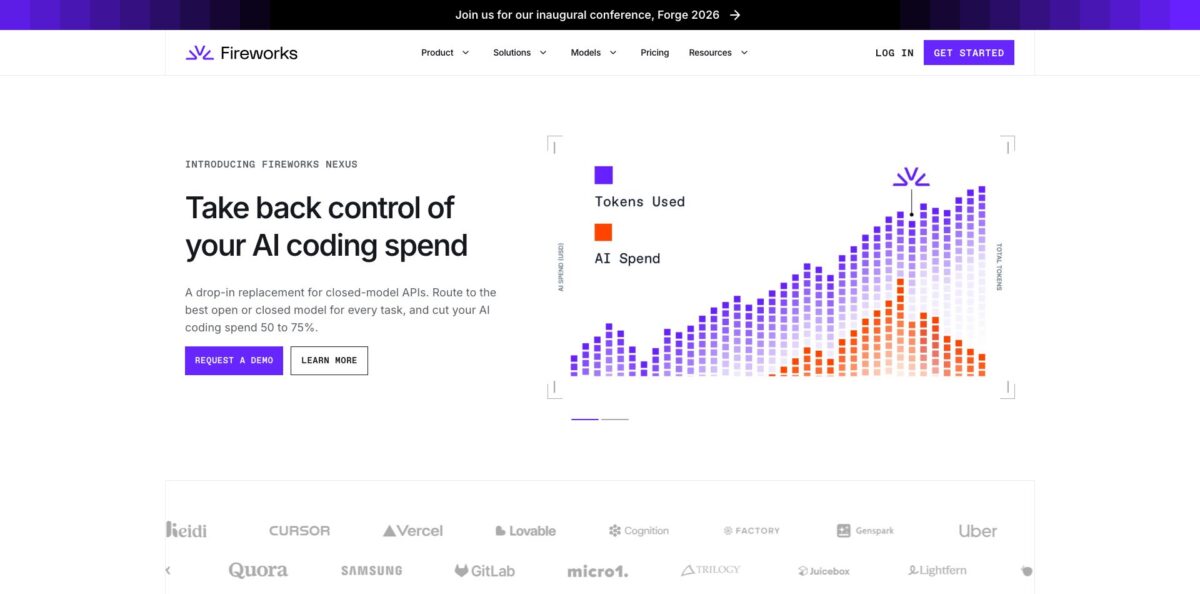
Fireworks AI is a hosted inference and training platform for open-weight models such as Kimi, GLM, DeepSeek, Qwen and OpenAI’s gpt-oss, built by a team that came from the PyTorch project. You call models through an API that accepts OpenAI and Anthropic SDK requests, so switching an existing app is mostly a matter of changing the base URL and model ID. On top of pay-per-token serverless access it adds dedicated GPU deployments, managed fine-tuning and a training API for reinforcement learning. The pitch is speed and cost: you get frontier-class open models without running your own GPU cluster. The weak spot is billing discipline, because everything is usage-based and costs can climb quickly if you skip spend limits. Pick it if you build AI features on open models and care about latency.
How to start using Fireworks AI?
Sign up at fireworks.ai, open the dashboard and click Create API key under your account settings. Fireworks runs on prepaid credits, so add a payment method and buy credits before you expect real throughput: an account without a payment method or credits is capped at 10 requests per minute. Export the key as
FIREWORKS_API_KEYin your terminal and you are ready for the first call.The quickstart uses GLM 5.3 Flash as the first model. You can install the official Python SDK with
pip install --pre fireworks-ai(it is still marked alpha), or keep the OpenAI or Anthropic SDK you already use and point it athttps://api.fireworks.ai/inference/v1. Model IDs look likeaccounts/fireworks/models/glm-5p3-flash. Streaming, tool calling and structured JSON output work through the same chat completions endpoint.Next, decide which serverless mode fits your traffic. Standard is the default. Adding
service_tier: “priority”moves your requests ahead of Standard traffic during peaks, so they are less likely to get a 503 overload error. Fast is a separate model ID, for exampleaccounts/fireworks/routers/kimi-k3-fast, aimed at 100+ tokens per second of output. Set a monthly spend limit and decide whether Auto Reload should top up credits automatically.When serverless limits or model choice stop being enough, install the
firectlCLI (Homebrew, Linux and Windows builds exist), runfirectl signinand create a dedicated deployment withfirectl deployment create. Dedicated deployments remove serverless rate limits, support autoscaling and are the only place where your own LoRA fine-tunes can be served. Watch the response headers and theusageobject to confirm what you are billed for each request.
Who is it for?
AI product engineers
You ship chat, search or agent features and the closed-model bill keeps growing. Fireworks lets you swap in open models through the same OpenAI-style client, and per-token prices on models like GPT OSS 120B start at $0.15 per million input tokens.
Teams running coding agents
Your developers burn tokens in Claude Code, Codex or Cursor every day. Fireworks Nexus and its open-source FireConnect CLI route those tools to open models, and FireRouter can send only the hardest turns to Claude or GPT on your own provider key.
ML teams that fine-tune
You have labeled data and want a model that knows your domain. Managed SFT and DPO start at $0.50 per million training tokens for models up to 16B parameters, and the Training API covers custom RL loops when standard fine-tuning is not enough.
Startups with latency-sensitive apps
Users notice every extra second of wait time in a chat window or autocomplete. Fast mode and dedicated deployments target high output speed, and per-GPU-second billing on dedicated hardware means you are not charged for start-up time.
Regulated and enterprise buyers
Legal will not approve sending prompts to a vendor that logs them. Fireworks keeps zero data retention by default for open models, encrypts data with TLS 1.2+ and AES-256, and lists SOC 2 and HIPAA reports in its Trust Center.
Data and evaluation teams
You need to label a million records, generate synthetic data or rerun a benchmark nightly. The Batch API processes JSONL files up to 80 GiB asynchronously at half the serverless price.
Fireworks AI pricing
Fireworks has no subscription plans and no free plan. You buy prepaid credits and usage is deducted per token for serverless inference, per GPU second for dedicated deployments and per training token for managed fine-tuning. Serverless text and vision models are billed on input, cached input and output tokens, with Priority and Fast modes priced higher and US-only variants costing about 1.5x the global rate. Batch inference is billed at 50% of serverless prices. Usage pauses when your balance hits zero unless Auto Reload is on, and you can set a monthly spend limit. All prices below are in USD from the official pricing pages on the date of this review.
GLM 5.3 Flash $0.15 / $0.03 / $0.50, GPT OSS 120B $0.15 / $0.015 / $0.60, DeepSeek V4.1 Flash $0.30 / $0.006 / $1.20, MiniMax M3 $0.30 / $0.06 / $1.20, GLM 5.3 $1.40 / $0.26 / $4.40, Kimi K3 $3.00 / $0.30 / $15.00.
GLM 5.3 Fast is $2.10 / $0.39 / $6.60.
priced by size, from $0.10 per 1M tokens under 4B parameters, $0.20 for 4B to 16B, $0.90 above 16B, and $0.50 to $1.20 for mixture-of-experts models. Embeddings cost $0.008 to $0.016 per 1M input tokens, or $0.10 for Qwen3 8B.
Full-parameter SFT and LoRA DPO cost twice as much. Fine-tuned models are served at the same price as base models, and Muse Glimmer 30B SFT is free until November 30.
per-token billing on a shared trainer pool, for example DeepSeek V4.1 Flash at $0.60 prefill, $3.60 sample and $4.98 train per 1M tokens.
Region-restricted deployments carry a 1.5x premium.
Custom. Reserved capacity, post-paid billing, higher quotas, SSO and audit logs through sales.
Fireworks AI key features
OpenAI and Anthropic compatible API: the serverless endpoint accepts requests from the official OpenAI and Anthropic SDKs, plus curl and the Fireworks SDK. You change the base URL and model name and keep the rest of your code. This makes A/B testing an open model against your current provider a small change rather than a rewrite.
Three serverless modes: Standard is the default, Priority sets service_tier to stay ahead of Standard traffic at peak times, and Fast routes to high-speed deployments aiming for 100+ tokens per second. Model quality stays the same across modes; only routing and price change.
Dedicated on-demand deployments: firectl or the REST API spins up a model on H100, H200, B200 or newer GPUs across US, EU and APAC regions. You get autoscaling, scale-to-zero, quantization options and speculative decoding without serverless rate limits. It is the path for custom models and steady high-volume traffic.
Fine-tuning and reinforcement learning: Managed Training runs LoRA SFT, DPO and ORPO from the UI, CLI or API, while the Training API lets you write your own loss and RL loop on Fireworks GPUs. Trained LoRA adapters deploy with live merge for one adapter or multi-LoRA for many adapters on one base model. Note that LoRA models can only be served on dedicated deployments, not serverless.
Batch API: upload a JSONL file and run large asynchronous jobs at 50% of serverless prices, with prompt caching applied automatically for extra savings. It suits data labeling, evaluations and distillation. Check model compatibility first, because an unsupported model can leave a job pending without a clear error.
Fireworks Nexus for coding tools: the FireConnect CLI rewrites settings in Claude Code, Codex, OpenCode, Cursor, VS Code and Copilot to call Fireworks models, and restores your originals when you turn it off. FireRouter picks a model per turn and passes hard tasks to closed models on your own key. Admins get per-user spend caps and SCIM sync with Okta, Entra ID or Google Workspace.
Data security controls: prompts and generations for open models are not logged by default, data is encrypted in transit and at rest, and training data can stay in your own S3, GCS or Azure bucket. Customer-managed encryption keys cover LoRA SFT, DPO and RFT datasets and checkpoints. Enterprise accounts add SSO, role-based access, audit logs and model access policies.
Fireworks AI Pros & Cons
Pros
Fireworks gives you a broad catalog of current open models behind one API that already speaks the OpenAI and Anthropic formats, so trying Kimi K3, GLM 5.3 or DeepSeek V4.1 Flash takes minutes. Prices for capable mid-size models are low, with several sitting at $0.15 to $0.30 per million input tokens, and cached input is cheaper again. Users on community forums point out that new open models tend to appear quickly after release. Zero data retention by default and published SOC 2 and HIPAA reports make it easier to pass a security review than with many smaller hosts. The same account scales from a single API key to dedicated GPUs and full fine-tuning, so you do not need to switch vendors as you grow. Start with serverless, then move to a dedicated deployment once traffic is steady.
Cons
There is no free plan, and everything is usage-based, so a runaway agent loop or a misconfigured batch job can produce a large bill. One reviewer reported an unexpected five-figure charge through an AWS Marketplace pay-as-you-go setup, and the docs warn that Total Spend can lag live traffic by a day or more. Speed claims are not universal: some users found certain models no faster than calling the original provider. Model availability changes too, with older models deprecated and some new releases arriving later than others. The dashboard and debugging tools also draw complaints from developers. Set a monthly spend limit on day one and benchmark your own prompts before committing.
Use Fireworks AI if you want…
- Run open-weight LLMs without managing your own GPUs.
- Swap closed-model APIs for cheaper open models quickly.
- Fine-tune models on your own data with LoRA.
- Serve custom models on dedicated autoscaling GPU deployments.
- Process large offline datasets at half serverless prices.
- Route Claude Code or Cursor through open models.
- Keep prompts out of vendor logs by default.
- Build agents with tool calling and structured JSON output.
Fireworks AI alternatives



Fireworks AI Reviews
A developer who mixes small local models with pay-as-you-go inference on Fireworks says the monthly bill stays between $10 and $40 and the speed beats any reasonable home rig, which makes buying tokens the practical choice.
A consultant running agentic coding sessions pays extra for a fast GLM endpoint at around 100 tokens per second and rarely spends more than $25 a week, while keeping a closed-model subscription for longer research tasks.
A full-stack developer credits Fireworks with lower latency and noticeable cost savings thanks to model control and OpenAI-compatible APIs, but wants clearer documentation and better debugging tools.
One user who signed up for the advertised speed was underwhelmed and found results mostly no better than calling DeepSeek directly.
A principal engineer rates the inference quality well but warns that a pay-as-you-go plan bought through AWS Marketplace led to a large unexpected charge, and asks for stronger spending caps and alerts.
FAQ
Does Fireworks AI have a free plan?
No. Fireworks uses prepaid credits, and without a payment method or credits your account is limited to 10 requests per minute. Occasional promotions exist, such as free Muse Glimmer 30B fine-tuning until November 30.
Is Fireworks AI compatible with the OpenAI API?
Yes. The serverless endpoint at api.fireworks.ai/inference/v1 works with the OpenAI SDKs, and an Anthropic-compatible endpoint supports the Anthropic SDKs and the messages API.
Does Fireworks AI store or train on my prompts?
By default Fireworks does not log or store prompt or generation data for open models unless you opt in. Data is encrypted in transit and at rest, and SOC 2 and HIPAA reports are available in its Trust Center.
What are the rate limits?
An account with a payment method and active credits can send up to 6,000 requests per minute across all APIs. Serverless token-per-minute limits rise with your spending tier, and dedicated deployments have no serverless rate limits.
Can I deploy my own fine-tuned model?
Yes. You can fine-tune on Fireworks or import a LoRA adapter trained elsewhere, then serve it on a dedicated on-demand deployment. LoRA models cannot run on shared serverless endpoints.
How do I control spending?
Set a monthly spend limit in the dashboard, with firectl or through the API, and decide whether Auto Reload should top up credits. Nexus adds per-user caps for teams using coding tools.
Which GPUs can I rent for dedicated deployments?
The pricing page lists H100, H200, B200, B300 and GB300 GPUs, billed per second with no charge for start-up time. Region-restricted deployments cost 1.5x.
Does Fireworks AI support vision, audio and embeddings?
Yes. The model library covers text, vision, audio, image and embedding models, and the docs include guides for vision inputs, video and audio inputs, embeddings and reranking.
Similar tools
 Novita AIDeveloper cloud with one API for 200+ open-weight AI models, plus GPU instances, dedicated endpoints and isolated sandboxes for AI agents.
 You.comDeveloper platform of web search, content extraction, cited research and model inference APIs that feed AI agents and RAG apps real-time web
 QodoAI code review platform that runs specialized agents on every pull request, enforces team rules and checks changes against tickets and linked