
H2O.ai
Data AnalysisUpdated November 10, 2026
Enterprise AI platform for predictive, generative and agentic AI, built on open-source H2O-3 AutoML and deployable on-premises or air-gapped.
We may earn a commission when you sign up through our links. It does not affect our reviews.
What is H2O.ai?
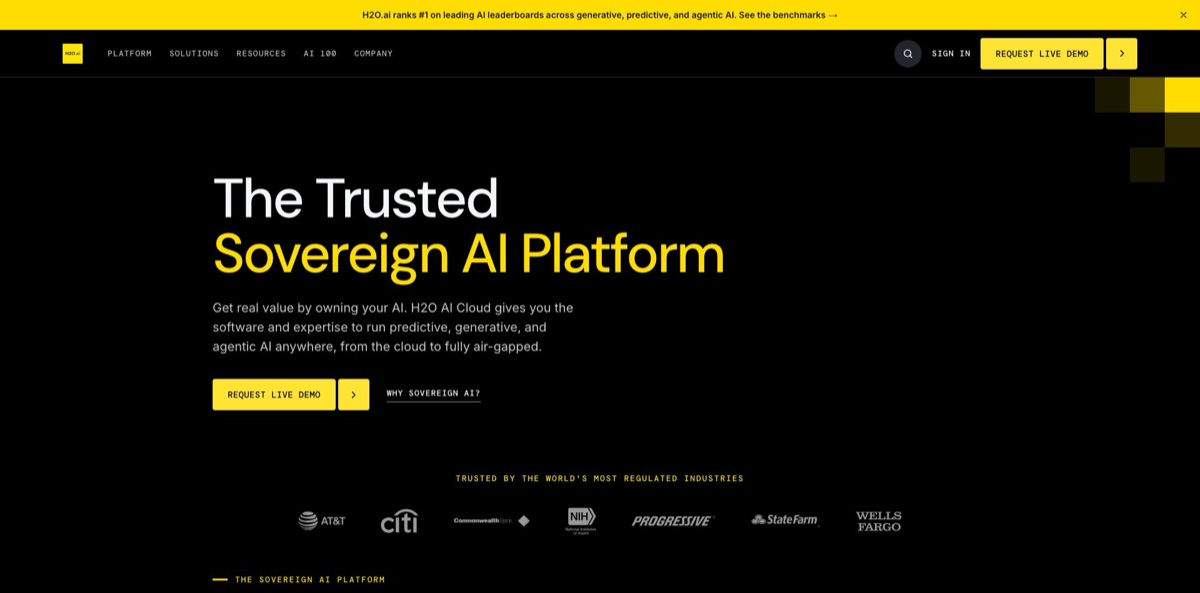
H2O.ai is an enterprise AI company whose commercial product, H2O AI Cloud, combines AutoML, document-grounded generative AI and agent orchestration in one platform that runs in a managed cloud, your own data center or a fully air-gapped network. Underneath sit the open-source H2O-3 library, the Driverless AI engine that documents every model it trains, and Enterprise h2oGPTe for RAG and agents. The problem it removes is the slow road from a promising model to one a regulator will accept: feature engineering, explainability reports and deployment are automated instead of hand-built. The weak spots are access and price transparency, because every paid product is sold through a demo and a quote, and the free open-source edition lost several production components in late 2026. Pick it if you work in a regulated industry and need predictive models you can explain and host yourself.
How to start using H2O.ai?
The quickest route that skips sales entirely is open-source H2O-3. Install Java first, because H2O-3 needs it even when you call it from Python or R, then run pip install h2o or install.packages(“h2o”). Calling h2o.init() starts a local cluster, and the browser-based Flow notebook opens at localhost:54321 if you prefer clicking to coding. Flow’s Assist Me button walks you through importing a file, parsing it and choosing a model, so you can see results before writing a line of code.
Your first real scenario is usually an AutoML run on a table you already understand, such as churn or loan default. Import the CSV, name the target column, set a time budget with max_runtime_secs, and train. H2OAutoML returns a leaderboard of GLM, GBM, XGBoost, Random Forest, deep learning and stacked ensemble models ranked by your metric. A single explain function call then produces explainability plots for the leader model or the whole run, which tells you quickly whether the signal is real.
For the commercial platform, the starting point is the Request live demo form; the old free-trial link now redirects there too. Once licensed, Driverless AI is the screen most data scientists live in. You connect data from files, JDBC, Snowflake, Databricks, S3 or Hadoop, pick the target, then set three dials for accuracy, time and interpretability before launching an experiment. AutoViz shows distributions, outliers and missing values first, and the leaderboard fills in as feature engineering and model search run on GPU. Generative AI teams instead open Enterprise h2oGPTe, create a collection, upload documents and choose a model and cost limit for that collection.
Before anything goes live, read the AutoDoc report and the AutoMLI reason codes that Driverless AI produces with every model, since that is the paperwork a model risk team will request. Export the Java MOJO or the Python scoring pipeline, then register the model in H2O MLOps, which watches drift, accuracy and fairness and supports one-click rollback. On the generative side, run your RAG collections and agents through Eval Studio before opening them to staff.
Who is it for?
Bank and insurance risk teams
You build credit, fraud and underwriting models that must survive model risk review. Driverless AI writes AutoDoc documentation and per-prediction reason codes while the model trains, so weeks of manual validation writing shrink to reviewing what the tool produced.
Data scientists who work in Python or R
You want fast distributed gradient boosting and AutoML without signing a vendor contract. Open-source H2O-3 installs from PyPI or CRAN, runs on a laptop or a cluster, and hands you a ranked model leaderboard in minutes instead of a week of manual tuning.
Public sector and healthcare IT
Your data cannot leave the building, which rules out most hosted AI services. H2O AI Cloud runs on-premises or fully air-gapped, the government edition is FedRAMP High certified, and the managed cloud reports SOC 2 Type II and HIPAA/HITECH.
Enterprise knowledge and operations teams
Staff lose hours searching policies, contracts and tickets. Enterprise h2oGPTe answers from your documents with citations, reads scans and forms through Document AI, and routes each request to OpenAI, Anthropic, Bedrock or a self-hosted model under cost caps.
Business analysts in Excel or Google Sheets
You need a quick classification or regression forecast but have no data science team on call. TabH2O’s add-ins send labeled and unlabeled rows to a pretrained tabular model and return predictions in seconds, with no training run to manage.
ML platform and MLOps engineers
You inherit models from many frameworks and have to keep them healthy in production. H2O MLOps and the Feature Store cover deployment, drift and fairness monitoring, retraining triggers and audit logs from one place.
H2O.ai pricing
H2O.ai does not publish prices for its commercial products. As of November 2026, the h2o.ai/pricing address and the former free-trial link both redirect to the Request a demo form, so every paid product is quote-based. What the company does state is the model: H2O AI Cloud is sold as one annual license based on compute and memory rather than per-token billing. That keeps costs predictable as usage grows, but it rules out small pay-as-you-go experiments. Two genuinely free entry points remain.
Apache 2.0 license covering AutoML, the full algorithm library, the Python and R clients, the REST API and single-node use. Starting with release 3.46.0.12, the MOJO runtime, Hadoop, Kubernetes deployment and Sparkling Water leave the open-source distribution, and AutoDoc is not included.
Hosted API access to the tabular foundation model for classification and regression, up to 100,000 rows and 100 columns per request, with sign-in through Google or LinkedIn and no credit card. Clustering, imputation and anomaly detection require a paid plan arranged through sales.
Custom. A commercial subscription with the same code as open source plus enterprise packages, MOJO scoring, AutoDoc, SSO and RBAC, committed CVE patching and support with SLAs.
Custom. A single-tenant H2O AI Cloud that H2O.ai operates on AWS, Azure or Google Cloud in the region you choose, provisioned in about an hour.
Custom. The full platform on your own cloud, on-premises or air-gapped, installed and upgraded with Terraform, Helm or Replicated.
Custom. The FedRAMP High certified edition for federal agencies.
H2O.ai key features
Driverless AI automates six stages of model building: AutoViz, feature engineering by evolutionary search, model selection and tuning with ensembling on GPU, AutoDoc, AutoMLI and scoring pipelines. You steer it with accuracy, time and interpretability dials instead of writing tuning loops, and you can add your own recipes for features, models and scorers. The result is a production-ready model plus its documentation in one run.
Explainability is built in rather than bolted on
AutoMLI provides K-LIME, Shapley values, surrogate decision trees, partial dependence, disparate impact analysis and a reason code for every prediction, while AutoDoc has shipped in every Driverless AI release since version 1.2 in June 2018. For lenders and insurers, that shortens the gap between a good model and an approved one.
Open-source H2O-3 is the distributed, in-memory engine underneath, with GLM, GBM, XGBoost, Random Forest, deep learning, stacked ensembles, K-Means, PCA, Isolation Forest and Word2Vec. Its AutoML shipped in 2017, and H2O.ai says more than 20,000 organizations and 2 million data scientists use the open-source line. You can drive it from Python, R, Java, Scala, the REST API or the Flow web UI.
Enterprise h2oGPTe handles the generative side: agentic RAG with cited answers, Document AI for scans, faxes and forms, and connections to OpenAI, Anthropic, Amazon Bedrock, Azure OpenAI, Databricks or self-hosted vLLM endpoints. Cost controls apply per user, team and model. The built-in H2O AI Super Agent adds nine agent types, including Deep Research, Data Science, Tool Builder and Code, plus 27 built-in tools, MCP servers and A2A endpoints.
TabH2O is a tabular foundation model that predicts without training
You send labeled rows as context and unlabeled rows to score, and it returns classification, regression or forecast results in under three seconds on 15,000 rows, scaling to 500,000 rows on one GPU. It works through a REST API, Python and add-ins for Excel and Google Sheets, and the hosted service does not store your data, though the model weights are not open.
H2O MLOps, the Feature Store and eScorer cover life after training
MLOps deploys models from any framework with drift, accuracy and fairness monitors, retraining triggers and rollback, while the Feature Store serves features offline for training and online for sub-millisecond inference. eScorer pushes H2O scoring pipelines into Snowflake, Amazon SageMaker, databases and edge servers.
Deployment options suit strict environments
Managed Cloud is single-tenant, with customer-selected regions such as N. Virginia, Ireland or Singapore, daily backups kept for 35 days and multi-AZ failover; Hybrid Cloud runs on your hardware or air-gapped; and the government edition is FedRAMP High certified. The managed environment reports SOC 2 Type II and HIPAA/HITECH.
H2O.ai Pros & Cons
Pros
Few vendors pair a mature AutoML engine with explainability this deep. Driverless AI produces documentation and per-prediction reason codes out of the box, open-source H2O-3 has a decade of production use behind it, and reviewers on Gartner Peer Insights and PeerSpot repeatedly credit the speed of going from raw data to a ranked model. The platform is model-agnostic on the LLM side, runs anywhere from a managed region to an air-gapped data center, and carries SOC 2, HIPAA and a FedRAMP High government edition. Users also describe support as responsive for a vendor of its size. Use H2O.ai when explainable, self-hosted predictive models are a hard requirement rather than a nice extra.
Cons
There is no public price list, no self-serve trial of the commercial platform and no pay-per-use option, so evaluation means a sales cycle. The open-source edition is shrinking: from release 3.46.0.12, MOJO scoring, Hadoop, Kubernetes deployment and Sparkling Water moved to the paid H2O-3 Secure tier, and the open-source h2oGPT repository has been archived on GitHub. Reviewers call the Driverless AI interface cumbersome and DataFrame manipulation primitive next to pandas, and H2O-3 requires Java even from Python. Some teams also had a known CVE block production use for months. Pin your H2O-3 version and confirm which components your pipeline needs before upgrading.
Use H2O.ai if you want…
- Build explainable credit and fraud models for regulators.
- Run AutoML on large tables without writing tuning code.
- Generate model documentation automatically as models train.
- Keep AI workloads on-premises or fully air-gapped.
- Answer staff questions from internal documents with citations.
- Route LLM requests across providers under strict cost caps.
- Get tabular predictions in Excel without training models.
- Monitor production models for drift, accuracy and fairness.
H2O.ai alternatives
H2O.ai Reviews
A data and analytics manager on Gartner Peer Insights describes Driverless AI as an intuitive no-code tool that goes from data to a finished model in minutes with top-tier accuracy, while noting it is weaker for unsupervised tasks.
Other Gartner and G2 reviewers find the interface cumbersome and the data preparation and ETL tools thin, and one says models built outside H2O often beat the Driverless AI result.
A fraud prevention team on PeerSpot switched from Spark to H2O-3 for fast, memory-efficient training and Java POJO/MOJO scoring under a millisecond, but calls its DataFrame manipulation primitive compared with pandas or dplyr.
Consultants on PeerSpot value AutoML for hands-off first-pass model comparisons and call setup easy, yet ask for a drag-and-drop workflow GUI like KNIME and better documentation for newcomers.
Enterprise users on GitHub reported that an open CVE flagged by their security scanners blocked H2O-3 in production for months, and that questions about a fix timeline were redirected to H2O.ai support.
FAQ
Is H2O.ai free?
Open-source H2O-3 is free under the Apache 2.0 license, and TabH2O has a free API tier for classification and regression. Driverless AI, Enterprise h2oGPTe, H2O-3 Secure and every H2O AI Cloud edition are quote-based.
Does H2O.ai offer a free trial of its enterprise platform?
Not a self-serve one: the former free-trial link now redirects to the demo request form. For hands-on practice, the H2O.ai University FAQ points to H2O Aquarium, a free sandbox with temporary access to selected tools.
How is H2O AI Cloud priced?
H2O.ai sells one annual license based on compute and memory rather than per-token pricing. Exact figures come only from sales after a demo.
Can H2O.ai run on-premises or air-gapped?
Yes. H2O AI Hybrid Cloud runs on your own cloud, on-premises or fully air-gapped, and Enterprise h2oGPTe can use internal model endpoints so documents and fine-tuned weights stay inside your network.
What changed in open-source H2O-3 in 2026?
Starting with release 3.46.0.12, the MOJO runtime, Hadoop, Kubernetes deployment and Sparkling Water moved to the commercial H2O-3 Secure edition, and opt-in telemetry was added, off by default. Existing releases stay available, so builds pinned to 3.46.0.11 keep running.
Which LLMs work with Enterprise h2oGPTe?
It connects to OpenAI, Anthropic, Amazon Bedrock, Azure OpenAI, Databricks and self-hosted vLLM endpoints, plus models fine-tuned in H2O Cascade and H2O’s open-weight Danube and Mississippi models.
Does H2O.ai have an API?
Yes. H2O-3 exposes a REST API with Python, R, Java and Scala clients, Enterprise h2oGPTe has a REST API and Python client, and TabH2O is called through a hosted REST API with bearer-token keys.
Are H2O.ai training courses free?
Yes. H2O.ai University offers free self-paced courses with certification on its website, and you pass with a score of 70% or higher.
Similar tools
 HexCollaborative analytics workspace that mixes SQL, Python and AI agents in notebooks, then publishes results as data apps and plain-language answers.
 WindwardMaritime AI platform that fuses AIS, satellite and ownership data into vessel risk scores, sanctions screening, alerts and container ETAs.
 Delve AIAI market research platform that builds personas from analytics, CRM and social data, then lets you chat with them or run synthetic