
Human or Not
AI ChatUpdated November 18, 2026
Free browser game where you chat with a stranger for two minutes and guess whether they are human or AI, plus group chat and image modes.
We may earn a commission when you sign up through our links. It does not affect our reviews.
What is Human or Not?
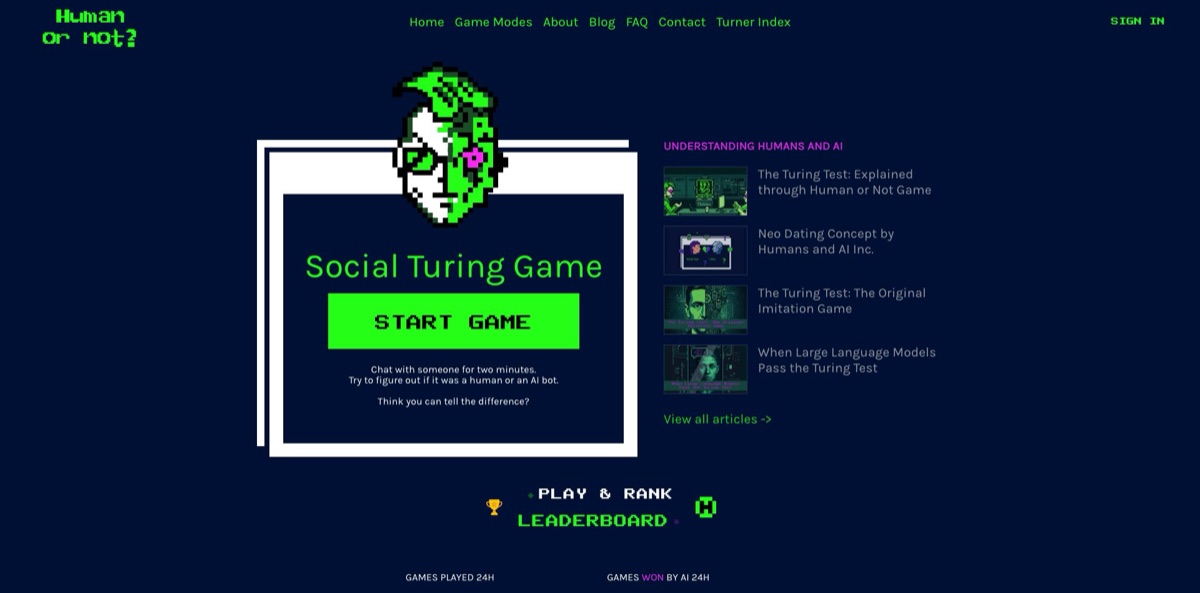
Human or Not is a free browser game built around the Turing test: you get matched with an anonymous partner, chat for two minutes, then vote on whether you were talking to a person or a large language model playing a persona. The version at humanornot.so is an independent relaunch, not the AI21 Labs research experiment from 2023, whose humanornot.ai domain now redirects to AI21’s corporate site. A two-person team builds it, Oleg on code and Kate on design, and the privacy policy names Landocs Ventures LTD in Israel as the operator. Besides the classic duel you get a three-player Group Chat, a real-or-AI Image Game, leaderboards and a public Turner Index that tracks how often players get fooled. The weak spot is privacy: every chat is public and may be used to train AI models. Pick it for curiosity, classroom demos or a quick bot-spotting workout.
How to start using Human or Not?
Open humanornot.so in a desktop or mobile browser and press Start Game. There is no registration wall, so your first round can begin within seconds as a guest. An account is optional: signing in with email, Google or X (Twitter) keeps your Human Coins, stats and chat history, and puts you on the leaderboards. Before you type anything, read the FAQ banner. It states that all information on the site is public, that other users can share your chats online, and that chat data may be used to train AI models.
Your first real scenario is a Classic round. The game pairs you with a random partner and starts a two-minute timer. The other side may be a real player trying to prove they are human, or a bot running on one of the models the FAQ lists: GPT-5, Claude and Google Gemini Flash. When the timer ends, you vote Human or AI and the game reveals the answer. Skip “hi, how are you” openers, since both people and bots answer them the same way. The site’s own tips suggest unconventional questions about recent events or personal experiences, and warn that typos and slow replies prove little because bots imitate both.
The key screen after that is Game Modes. Classic is the original one-to-one format. Group Chat puts you in a room with two other participants for three minutes, and you label each one Human or AI at the end; the page tracks your progress before letting you into this mode. The Image Game shows ten images, gives you 30 seconds for each, starts on Medium difficulty, raises it after three correct answers in a row and lowers it after three misses. During a chat, the Extend Chat button lets both sides keep talking past the timer, which costs Human Coins.
To check how you are doing, open the Play & Rank leaderboard, which shows players ranked by games, humans earned and win percentage over the last 20 minutes, 24 hours or seven days. Group Chat and the Image Game have their own leaderboards. The Turner Index page then puts your results in context: it publishes the share of games in which players mistook an AI for a human, split by device and country. If you want to share a funny round, the game offers a share option for finished chats, so scrub anything personal from the chat first.
Play five Classic rounds as a guest before creating an account, so you learn the rhythm of the timer without tying your email to public chats.
Who is it for?
Curious casual players
You keep hearing that chatbots now sound human and want to find out whether you can still tell. A round takes about two minutes and needs no sign-up, so it fits into a coffee break. You come away with a concrete sense of how convincing current models are, instead of an opinion formed from headlines.
Teachers and AI literacy trainers
You need a fast, memorable demo of why students should not trust that a chat partner is human. Running a few rounds on a projector shows persona-prompted bots in action. Check the age policy first: the FAQ says the site is for everyone, while the privacy policy says it is not designed for users under 18, and all chats are public.
Content creators and streamers
Reaction content around “was it a bot?” moments has a track record on TikTok, where Human or Not clips have gathered millions of views. Each round produces a self-contained story with a reveal at the end. The share option and leaderboards give you ready-made hooks for follow-up videos.
AI researchers and product people
You study how humans perceive machine conversation, or you design chatbots that need to sound natural. The Turner Index offers a live, large-sample view of detection rates by device and country. The team invites researchers to ask about data access and joint projects, which beats building your own Turing-test setup from scratch.
Trust and safety or fraud-awareness teams
Your users get targeted by bots on dating apps, marketplaces and support chats. Playing a few rounds trains the instinct to question smooth, polite strangers. The Image Game adds practice in spotting AI-generated photos, a skill that carries over to fake profiles and listings.
Human or Not pricing
The game follows a free-to-play model. The FAQ states that the core game is completely free, and the privacy policy describes ad partners such as Google AdSense and Primis, so the free game is ad-supported. On top of that sits an in-game currency, Human Coins, which you earn by guessing correctly and spend on extras such as extending a chat after the timer runs out. There is no public pricing page.
Classic, Group Chat and the Image Game are playable without registration. A free account adds leaderboard placement, saved stats, a Human Coin balance and chat history. Expect ads on the site.
paid coin packs are sold through an in-game checkout, but humanornot.so does not publish their prices on any public page. The amount appears only once you open the checkout.
the same in-game checkout includes a Premium subscription option. Its price and exact perks are not listed publicly, so treat any figure you see elsewhere as unverified.
Human or Not key features
Classic two-minute Turing chat
You talk one-to-one with an unknown partner, then vote Human or AI and see the truth immediately. The bots use personas and casual typing, so obvious tells like perfect grammar rarely help.
Group Chat with two partners
Three participants share a room for three minutes, and you label each of the other two as Human or AI. Sending both the same prompt and comparing replies is the main advantage this mode gives you. It is harder than Classic because you need two correct calls per round.
Real-or-AI Image Game
Ten images per session, 30 seconds per image, and difficulty that adapts to your streaks of right or wrong answers. It has a separate leaderboard. This extends the detection practice from text to photos, where AI fakes are spreading fastest.
Turner Index dashboard
A public page tracks the percentage of games where players mistook AI for a human, with seven-day trends and device and country splits. When checked in November 2026, it reported a 36% miss rate across 137,572 conversations in the previous seven days and 17,481 games in the previous 24 hours. The numbers update continuously, so read them as a snapshot.
Leaderboards and Human Coins
Correct guesses earn coins and climb the Play & Rank, Group Chat and Image Game leaderboards. Coins also pay for Extend Chat when you want to keep talking after the reveal.
Chat history and sharing
Registered players can reopen past conversations, and the reveal screen lets you send a chat to a friend as a dare. Remember that the operator treats every chat as public. Sharing is fun, but anything you typed can travel far beyond your screen.
Human or Not Pros & Cons
Pros
The barrier to entry is close to zero: no sign-up, no download, and a round finishes in two minutes. The relaunch has grown beyond the original one-mode experiment, with Group Chat, an Image Game and several leaderboards that give you reasons to come back. Bots run on current models from OpenAI, Anthropic and Google with persona prompts, so the challenge stays hard as the models improve. The Turner Index adds real context by showing how the wider player base performs, and the team publishes its operator details and contact addresses. For a teacher or a curious player, it is the quickest way to feel how convincing chatbots have become. Start with Classic, then try Group Chat once you have a feel for typical bot behavior.
Cons
Privacy is the main trade-off. All chats are public, other users may share them, and the operator may use chat data to train AI models, so nothing personal belongs in the chat box. Anonymous strangers can be rude or explicit, and the site’s age guidance contradicts itself between the FAQ and the privacy policy. The coin system bothers some long-time players, because extended chats now cost coins and paid top-ups have no published prices. A few of the site’s own blog posts still describe the 2023 AI21 version, which muddies the history. Keep sessions anonymous, avoid real names or locations, and supervise any younger players.
Use Human or Not if you want…
- Test whether you can still spot a chatbot.
- Show students how persona-prompted AI imitates people.
- Practice judging AI-generated images under time pressure.
- Compare your detection skills against a global leaderboard.
- Track live statistics on how often humans get fooled.
- Play a quick social game without creating an account.
- Create reaction content around surprising human-or-bot reveals.
- Study bot conversation tactics before designing your own chatbot.
Human or Not alternatives


Human or Not Reviews
Launch-day commenters on Product Hunt said the bots felt convincingly human, with one admitting a partner seemed like a real person until the reveal, and others complimented the retro pixel-style design.
A regular player liked the game but objected when extended chats moved from earned XP to Human Coins, saying free players get only a few messages and asking for a different way to support the project.
On TopAI.tools, 18 of 28 reviewers recommend it, mostly for how easy it is to pick up, while the critics mention inconsistent results and missing features.
Players on the r/Humanornot subreddit swap tells for spotting bots, such as hostile partners who keep using the same stock insults, and some of those tips come straight from humanornot.so’s own guidance.
FAQ
Is Human or Not free to play?
Yes. The core game, including Classic, Group Chat and the Image Game, is free and supported by ads. Optional Human Coin top-ups and a Premium option are sold in-game, but their prices are not published on a public page.
Is humanornot.so the same as the original Human or Not by AI21 Labs?
No. AI21 Labs ran the original as a limited-time research experiment in 2023, and humanornot.ai now redirects to ai21.com. Humanornot.so is a separate project inspired by it, and its operators state that they are not the original research team.
Who runs Human or Not now?
The site credits Oleg (programming) and Kate (design) as its creators, and its metadata names Humans and AI Inc. The privacy policy lists Landocs Ventures LTD, based in Petah Tikva, Israel, as the operator and data controller.
Are my chats private?
No. The FAQ and terms state that all chats are public, can be shared by other users or shown on leaderboards, and may be used to train AI models. For data deletion or privacy requests, the contact page points to legal@humanornot.so.
Which AI models power the bots?
The FAQ lists GPT-5, Claude and Google Gemini Flash, and the Turner Index page mentions Google Gemini and OpenAI GPT models. The team says it updates the model mix as AI evolves, so the lineup can change.
Do I need an account to play?
No. You can start a game instantly as a guest. An account, available through email, Google or X (Twitter), saves your stats, Human Coins and chat history and puts you on the leaderboards.
Is Human or Not suitable for children?
The guidance is mixed: the FAQ says the site is for everyone, including kids, while the privacy policy says it is not designed for anyone under 18. Since chats are public and partners are anonymous, adult supervision is the safer choice.
Is there a Human or Not mobile app?
Humanornot.so runs in mobile browsers and can be added to your home screen as a web app. The “Human or Not?” app on Google Play comes from a different developer linked to humanornot.io, not from the humanornot.so team.
Similar tools
 AI FiestaAll-in-one AI app that bundles 100+ models from OpenAI, Anthropic, Google and others with image, video, slide and website studios in one
 Clerk ChatTexting and AI calling add-on for Microsoft Teams that brings SMS, RCS and WhatsApp to your existing numbers, plus AI agents for
 6figr Career RoastFree 6figr tool where AI personas like Elon Musk roast your LinkedIn profile or resume, backed by salary data, offer analysis and