

Hypotenuse AI
Content CreationUpdated October 27, 2026
AI-first PIM for ecommerce teams that enriches product data, writes on-brand product descriptions in bulk and batch-edits catalog images.
We may earn a commission when you sign up through our links. It does not affect our reviews.
What is Hypotenuse AI?
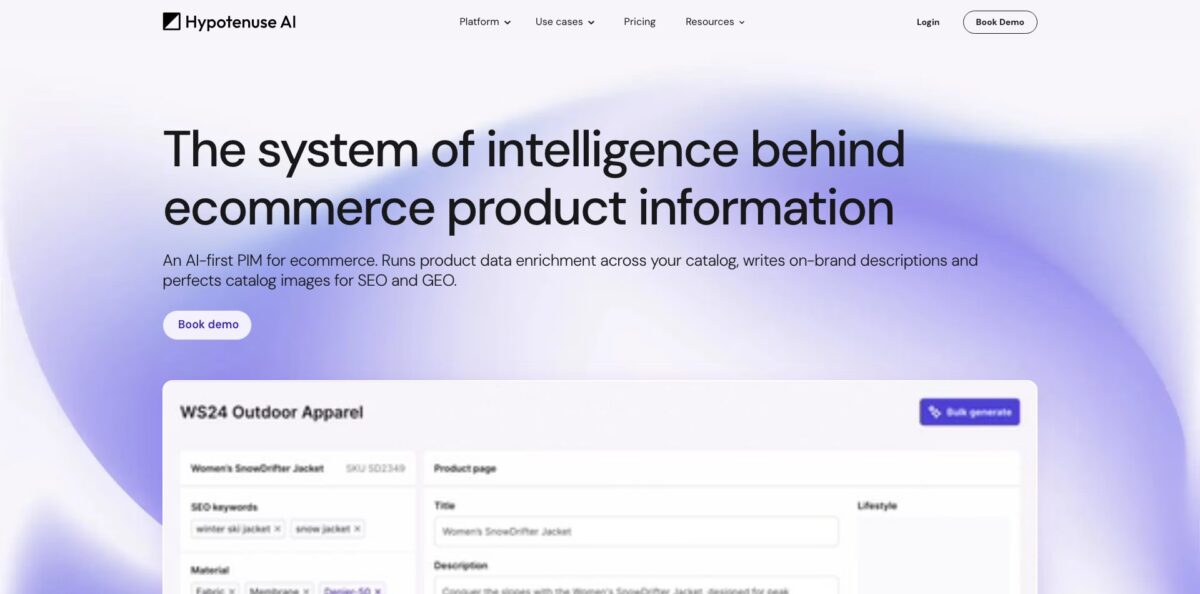
Hypotenuse AI started as an AI copywriter and has since rebuilt itself as an AI-first PIM, which the company now pitches as a product experience management (PXM) platform for ecommerce catalogs. You bring in product data from a spreadsheet, Shopify, Salsify, Akeneo or another system, and specialized AI agents fill missing attributes from the web, UPC codes, spec sheets and images, tag and categorize SKUs, write titles and descriptions in a trained brand voice, and batch-edit product photos. The problem it removes is the gap between sparse supplier data and a finished, search-ready product page, repeated across thousands of SKUs. The weak spot is access: both plans are quote-based, the Basic tier covers mostly copywriting, and the PIM, image editor and bespoke models sit behind an enterprise demo. Pick it if catalog volume is your bottleneck; a ten-product shop will find it heavy.
How to start using Hypotenuse AI?
Go to hypotenuse.ai and click Try for free, which opens the sign-up screen on app.hypotenuse.ai. The trial runs on the Basic plan: one seat, the product description generator and more than 20 other ecommerce content types such as meta titles, category pages and blog articles. If you already know you need the PIM, attribute enrichment or the bulk image editor, use Book demo instead, because those modules belong to the Ecommerce Enterprise plan and the sales team configures them with you.
Your first real job is usually a batch of product descriptions. Import a .csv or .xlsx file with product names, specs and any manufacturer copy, or connect a Shopify store and pull every product attribute in with a one-click import. Add the SEO keywords you care about, or let the AI suggest them based on your existing images and descriptions. Then run the bulk generator, which the company says processes thousands of products in one go.
The screen worth your time is brand voice and formatting. Instead of describing your tone with adjectives, you feed the model real PDPs, marketplace listings and brand guides, then set banned words, required terms and the structure you want: headers, bullets, paragraphs or tables. On Enterprise this becomes a bespoke model tuned to your taxonomy, attribute rules and channel requirements, with separate voices for each sub-brand. Before scaling up, generate a handful of descriptions, compare the variations side by side and regenerate the weak ones.
Review is built into the workflow. You edit drafts in the editor, mark finished items as done, and export in the same format you imported, or hit Publish to push descriptions straight to Shopify with your existing HTML and size tables intact. Enterprise teams add the AI quality checker, which tests content and product data against brand, legal and channel rules before anything goes live, plus SEO monitoring that tracks how each product page ranks on Google, Amazon and Walmart afterwards.
Who is it for?
Ecommerce managers at large retailers
You onboard hundreds of SKUs a week and supplier sheets arrive half empty. Hypotenuse fills attributes from the web, UPC codes and images, flags low-confidence values for approval and writes the PDP copy in the same pass. The launch backlog turns into a review queue instead of a research project.
Marketplace sellers on Amazon, Walmart and Target
Every channel wants different titles, bullet counts and image rules. The content agent restructures titles to fit Amazon’s format and character limit, and the image compliance checker tests photos against retailer requirements before upload. Fewer listings get held back for missing or non-compliant fields.
Distributors with multi-brand catalogs
You resell products from dozens of manufacturers, so photos and specs never match. Bulk image presets standardize backgrounds, crops and resolution, while the data agent normalizes units such as “CM”, “cm” and “centimeter” into one value. Your storefront finally reads like one catalog.
Shopify brands with growing collections
Writing unique copy for hundreds of near-identical variants is where freelancers burn out. The Shopify integration imports products, generates several variations per item and publishes back in bulk without breaking your HTML. Seasonal drops go live with full descriptions instead of placeholders.
Global teams selling in many markets
Translating product pages through an agency is slow and priced per word. Hypotenuse generates content in more than 40 languages from the same product data, with country-specific keyword suggestions and your brand rules applied. Regional teams review copy instead of rewriting it.
Agencies serving ecommerce clients
You juggle several brand voices and formatting rules at once. Separate trained voices and saved formatting presets let one team produce on-brand catalog copy for each client without styles bleeding into each other.
Hypotenuse AI pricing
Hypotenuse AI no longer publishes dollar prices. As of October 2026 the official pricing page lists two plans, both marked Custom, and the quote depends on seats, word volume and which modules you need. Older third-party listings still show fixed monthly tiers from the company’s AI-writer days; treat those as outdated, since none of them appear on the official site. The only self-serve entry point is a free trial on the Basic plan.
Custom (quote-based), with a free trial through Try for free. You get 1 seat, 40+ languages, the product description generator and 20+ other ecommerce content types, including meta titles and descriptions, category pages and blog articles. Bulk tools and CSV/XLSX import in the Hypotenuse template are included, HypoChat is limited, and you can upload 30 reference documents and generate 1,000 HypoArt images on the premium algorithm. Support runs through email and live chat, and more seats or words require a conversation with sales.
Custom, sold through a demo. It adds product information and taxonomy management, attribute enrichment, tagging and categorization, the AI quality checker, the bulk AI image editor, bespoke AI models, custom integrations with your PIM, ERP or ecommerce platform, team access controls and custom seats. Imports work in your own file format, HypoChat is listed as unlimited (with an asterisk), and you get SEO monitoring, digital asset management, custom review workflows, a dedicated account manager and onboarding. The comparison table also lists SOC 2 Type II coverage and the promise that your data does not train the AI model under this plan.
Hypotenuse AI key features
Product data enrichment
AI agents search the web, supplier feeds, UPC codes, spec sheets and product images to fill missing attributes, then convert loose text like “red” or “cotton” into structured color and material fields. Uncertain values come with confidence scores, so your team approves changes instead of researching them. You stop launching products with empty filter fields.
Bulk content generation in your brand voice
Import a catalog and generate product descriptions, meta titles and descriptions, category page copy and social captions for thousands of SKUs at once. The voice model learns from your real listings and applies banned-word and formatting rules every time. Unique copy for similar variants also keeps duplicate text off your category pages.
Batch AI image editing
Set background, crop, resolution and format rules once, save them as presets per brand or product line, and apply them to the whole library. The editor upscales low-resolution shots, sharpens fabric and hardware detail, outputs JPG, PNG, WebP, TIFF or RAW, and flags images below your quality bar.
Tagging, categorization and taxonomy
The platform classifies products into your internal taxonomy or external standards such as Google Shopping and Amazon, adds descriptive tags for site search and filters, and attaches a confidence score and rationale to each placement. It also suggests new tags when a term like “modular” starts gaining search demand. Your navigation stays consistent as the catalog grows.
SEO and GEO optimization
Hypotenuse suggests keywords per product, works them into the copy and generates structured markup and FAQ schema, so pages can show up in rich results and get cited by assistants like ChatGPT and Perplexity. It compares your listings with competitors to surface content gaps and tracks rankings across Google, Amazon and Walmart. You get a priority list instead of guessing which PDPs to fix next.
Integrations and API
Native connectors cover Shopify, Salsify, Akeneo, Mirakl, NetSuite, Plytix, Salesforce Commerce Cloud and Stibo, plus WordPress and Webflow for blog posts. A REST API accepts whole catalogs in bulk and returns product descriptions with your tone, style and structure settings; you request a key from the company. Enterprise customers can order custom integrations when their stack isn’t listed.
Content toolbox
Beyond catalog work, you get HypoChat for AI chat with real-time web research and PDF or DOC uploads, HypoArt for text-to-image generation, and templates for blog articles, Google ads, Instagram captions, landing pages and summaries. These cover the marketing tasks around a launch without another subscription.
Hypotenuse AI Pros & Cons
Pros
Hypotenuse AI is one of the few content tools built around the product catalog rather than the single prompt. Enrichment, copy, images, tagging and SEO all run on the same product record, so a description is written from attributes the AI has already filled and you have already approved. The bulk workflow handles thousands of SKUs and exports in the format you imported, which matters when a PIM or a Shopify store is your source of truth. Brand voice is trained on your real listings, banned words are enforced automatically, and output covers more than 40 languages. G2 reviewers rate ease of use and setup highly. Start with one product line and one brand voice to measure accuracy on your own data before rolling it out.
Cons
Nothing about the price is public: both plans say Custom, so you can’t compare cost against Jasper or a traditional PIM without a sales call. The enterprise modules, including the PIM, enrichment, image editor and bespoke models, are not part of the Basic trial, so the trial shows you a different product from the one large teams buy. Most public user reviews still describe the older writing assistant, and those reviewers mention repetitive sentences in long pieces, chat limits and a subscription they found expensive. The help center link in the site menu currently redirects to the homepage, so self-serve documentation is thin. Ask for a pilot on your own SKUs with a written quote before you sign an annual contract.
Use Hypotenuse AI if you want…
- Generate unique product descriptions for thousands of SKUs.
- Fill missing product attributes from web, UPC and images.
- Enforce one brand voice across every product page.
- Standardize product photos to marketplace background rules.
- Translate catalog content into 40+ languages with local keywords.
- Push finished descriptions straight back to your Shopify store.
- Tag and categorize products against Google or Amazon taxonomy.
- Optimize product pages for Google and AI assistants.
Hypotenuse AI alternatives



Hypotenuse AI Reviews
Content writers on Software Finder like the research-backed blog drafts and the HypoChat assistant, though one notes similar sentences repeating across longer blog posts.
A content director reports strong results when prompts include detailed references, but notes the AI still misses fine details and handles politically sensitive topics poorly.
Small-team users find the built-in tools handy for ad copy and social posts, yet several call the monthly subscription expensive, especially for buyers in lower-income markets.
Early Product Hunt reviewers praised how quickly it turns product details into usable descriptions, while one wanted hard evidence on how the generated articles actually perform.
G2 reviewers comparing it with Jasper score it higher for ease of use, setup and support, but mention that drafts occasionally need minor edits before publishing.
FAQ
Does Hypotenuse AI have a free plan?
There is no permanent free plan on the pricing page. The Basic plan offers a free trial through Try for free, and after that both Basic and Ecommerce Enterprise are priced by custom quote.
How much does Hypotenuse AI cost?
As of October 2026 the official pricing page shows Custom for both plans. You get a price after contacting sales or booking a demo, based on seats, word volume and the modules you need.
Is my product data used to train the AI?
The company says your data powers only your own workflows and is never shared with third parties or used to train public AI models. The plan comparison lists the no-training guarantee and SOC 2 Type II compliance under Ecommerce Enterprise, so confirm the terms for Basic before uploading sensitive catalogs.
Which platforms does Hypotenuse AI integrate with?
Commerce connectors include Shopify, Salsify, Akeneo, Mirakl, NetSuite, Plytix, Salesforce Commerce Cloud and Stibo, and blog posts can go to WordPress and Webflow. Enterprise customers can request custom integrations with other PIM or ERP systems.
Does Hypotenuse AI have an API?
Yes. A REST API lets you send product information, including whole catalogs in bulk, and retrieve generated product descriptions; you request an API key from the company.
How many languages does Hypotenuse AI support?
More than 40, including several English variants, Spanish, French, German, Japanese, Chinese, Arabic, Hindi, Ukrainian and Vietnamese. Translated content gets country-specific SEO keyword suggestions.
How many products can Hypotenuse AI handle?
The company states there is no fixed SKU cap and that it works with catalogs ranging from a few thousand to millions of products. How much content you can generate at once depends on your subscription.
Do I need to replace my current PIM?
No. Hypotenuse AI can work as your main PIM or sit on top of an existing one, enriching data and generating content before syncing it back.
Similar tools
 RunableGeneral AI agent that turns one prompt into websites, slide decks, social carousels, videos and apps, with plugins and scheduled tasks.
 AISEOAI writing suite with a text humanizer, article and Outrank generators, AI detector and plagiarism checker, plus AI search visibility tools.
 Octopus.doVisual sitemap builder that drafts page structure, block copy and SEO tags with AI, crawls existing sites and connects to ChatGPT, Claude