

Juji
Chatbot BuildersUpdated October 5, 2026
Build empathetic, cognitive AI chatbots with no-code tools to automate high-touch interviews and extract deep psychographic user insights.
We may earn a commission when you sign up through our links. It does not affect our reviews.
What is Juji?
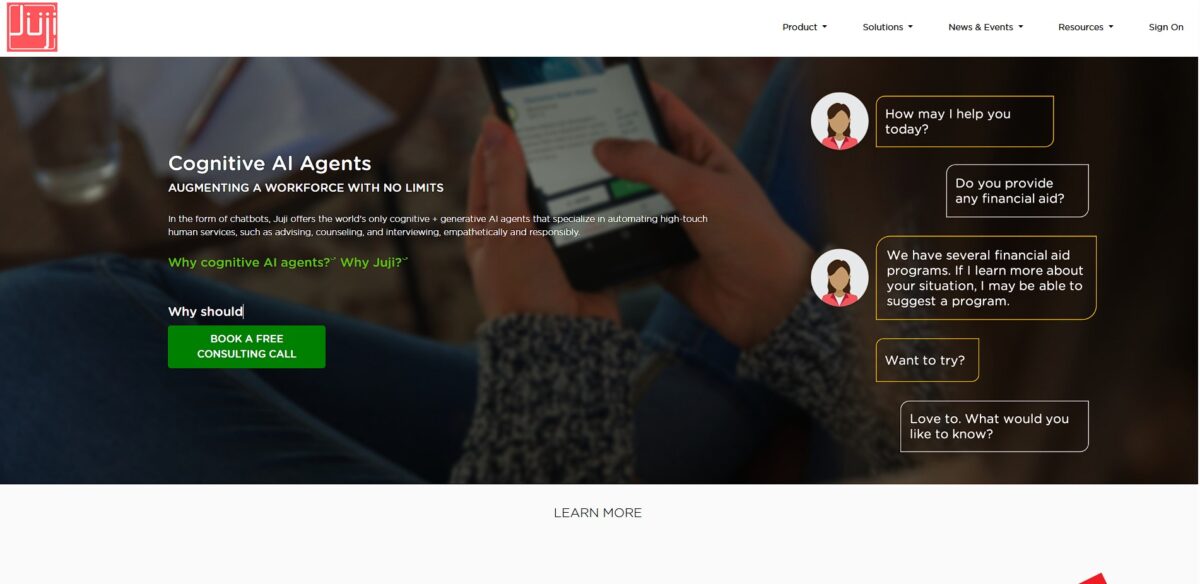
Juji ditches the standard “if-this-then-that” logic for cognitive AI that listens for what people actually mean. Instead of just answering FAQs, it uses computational psychology to infer personality traits like impulsivity or sentiment in real-time. This allows a university or clinic to automate complex interviews or counseling sessions that normally require a human’s emotional touch. While typical bots break when a user wanders off-topic, Juji manages these digressions automatically and steers the conversation back to the goal. This matters because it shifts automation from simple task completion to building an actual rapport with users. It works well for high-stakes services like recruitment or healthcare, though it might be overkill for a basic retail store. Pick Juji if your chatbot needs to handle nuanced, multi-turn human interactions without a dev team.
How to start using Juji?
You start by defining your main chat flow in the Juji Studio. Think of this like setting up an online survey where you list the questions you want the bot to lead with. Instead of static fields, each question connects to a pre-built mini-conversation that handles varied user inputs and side-tracking without extra setup. You don’t have to manually map every possible way a person might say “I’m 30 years old”; the conversational messiness is handled out of the box.
The next phase involves populating the Q&A list for user-initiated tasks. You can upload a CSV file with question-and-answer pairs or type them directly into the dashboard. Juji allows these answers to be multi-turn interactions, meaning a simple user question can trigger a deeper, helpful sub-dialogue. You can even reuse parts of your main flow here, which keeps your bot’s logic consistent across different entry points and lets users jump into complex tasks whenever they are ready, even mid-conversation.
Fine-tuning the personality of your bot happens through “message cards.” You select a shopper or base persona to customize how the bot phrases its responses to match the user’s inferred traits. Since Juji analyzes text on the fly to score personality dimensions, your bot can swap its tone from professional to enthusiastic based on the person it’s talking to. The assistant comes across as a tailored, human-like listener rather than a rigid script, and that builds trust.
Deploying the final product requires a simple embed code for your website or a standard API for third-party apps. You don’t need to download SDKs or manage complex code updates; changes made in the Studio reflect on your live site instantly. Maintenance stays in the hands of the business team rather than a dedicated engineering squad. The platform is built for speed, but very specific behavioral quirks might still require some manual label tweaking to get the “ad-lib” topics just right.
Who is it for?
Academic Researchers
Scholars can automate semi-structured interviews and thematic analysis without writing a single line of Python. This moves you from manual coding to spotting behavioral patterns in hours rather than weeks.
UX Designers
Teams looking to map user intent find it easier to bridge the gap between “what they said” and “what they meant.” It captures the subtle psychological cues that traditional flowcharts often miss.
HR & Recruiters
Analyzing interview transcripts helps predict job performance by identifying personality traits hidden in natural conversation. You get a deeper read on a candidate’s soft skills than a standard resume screening provides.
Market Analysts
Professionals handling open-ended survey responses can group feedback into meaningful themes automatically. It helps you understand the “why” behind customer churn or loyalty without drowning in spreadsheets.
Customer Success Managers
Linking support data with conversational signals reveals which accounts are sitting on a renewal at risk. You can pivot your talk track based on real-time sentiment rather than guessing.
Learning & Development Leads
Identify specific friction points in employee training or online learning by dissecting feedback for repeated pain points. This turns vague complaints into targeted curriculum updates. Pick Juji if your data is “messy” human speech; skip it if you just need a basic button-based FAQ bot.
Juji pricing
Juji operates with a pricing model that prioritizes active engagement over passive seat counts. You can build and test your cognitive assistants for free, ensuring the logic holds before any money leaves your pocket. Once you go live, the billing shifts to a subscription-based structure that scales with the volume of chat experiences your bots handle. This prevents you from paying for dormant accounts and focuses costs on actual user interactions.
This serves as an entry point for small deployments where you need high-fidelity AI responses without a huge user base.
This plan requires a monthly or annual fee and activates once you deploy. It includes the first 100 chat experiences, with overages charged based on additional usage.
Juji offers a dedicated, nonprofit-focused tier specifically for educational institutions. Universities can deploy AI tutors without the standard commercial overhead.
Advanced data insights and API integrations are billed by usage. This helps you avoid high flat fees if you only occasionally need to export complex behavioral data. On the downside, pricing for high-volume enterprise needs remains relatively opaque and likely requires a direct conversation with their team. Only deployed bots count toward your bill, so you can iterate on ten different drafts in the sandbox without triggering a charge, which gives your team room to fail and refine the AI’s “personality” before spending a dime. Stick to the free sandbox for as long as possible to ensure your RAG data is actually resolving queries before activating a paid tier.
Juji key features
Cognitive AI templates handle complex student or patient interactions without manual scriptwriting
You pick a template for recruitment or counseling and let the pre-built logic manage the conversation flow. Bots no longer get stuck when users ask unexpected questions mid-survey.
Psychographic insight extraction identifies user personality traits and motivations from text conversations in real time
Instead of just logging answers, the system builds a behavioral profile for your sales or admissions team. You end up with a “cheat sheet” on how to tailor your human follow-up.
No-code active listening logic interprets nuanced sentiment and “reads between the lines” during chats
The bot won’t just scan for keywords; it attempts to understand the emotional context of a user’s frustration or excitement. That opens the door to empathetic automation in high-stakes fields like healthcare or education.
Customizable chatbot personas let you adjust the bot’s avatar and tone to match specific age groups or industries
You can shift from a formal academic advisor to a casual peer mentor with a few clicks, which helps, since a mismatched bot personality can drive away Gen-Z applicants who expect a specific vibe.
The hybrid Studio and IDE environment allows non-technical staff to build while developers use a high-level scripting language for custom policies. While the GUI handles 90% of the work, the IDE lets you fine-tune product recommendation rules without wrestling with a restrictive drag-and-drop interface. Your tech team doesn’t get bottlenecked by simple UI changes.
Multi-platform deployment pushes your cognitive agent to Facebook Messenger or a web-based widget through a centralized dashboard. It isn’t a deep omnichannel tool for every social app, but it handles the big two for education and business leads effectively. You don’t have to rebuild the brain of your bot for each site.
Juji Pros & Cons
Pros
Juji excels at active listening by inferring user intent and personality traits from open-ended text. You don’t just build a decision tree; you deploy an agent that remembers past context and follows up on specific student or patient needs automatically. This shifts the bot from a passive FAQ search bar to a proactive assistant that handles complex elicitation tasks. I noticed it manages interruptions better than standard flow-based builders, allowing users to ask side questions without breaking the main interaction. This matters because it creates a conversational experience that feels human and reduces user frustration during intake processes. Use Juji for high-stakes interviews where understanding the “why” behind an answer is as important as the answer itself.
Cons
The focus on “cognitive AI” means the platform has a steeper learning curve for those used to simple button-based marketing bots. While it requires no code, you spend more time crafting personality definitions and conversation goals than you would dragging boxes in a basic visual builder. It works well for deep psychological insights but feels like overkill for simple e-commerce tracking or weather updates. The trade-off for this depth is a UI that prioritizes logic and data structures over flashy design elements. Expect your team to shift their mindset from “building a flow” to “training an intelligence.” Stick to simpler tools if your only goal is redirecting users to a support email.
Use Juji if you want…
- Scale high-touch human services with empathetic, cognitive automation.
- Capture deep psychographic insights from two-way user conversations.
- Humanize online surveys to combat fatigue and improve completion.
- Personalize learning experiences using real-time behavioral and personality analytics.
- Automate complex student recruitment and healthcare triage workflows easily.
- Build sophisticated AI assistants without writing a single line of code.
- Elicit higher quality data through active listening and empathy.
- Bridge the divide between generative AI and computational psychology.
Juji alternatives

Juji Reviews
“The cognitive AI is surprisingly deep. It actually follows complex conversations without losing the thread.”
“Finally a no-code builder that doesn’t feel like a toy. The psychographic insights are a game changer for our HR team.”
“Building empathetic flows was much faster than I expected. The hybrid AI approach is legit.”
FAQ
Do I need coding skills to build a chatbot?
No, Juji is a no-code platform that allows non-IT professionals to create and manage custom cognitive AI assistants as easily as using software like PowerPoint or Excel.
Can I train the chatbot with my own business data?
Yes, you can upload CSV files, PDFs, or provide website URLs to train the AI on your specific proprietary knowledge and custom Q&A pairs.
Which channels can I deploy my chatbot on?
Juji chatbots can be directly deployed to any website as a widget or a standalone page, and can also be integrated into Facebook Messenger.
Does it support multiple languages?
By default, Juji chatbots are designed for English, but you can enable multilingual support by using the Juji API in conjunction with third-party language translation services.
Is there a way for humans to take over the conversation?
While Juji focuses on autonomous cognitive automation, it can be configured to guide users to specific next steps, such as speaking with a human advisor, based on the conversation flow.
How long does it take to create an AI chatbot?
Using pre-built templates and the no-code builder, a customized AI assistant can be generated and deployed in a matter of days or even hours.
Can the chatbot understand user sentiment?
Yes, Juji features one-click sentiment analysis and computational psychology to infer user personality traits, moods, and interests in real-time during a conversation.
Does Juji offer a free trial?
Juji allows you to get started for free, letting you build and test your chatbot until you are ready to launch it for live user engagements.
Similar tools
 Expertise AIWebsite AI agent, formerly Chatsimple, that answers B2B visitors, identifies and qualifies leads, books meetings and syncs chats into HubSpot or Salesforce.
 BotnoiThai no-code builder for AI chatbots and agents that answer customers on LINE, Facebook Messenger and the web, billed per bot message
 VoiceflowPlatform for building, testing and running AI customer support agents across web chat, phone and SMS, with playbooks, workflows and tools.