

LEAFIO AI
AI AutomationUpdated November 13, 2026
Cloud retail planning platform that automates replenishment, assortment, planograms and promotions for grocery, pharmacy and convenience chains.
We may earn a commission when you sign up through our links. It does not affect our reviews.
What is LEAFIO AI?
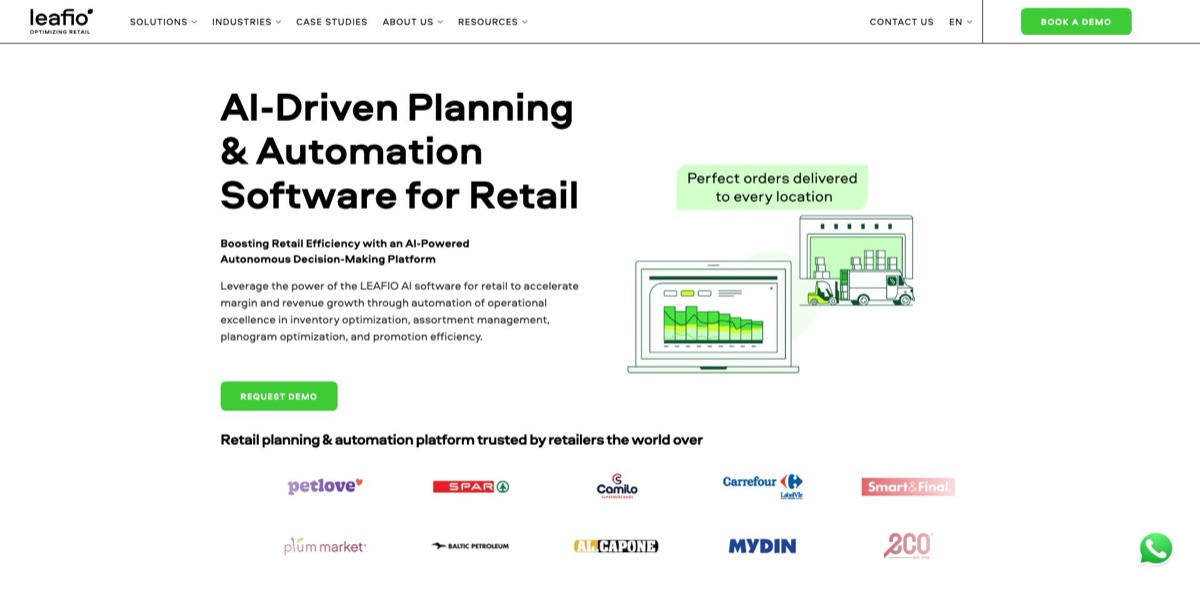
LEAFIO AI is a cloud planning layer that sits on top of a retailer’s ERP and turns daily sales, stock and supplier data into replenishment orders, assortment matrices, store-specific planograms and promo forecasts. It targets chains with thousands of SKUs and dozens or hundreds of stores, where planners still spend the week recalculating orders and redrawing shelves in spreadsheets. Machine learning models handle demand forecasting, pattern recognition and anomaly detection, while rule-based logic covers operational constraints such as minimum order quantities and ordering calendars. The weak spots are the buying process and the ramp-up: there is no self-serve trial, no public price, and the vendor puts a typical rollout at about six months. Pick it if you run a multi-store grocery, pharmacy, convenience or specialty chain and can commit IT time to a proper data integration project.
How to start using LEAFIO AI?
Everything begins with the Request demo form on leafio.ai. You choose between the LEAFIO AI Retail Platform and LEAFIO Logistics solutions, pick your industry (retail, apparel retail, distributor, CPG manufacturer, wholesaler and a few others) and leave a corporate email. There is no sign-up button or sandbox account, so the first real step is a call. LEAFIO says its integration and pre-sales engineers will review your technical stack before the demo, so bring your ERP name and version, store count and a rough SKU count to that conversation.
Next comes technical discovery, where the vendor confirms one of two integration models. Standard Integration is the batch route most clients use: you schedule daily ERP exports and deliver them to a LEAFIO-provided SFTP server, an S3 bucket or the REST API, and orders come back as CSV or JSON files shaped like your ERP’s own export structure. Custom Integration means the LEAFIO team builds and manages a direct connection to your ERP or database, which suits non-standard setups. Either way, you supply sales by SKU, store and date, stock on hand, orders in transit, the product catalog, supplier lead times and MOQs, and price and promo data.
With data mapped, pick a starting module rather than switching everything on at once. Inventory Optimization is the usual entry point for chains fighting stockouts and overstock, while Shelf Efficiency fits teams that still build planograms by hand. For merchandising, the vendor suggests a pilot on one category or 10 to 30 stores, typically running 8 to 10 weeks. Inside Shelf Efficiency you build planograms with drag-and-drop or the autofacing tool, which sizes facings from sales, turnover and stock, then send them to stores. Modules share one data set, so an approved assortment matrix later flows into replenishment and planograms without re-keying.
Verification happens in phases. The integration plan ends with a test exchange, a data quality review that catches missing SKUs, broken store hierarchies and supplier data gaps, and an IT sign-off against a live data sample. After that, planners compare LEAFIO’s calculated orders and forecasts with what they would have ordered themselves before letting automation run on its own. In stores, associates receive tasks in the iOS or Android app and send back a photo of the finished shelf, so head office can track execution across the chain. Plan for roughly six months from kickoff to a stable rollout.
Who is it for?
Replenishment and supply chain directors
Your buyers recalculate orders store by store in spreadsheets, and the result is empty shelves in one location and overstock in the next. LEAFIO AI generates demand-driven orders across stores and warehouses and returns them to the ERP ready to confirm. Planners move from typing quantities to reviewing exceptions.
Category managers
You decide which SKUs stay in which store cluster, but performance reports arrive late and in pieces. Assortment Performance tracks SKU productivity by cluster or format and lets you simulate a change before rollout. Slow movers get flagged before they turn into write-offs.
Space planning and merchandising teams
Maintaining hundreds of planograms by hand eats most of the week. Autofacing and automatic planogram generation build store-specific layouts from sales data, and group management pushes product changes to up to 1,000 stores at once. Your team spends its time on layout strategy instead of redrawing shelves.
Promotion planners
Promo stock is either short on day one or stuck in the back room after the campaign ends. The promotion module forecasts stock needs, recalculates target stock per store while the campaign runs and compares forecast with actual sales afterwards. The Promo Assistant explains each forecast before you approve it.
Store operations managers
Head office instructions get lost between email, chat and printed checklists. The SuperApp and the merchandising app put tasks, planograms, stock levels and a barcode scanner on store staff phones, with photo reports flowing back. You can see which stores finished their tasks without calling around.
CPG manufacturers and distributors
Brands that manage shelves across many retail accounts need planograms and stock visibility outside their own walls. LEAFIO sells to CPG and distribution companies as well as retailers, and its own case studies include a manufacturer handling about 4,000 points of sale. Expect the same scoped, enterprise-style rollout.
LEAFIO AI pricing
LEAFIO AI does not publish prices. The leafio.ai/pricing address returns a 404, and every product page sends you to the Request demo or Contact us form, so pricing is quote-based. A third-party directory listing on SourceForge says the price depends on the number of SKUs and stores, which matches how the platform is scoped: by module, by network size and by integration model. The same listing shows support as included and training as included with paid premium options. No free plan, free trial or self-serve tier is advertised anywhere on the official site.
Custom. Demand forecasting, automatic replenishment orders, multi-echelon balancing between warehouses and stores, plus fresh and seasonality modules.
Custom. Cluster-level assortment planning, SKU productivity tracking and change simulation before rollout.
Custom. Floor plans, a planogram builder with autofacing, automatic planogram generation, shelf analytics and the merchandising mobile app.
Custom. Promo forecasts, scenario planning, in-campaign stock recalculation and the Promo Assistant.
Custom. Retail execution app with role-based dashboards, a task manager and a barcode scanner, sold standalone or as a platform extension.
Custom. Scoped during pre-sales technical discovery, with either Standard (batch file exchange) or Custom (built and managed by LEAFIO) integration.
LEAFIO AI key features
Demand-driven replenishment in Inventory Optimization generates orders automatically for every level of the supply chain, from warehouses to individual stores. Seasonality and promotions are handled through adaptive coefficients that update as new sales arrive, rather than static averages. Routine calculations such as reorder quantities and stock balancing run on their own, while planners keep control of strategic decisions and exceptions. The vendor claims payback within the first year, but treat that as its own estimate.
Store-specific planograms come out of a builder that supports drag-and-drop plus an autofacing tool, which sets facings from sales, turnover, stock and ABC analysis. Automatic generation applies rules for brands, price and size to standardize displays across the chain, and fixture zoning lets you block out supplier or category areas. Group management and “format fixture” add or remove products across up to 1,000 stores in a few clicks.
Promotion planning stores every past campaign and uses it to forecast the stock each promo needs, falling back on similar products when you promote a new item. You can model discount levels, mechanics, timing and advertising channels before launch, and the system recalculates target stock per store while the promo runs. The Promo Assistant explains what each forecast means and highlights risks. Afterwards you get forecast versus actual sales, turnover and lost sales in one view.
Assortment management by cluster localizes the SKU matrix by cluster, format or performance group and evaluates SKU productivity continuously. You can simulate a change and see revenue impact and cannibalization before it reaches stores. The approved matrix flows into replenishment, planograms and promo planning, so one decision updates several processes at once.
Store execution apps run on iOS and Android
The merchandising app shows associates the planogram, a table of what to add or remove, and stock per SKU, with a built-in barcode and QR scanner and a photo upload for the finished shelf. The SuperApp adds role-based KPI dashboards, a task manager on mobile and web, and a scanner that flags only the items needing a recount before tomorrow’s order. AI comparison of shelf photos against planograms is described as a pilot feature on the vendor’s workflow page.
ERP integration and security cover the procurement checklist
Named ERP compatibility includes SAP S/4HANA and Business One, Microsoft Dynamics 365 and Business Central, Oracle Retail, Oracle NetSuite and PDI, with data moving over SFTP, S3 or REST API. The platform is ISO/IEC 27001:2022 certified, encrypts data at rest with AES-256, gives each client a dedicated database and offers EU or US data residency.
LEAFIO AI Pros & Cons
Pros
LEAFIO AI covers four planning jobs that many chains buy from separate vendors (replenishment, assortment, space planning and promotions) plus store execution apps, all on one shared data set. An assortment decision therefore updates planograms and orders without re-keying. The integration model is pragmatic: if your ERP can export CSV files to SFTP or S3, you can connect, and the vendor lists SAP, Dynamics, Oracle, NetSuite and PDI compatibility. Reviewers on G2 and SourceForge consistently praise the implementation team’s responsiveness and willingness to tailor the system. Security paperwork, including ISO 27001:2022, GDPR alignment and EU or US residency, is ready for procurement. Start with the module that addresses your most expensive problem and add others once the data pipeline is proven.
Cons
Nothing about LEAFIO AI is self-serve. There is no public pricing, no trial, and a typical rollout takes about six months, with data mapping and test integration phases that need your IT team’s time. Users report that the interface slows down on large item sets and that building hundreds of unique fixture templates is tedious. One Capterra reviewer said the first integration ran longer than hoped for a large chain, and another wanted more granular permission templates. Independent reviews are few (around 30 on G2, a handful elsewhere), and the large percentage gains on the website come from vendor case studies. Ask for reference calls with a chain of your size and category mix before signing.
Use LEAFIO AI if you want…
- Automate store-level replenishment orders from daily ERP sales.
- Generate store-specific planograms from real sales data.
- Push planogram changes to hundreds of stores at once.
- Forecast promo stock and avoid post-campaign overstock.
- Localize assortment matrices by store cluster or format.
- Give store staff tasks, scanners and planograms on phones.
- Reduce stockouts and excess inventory across a multi-store network.
- Keep your current ERP while adding an AI planning layer.
LEAFIO AI alternatives

LEAFIO AI Reviews
An inventory manager at a large company credits the platform’s demand forecasting with fewer stockouts and less excess stock, and likes having inventory, assortment and promotions in one place, though the initial setup took time and coordination before it ran smoothly.
G2 reviewers call the platform easy to use with thorough analytics, but say loading gets slower as the number of items grows, and that building hundreds of unique equipment templates is tedious.
One enterprise reviewer describes moving more than 250 stores from Excel product libraries to auto-generated, data-driven planograms executed with handheld scanners, and praises the vendor team for tailoring the system to their business.
Capterra reviewers report better shelf availability and much faster order generation, though one large chain found the first data integration slower than hoped and another would prefer tables to the many charts in the analytics section.
A home appliance retailer values the built-in analytics and detailed floor planning, but misses a way to save different versions of a layout.
FAQ
Does LEAFIO AI have a free plan or free trial?
No. The official site offers no free tier, trial or sandbox; access starts with a demo request and a pre-sales technical review of your systems.
How much does LEAFIO AI cost?
Prices are not published, so pricing is quote-based. A SourceForge listing says the cost depends on the number of SKUs and stores, and the modules and integration model you choose also shape the quote.
Which ERP systems does LEAFIO AI integrate with?
The vendor lists compatibility with SAP S/4HANA and Business One, Microsoft Dynamics 365 and Business Central, Oracle Retail, Oracle NetSuite and PDI. Other ERPs or custom databases can usually connect if they export structured data via SFTP, S3 or REST API.
How long does implementation take?
LEAFIO puts a typical implementation at about six months, rolled out in phases. Merchandising pilots on one category or a group of 10 to 30 stores usually run 8 to 10 weeks.
Is my data secure, and where is it stored?
LEAFIO holds ISO/IEC 27001:2022 certification valid until August 2028, encrypts data with TLS in transit and AES-256 at rest, and keeps each client in a dedicated database. Hosting is in a certified data center in Germany, with EU and US data residency options.
Is there a LEAFIO AI mobile app?
Yes. The merchandising app for iOS and Android delivers planograms and tasks to store staff, and the SuperApp adds dashboards, a task manager and a barcode scanner on mobile and web.
Can I buy just one module?
Yes. Inventory Optimization, Assortment Performance, Shelf Efficiency and Promotion Management can be implemented separately or together, and the SuperApp also works as a standalone product.
What languages does LEAFIO AI support?
The website is available in English, Spanish, Portuguese and Polish, and the vendor says the system comes in several language versions with a multilingual interface for store staff. Confirm your required languages during the demo.
Similar tools
 GPT WorkspaceAI agent for Google Docs, Sheets, Slides, Gmail and Drive that edits your files, runs GPT formulas in bulk and automates routine
 FPT.AIVietnamese enterprise AI platform from FPT Smart Cloud for chatbots, call-center voicebots, document reading and eKYC that automate customer operations.
 Frigate NVROpen-source NVR that runs real-time AI object detection on your own hardware and sends camera events to Home Assistant and other MQTT