

Level AI
AI AgentsUpdated October 27, 2026
Contact center AI platform that scores every call, chat and email, runs voice and chat virtual agents, and gives live agents real-time guidance.
We may earn a commission when you sign up through our links. It does not affect our reviews.
What is Level AI?
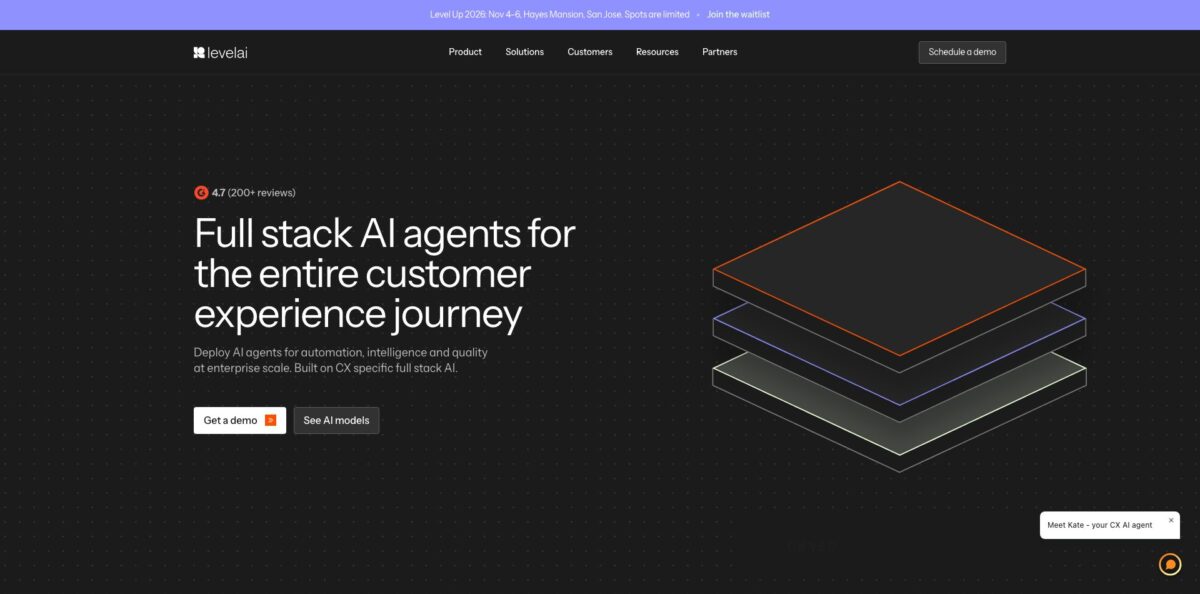
Level AI is a contact center platform that analyzes every customer call, chat and email and then acts on what it finds. It began as automated quality assurance and conversation intelligence, and it now bundles voice and chat virtual agents, real-time agent assist, coaching, screen recording and a set of task-specific AI Workers. In July 2026 the company unveiled Latitude, the seven in-house models behind the platform, covering transcription, redaction, intent detection, summarization, inferred CSAT, QA scoring and Voice of the Customer. The problem it removes is sampling: manual QA teams often review only 1 to 3 percent of interactions, while Level AI scores all of them against your own rubric. The weak spots are quote-only pricing, AI scores that reviewers still double-check, and a rollout measured in months. Pick it if you run a sizable contact center with a QA function; a five-person help desk will find it oversized.
How to start using Level AI?
There is no self-serve signup or free trial on thelevel.ai. Every path leads to the “Schedule a demo” or “Get a demo” button, which books a personalized 30-minute demo. Before that call, collect three numbers: total monthly interactions, agent count and the channel split between calls, chats and email. The official ROI calculator asks for exactly these inputs, and the vendor’s own pricing guide says quotes depend on channel mix, agent count and the product SKUs you pick.
Next comes integration. The integrations page lists telephony and CCaaS systems such as Five9, Genesys, Amazon Connect, Talkdesk, Twilio, NICE, Dialpad, Vonage and RingCentral Video, support desks like Zendesk, Salesforce, Intercom, Freshworks, Kustomer, Gladly and Gorgias, knowledge sources such as Guru, Confluence, SharePoint, Notion and Google Drive, and SSO through Okta, OneLogin, Azure, Auth0 or Google. For bulk data there are SFTP, S3 and Snowflake connectors. Once connected, calls, chats and tickets flow in, audio gets transcribed, and names, card numbers and SSNs are redacted before any AI processing. G2 reviewer data cited by eesel puts typical implementation at around three months, so plan the project accordingly.
The first screen most teams configure is Auto-QA. You can paste in your existing scorecard or start from a library of pre-trained questions and industry rubrics. Hybrid scorecards mix AI-scored questions, such as whether the agent verified identity, with human-scored ones like empathy, and both roll up into one score. Conditional logic marks questions as N/A by call type or department. Admins can test rubrics against real conversations in a sandbox before switching any reporting over, and when an evaluator disagrees with a score, the override feeds future calibration.
If you are buying virtual agents, the Copilot is the starting point. Upload an SOP as a Word document, PDF or plain text, and Copilot turns it into a reviewable draft, asks clarifying questions and connects the tools the agent needs. You then refine behavior in plain language, with confidence gating and visual diffs showing the effect of each edit while draft locks protect the live agent. Before publishing, Copilot simulates customer conversations and blocks the release when a critical workflow fails. After launch, virtual agent conversations are scored with the same QA rubrics as your human team.
Who is it for?
QA managers
Your team reviews a handful of calls per agent each month and argues about whether the sample is fair. Level AI scores 100 percent of calls, chats, emails and bot conversations with evidence attached, so your analysts move from listening to calibrating and coaching.
Contact center directors
You run hundreds of seats across voice and digital channels and need one view of quality, handle time and resolution. The platform puts QA, analytics, agent assist and virtual agents on one data layer, which means fewer tools to reconcile at month end.
BPO operators
Clients expect the same quality standard across sites, shifts and languages. Shared rubrics, automated scoring and screen recording that captures up to four monitors give you auditable proof of process adherence for every client program.
Compliance teams in regulated industries
Banks, insurers, healthcare providers and collections agencies must prove disclosures were read and sensitive data was protected. Level AI redacts PII across audio and transcripts, flags compliance gaps in every interaction, and lists HIPAA, PCI DSS, SOC 2 and HITRUST in its compliance program.
Team leads and coaches
Building a coaching plan from a few sampled calls takes hours and still misses patterns. The Coaching Plan Worker drafts structured plans from QA results and conversation evidence, which you edit and share with agents.
CX and product leaders
Surveys reach a small, emotional slice of customers. iCSAT and Voice of the Customer analysis infer satisfaction and classify contact reasons across all interactions, so product feedback and churn signals surface with real call examples behind them.
Level AI pricing
Level AI does not publish a price list. The /pricing URL on thelevel.ai returns a 404, and every buying path ends at the demo form, so pricing is quote-based. The vendor’s own pricing guide states that deployments combine per-agent pricing, platform licensing and usage components, sized on channel mix, agent count and product SKUs. Per-agent figures quoted on third-party blogs are not confirmed by Level AI, so treat them as rumors rather than list prices.
Free. A personalized 30-minute walkthrough is the only public entry point; no free plan or self-serve trial is advertised.
Custom. Seat-based component of the quote; ask how a billable agent is defined and whether supervisors who only view dashboards count.
Custom. A platform component on top of seats; its size varies with the product SKUs you include, such as Auto-QA, Agent Assist, coaching, screen recording, Voice of the Customer or AI Workers.
Custom. Tied to interaction volume and channel mix; expect this line to matter most when virtual agents handle conversations directly.
Custom. Audit reports are available through the Trust Center on request, and a HIPAA BAA is offered for healthcare deployments.
Level AI key features
Auto-QA with QA-GPT scores 100 percent of calls, chats, emails and bot conversations against your scorecard
Each score comes with supporting evidence and reasoning, and QA-GPT suggests answers with timestamps for manual reviews. Hybrid scorecards and a testing sandbox let you automate the objective questions first and keep humans on subjective ones.
AI Virtual Agent handles voice and chat in 50+ languages, combining agentic conversation with deterministic workflows in one builder for authentication and policy steps. It supports outbound calling with bulk outreach, event-driven callbacks and voicemail drops. Since October 2026 the same agent also runs on WhatsApp through Meta’s Cloud API, keeping conversation context for up to 30 minutes when a customer steps away.
Agent Assist and AgentGPT give live agents in-call guidance, next-best actions, relevant knowledge articles and automated call summaries. AgentGPT generates answers from your own knowledge base and improves from agent feedback. The goal is shorter handle times and fewer escalations, especially for new hires still learning policies.
AI Workers are task-scoped agents that reason over transcripts, CRM records, QA results and sentiment signals
Ready-made Workers include Executive Research, Conversation Research with direct quotes as evidence, Coaching Plan, Product Feedback, Team Performance and Screen Recording Evaluation, and you can build your own. MCPs connect them to third-party systems, and evals score every response before a user sees it.
iCSAT and Voice of the Customer replace survey sampling with inferred satisfaction for every interaction
iCSAT blends sentiment, customer effort signals such as repetition, transfers and time, and resolution into one score, while VoC classifies contacts into a three-level topic hierarchy. You can drill from a low score straight to the calls that caused it.
Agent screen recording captures the full desktop on up to four monitors and starts or stops automatically from telephony or chat triggers such as AWS, Twilio or Salesforce. Sensitive data on screen is redacted with a stated 90%+ accuracy, and AI tags like frustration, returns and escalations make recordings searchable. QA and fraud teams get a visual record next to the audio.
Latitude models and security: seven fine-tuned models run on Level AI’s own GPU clusters, and the vendor claims up to 49x lower cost and 4x lower latency than frontier LLMs at equal accuracy, with 97 percent of tokens processed on its own models. Certifications include ISO 27001, SOC 2 Type II, PCI DSS and HITRUST, alongside HIPAA and GDPR compliance, plus contractual zero data retention for third-party AI sub-processors.
Level AI Pros & Cons
Pros
Level AI turns QA from a sampling exercise into full coverage. One enterprise retail reviewer on G2 describes moving from about 2 percent manual review to nearly fully automated scoring, and another praises how quickly example calls can be pulled for training or root-cause work. Human and AI agents are measured with the same rubrics, which keeps virtual agent quality honest. The integration list covers the major CCaaS, CRM and helpdesk systems, and the compliance stack is strong for banks, insurers and healthcare. Running 97 percent of its AI workload on in-house models also limits how much customer data reaches outside providers. The company is venture-backed, closing a $39.4 million Series C in July 2024. Use the hybrid scorecard to automate objective questions first and build trust gradually.
Cons
There is no public pricing, no free trial and no way to try the product without a sales cycle. G2 reviewer data points to roughly three months of implementation. The most frequent G2 complaint is AI scoring accuracy: reviewers say some QA scores miss tone or context and need tailoring to company score sheets, so supervisors keep verifying a share of evaluations. Others mention slow performance, including delayed updates and instascore calculations, translation errors with heavy accents and dashboards that can feel ambiguous. The Latitude cost and latency figures are self-reported benchmarks. Insist on a pilot with your own recordings and a written accuracy target before committing.
Use Level AI if you want…
- Score every call, chat and email automatically.
- Replace manual QA sampling with evidence-backed scorecards.
- Deploy voice and chat virtual agents from SOPs.
- Give live agents real-time answers and next steps.
- Measure human and AI agents on one rubric.
- Infer customer satisfaction without sending surveys.
- Generate coaching plans from real conversation evidence.
- Monitor agent screens for compliance and fraud.
Level AI alternatives


Level AI Reviews
An enterprise retail reviewer on G2 reports QA moving from roughly 2 percent manual coverage to almost fully automated scoring, and others say spotting trends across thousands of interactions became fast. A QA specialist adds that the analytics dashboard can feel ambiguous.
A recurring G2 complaint is that AI QA scores are occasionally wrong or miss tone and context, so they need tuning to the company’s own score sheets and spot checks by supervisors. Reviewers still credit the tool with large time savings for QA teams.
G2 users often praise the intuitive interface and a helpful support team, but several report slow performance, with delayed updates and instascore calculations holding back timely feedback to agents.
Reviewers with multilingual or accented call traffic mention translation and transcription slips, and one enterprise user says pulling data across global accounts still involves a lot of manual work.
One G2 reviewer calls the manual screen recording workflow outdated and tedious for an automation platform, while others value the real-time agent assist and helpful notifications.
FAQ
Does Level AI have a free plan or free trial?
No. Level AI offers neither a free plan nor a self-serve trial; the public entry point is a free 30-minute personalized demo booked through the website.
How much does Level AI cost?
Pricing is quote-based and not published. According to the vendor, deals combine per-agent pricing, platform licensing and usage components based on channel mix, agent count and the products you choose.
Which contact center platforms does Level AI integrate with?
The integrations page lists Five9, Genesys, Amazon Connect, Talkdesk, Twilio, NICE, Dialpad, Vonage, UJET and RingCentral Video, plus Zendesk, Salesforce, Intercom, Freshworks, Kustomer and Gladly. SFTP, S3 and Snowflake connectors cover bulk data imports.
Is my customer data used to train other companies’ models?
Level AI says its Latitude models run on its own dedicated GPU clusters and that customer data never trains someone else’s model. Third-party AI sub-processors are contractually barred from retaining or training on customer data, and tenant isolation applies at inference.
Which security certifications does Level AI hold?
The security page lists ISO 27001, SOC 2 Type II, PCI DSS and HITRUST CSF, with HIPAA compliance backed by an available BAA and GDPR coverage through a DPA and SCCs.
How many languages do Level AI virtual agents support?
The vendor states that its voice and chat virtual agents work in more than 50 languages, and teams can expand languages in plain-language instructions through the Copilot.
Does Level AI offer a public API?
No public developer documentation was found. Integration runs through prebuilt connectors and data pipelines, and AI Workers use MCPs to reach Level AI data and third-party systems.
How long does implementation take?
G2 reviewer data cited by third-party analysts puts typical implementation at about three months, with return on investment reported after roughly four months. Timelines depend on the number of integrations and scorecards.
Similar tools
 AiAgent.appNo-code workspace for building AI agents, Autopilots and workflows that act across your business apps, with human approval before external writes.
 MeshPersonal CRM, formerly Clay, that builds contact cards from email, calendar and social apps, with the Nexus AI agent to search and
 Emergence AIEnterprise agent platform whose CRAFT agents profile, govern and query company data under verified controls, deployed on your own Kubernetes.