

LlamaIndex
AI AutomationUpdated October 5, 2026
LlamaIndex is a powerful data framework connecting your private enterprise data to LLMs for accurate RAG applications.
We may earn a commission when you sign up through our links. It does not affect our reviews.
What is LlamaIndex?
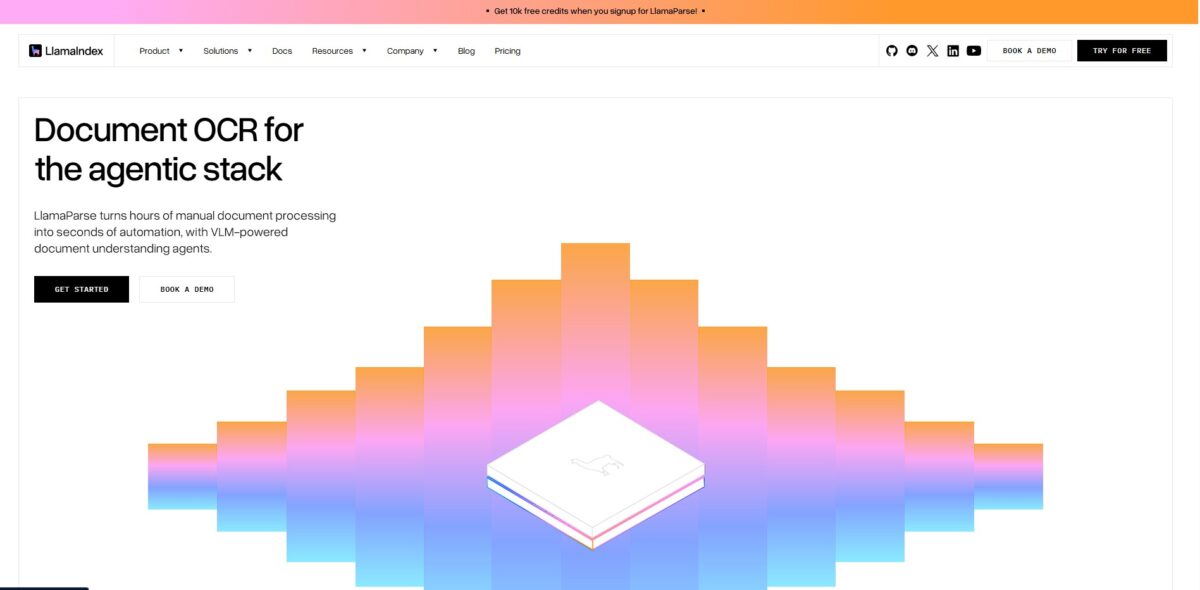
LlamaIndex acts as a data bridge for your LLM. It connects your private documents—PDFs, SQL databases, or Slack threads—to models like GPT-4 so they can answer questions using your specific info rather than just their training data. I noticed it handles the annoying parts of RAG, like chunking text and managing vector embeddings, which stops your chatbot from hallucinating when asked about a niche internal HR policy. While it shines at structured retrieval, the learning curve can feel steep if you just want a simple prompt wrapper. This framework turns static files into a searchable knowledge base, making your AI actually useful for domain-specific tasks. Use it if you need a specialized retrieval pipeline but skip it for generic chat apps.
How to start using LlamaIndex?
Fire up your terminal and run pip install llama-index to grab the core library. You will need an OpenAI API key saved as an environment variable to use the default models. If you prefer keeping your data local, you can swap in Ollama or Hugging Face integrations instead. This initial setup takes less than a minute. The infrastructure headache is gone, so you can focus on your data.
Create a data folder and drop in your text files or PDFs. Use the SimpleDirectoryReader to pull that content into your script. It automatically detects file types, which saves you from writing custom parsers for every random doc. Then, initialize a VectorStoreIndex with those documents. This turns your static files into a searchable mathematical representation. Why this matters: You stop hunting for info and let the code find the context for you.
Connect your index to a query engine with a single line of code. You can now ask questions about your documents in plain English using the query method. It retrieves relevant snippets and synthesizes a clear answer. While the five-line starter works for small folders, you should persist your index to disk for larger datasets to avoid re-embedding everything on every run. In effect, you get a conversational interface to unorganized internal knowledge.
For production, move beyond in-memory storage and connect to a vector database like Qdrant or Pinecone. You should also consider chunking strategies if your documents have complex layouts or long sections. LlamaIndex allows you to swap these components without gutting your logic. It scales well for enterprise RAG but can feel overkill if you just need to search a few CSVs. The result is a system that grows with your data volume without hitting a performance wall.
Use the SimpleDirectoryReader for a quick prototype, but switch to LlamaParse for complex PDFs with tables to ensure the model actually reads the data correctly.
Who is it for?
Python developers building RAG applications who find raw LLM prompts too unpredictable
You get a structured way to handle indexing without manually writing every retrieval loop. No more reinventing the wheel for every PDF or doc you ingest.
Data engineers drowning in unstructured enterprise files like messy PDFs or ancient PowerPoint decks. It converts chaotic internal folders into a queryable knowledge base that actually understands relationships between nodes. Static files become active data for your agents.
ML practitioners who tried LangChain but felt it was too “magical” or abstract for heavy data tasks. You get granular control over chunking strategies and retrieval methods like top-k similarity or hybrid search. When a model misses a specific fact, you can debug exactly why.
SaaS founders rushing to add “Chat with your Docs” features before their competitors do
It offers pre-built connectors for Slack, Google Drive, and Notion to pull live data into your app in an afternoon instead of a month. Speed-to-market usually wins in the current AI gold rush.
Technical architects tasked with making LLMs safe for private corporate data
The framework keeps your indexing logic local, ensuring sensitive information doesn’t leak into the model’s training weights. That satisfies security audits while still delivering personalized AI answers.
LlamaIndex pricing
The open-source library costs nothing. You can download the Python or TypeScript packages and build locally without a subscription. The real bill arrives when you move to the managed LlamaCloud services. This platform uses a credit-based system where 1,000 credits equal $1.25. Every page you parse or document you index eats into your balance. It is a pay-as-you-go model that scales with your data volume.
Free Tier: $0/month. You get 10,000 monthly credits to test small RAG pipelines. This suffices for hobbyists or developers prototyping a single document parser. One user only.
Starter Plan: $50/month. This grants 50,000 credits and allows up to 5 users. You can pay for extra credits if you hit the ceiling, which prevents your production workflows from stalling.
Pro Plan: $500/month. Designed for bigger teams, it includes 500,000 credits and supports 10 users. You also get dedicated Slack support to help debug complex retrieval issues.
LlamaParse Costs: Credit consumption varies wildly by model. Basic parsing costs 1 credit per page. If you use a heavy agent like Sonnet 4.0 for messy financial tables, it can jump to 90 credits per page. That is a massive price hike for high-accuracy layout detection. This ensures your LLM actually understands the relationship between headers and cells in a complex PDF.
Regional Multipliers: Data residency matters. Processing in Europe adds a 1.5x multiplier to your credit usage. This accounts for higher infrastructure costs or specific compliance requirements like GDPR. That matters because a job costing $10 in the US will cost $15 in the EU.
LlamaIndex key features
LlamaHub data connectors ingest files from Slack, Notion, or local PDFs
You won’t spend hours writing custom scrapers for every file format in your company. It takes you from raw, messy data to an LLM-ready format.
The parsing engine breaks down complex document layouts like nested tables and multi-column research papers
It keeps related context together instead of splitting a sentence in half mid-chunk. As a result, the AI can actually understand that a table row is a single unit of information.
Advanced retrieval strategies go beyond simple keyword matching by using rerankers and small-to-big context windowing
It finds the exact paragraph needed for an answer rather than just the general file. That drastically reduces the chance of the model making up answers when it can’t find the right data.
The framework supports structured outputs, turning loose conversational text into clean JSON or database entries
You can feed it an email and get back a structured support ticket automatically. You can plug AI directly into your existing software workflows.
Built-in evaluation tools measure how faithful the AI’s response is to the source documents
I noticed it flags when a model gets “creative” with facts that aren’t in your files. You get a clear metric on how much you can trust the system before shipping it to users.
Agentic orchestration allows the system to decide when to search a database versus when to query an API
It acts more like a researcher than a simple search bar. The tool can handle multi-step tasks without a human mapping out every single branch of logic.
LlamaIndex Pros & Cons
Pros
LlamaIndex focuses on one thing: connecting your specific data to an LLM. It simplifies data ingestion with over 160 loaders through LlamaHub, letting you pull from Slack, Notion, or raw PDFs without writing custom scrapers. This specialization makes it much faster to build a basic RAG pipeline compared to more general frameworks. The hierarchical indexing is particularly effective for large, text-heavy technical manuals where maintaining section context is difficult. It keeps the AI from losing the “big picture” when searching through fragmented document chunks. Use it for straightforward search and retrieval tasks where you want to minimize development time.
Cons
The library adds abstraction layers that can make debugging difficult once you move beyond simple use cases. While it excels at indexing, it lacks the deep, multi-step agent reasoning and tool integration found in frameworks like LangChain. You might find yourself reverse-engineering internal classes just to change a specific retrieval behavior. The documentation can feel messy, and maintaining code through frequent updates adds an ongoing tax to your project. This matters because a five-line starter script can quickly evolve into a complex system that is hard to customize or optimize. Choose a different path if your application requires complex, dynamic workflows rather than just efficient document querying.
Use LlamaIndex if you want…
- Connect private enterprise data to LLM reasoning.
- Build custom RAG pipelines with minimal boilerplate.
- Index complex documents for fast natural language retrieval.
- Create data-aware AI agents that understand your context.
- Bridge disparate data sources through a unified interface.
- Query unstructured PDFs using simple Python commands.
- Scale knowledge assistants across massive internal wikis.
- Optimize retrieval accuracy for domain-specific technical queries.
LlamaIndex alternatives


LlamaIndex Reviews
Hands-down the best for RAG pipelines. Data ingestion is seamless, but the documentation can be a moving target.
Perfect for structured retrieval. It handles complex PDF parsing better than LangChain, though the abstraction layers are occasionally thick.
Great for quick prototypes. The integration with various vector stores is a lifesaver, but memory management gets tricky at scale.
Powerful orchestration. The new Workflows engine is a huge step up for building event-driven agents compared to rigid DAGs.
FAQ
What types of data formats does LlamaIndex support?
LlamaIndex supports a wide range of formats including structured, semi-structured, and unstructured data such as PDF, CSV, JSON, HTML, and Markdown, as well as integrations with databases like SQL and SaaS platforms like Notion and Slack.
How does LlamaIndex handle document parsing?
It uses modular data connectors and tools like LlamaParse to extract text, tables, and images from complex documents, converting them into a standardized format for indexing.
What is the difference between a Document and a Node in LlamaIndex?
A Document represents an entire data source like a file or API response, while a Node is a smaller, semantically meaningful chunk of that Document used for precise retrieval.
Can I use LlamaIndex with local LLMs?
Yes, while it defaults to OpenAI, LlamaIndex is flexible and allows you to configure your own local embedding models or large language models for enhanced privacy and control.
What are the primary stages of a RAG pipeline in LlamaIndex?
The pipeline consists of loading data via connectors, indexing it into searchable structures, storing the index, and querying to retrieve and synthesize answers.
Does LlamaIndex support multi-modal data?
Yes, it can process and reason across different data types including text, images, and audio through specialized readers and multi-modal models.
What is LlamaHub?
LlamaHub is an open-source repository containing hundreds of community-contributed data loaders and tool integrations that can be easily plugged into any LlamaIndex application.
How does LlamaIndex ensure retrieval accuracy?
It utilizes advanced techniques such as semantic chunking, metadata filtering, reranking, and recursive retrieval to ensure the most relevant context is provided to the LLM.
Similar tools
 GPT WorkspaceAI agent for Google Docs, Sheets, Slides, Gmail and Drive that edits your files, runs GPT formulas in bulk and automates routine
 FPT.AIVietnamese enterprise AI platform from FPT Smart Cloud for chatbots, call-center voicebots, document reading and eKYC that automate customer operations.
 Frigate NVROpen-source NVR that runs real-time AI object detection on your own hardware and sends camera events to Home Assistant and other MQTT