

MiniMax
AI AutomationUpdated October 5, 2026
MiniMax is a developer platform offering multimodal AI models for text, speech, music, and video via a single API.
We may earn a commission when you sign up through our links. It does not affect our reviews.
What is MiniMax?
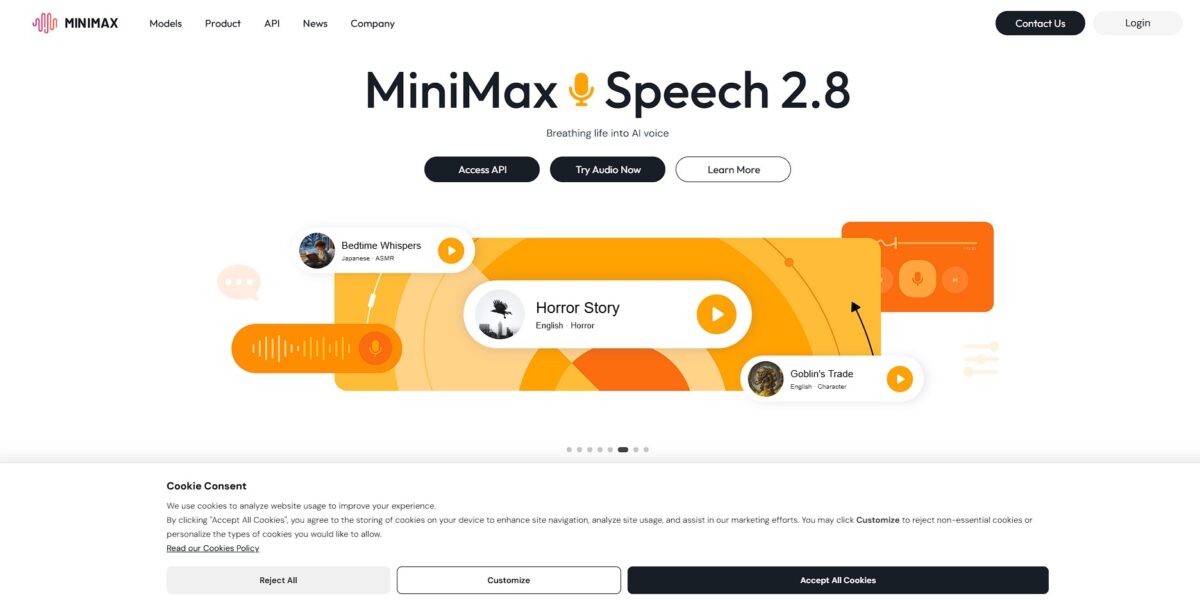
MiniMax is a developer-focused platform that manages multimodal AI models for text, speech, music, and video through a single API. It gives you access to specialized engines like the M2.7 text model and Speech 2.8, which handle everything from complex coding assistance to cloning a human voice in about 10 seconds. While many AI suites feel like generic wrappers, this setup is built to process massive context windows—up to 10 million characters—without the usual performance degradation. I noticed it handles messy, non-standard text like phone numbers or URLs much better than traditional text-to-speech tools, reading them naturally rather than character-by-character. This matters because it saves you from writing custom pre-processing scripts for every dynamic data field in your app. It works excellently for building responsive voice agents or automation workflows, though the credit system can be tight if you are just poking around. If you need consistent character voices or complex document parsing across multiple formats, this is a solid technical pivot from standard LLM providers. Use it when low-latency audio or massive context handling is the priority over simple chatbot logic.
How to start using MiniMax?
Start at platform.minimax.io to set up your developer account. You will need a valid email to get through the initial gate. Once inside, navigate to the API Keys section to generate your first secret. This key identifies your requests and tracks your usage. Copy it immediately and store it in a secure environment file because the dashboard hides it after the initial view. This prevents accidental exposure in public repositories.
Next, decide between the Pay-as-you-go model or a specific Token Plan. The former handles varied workloads across text, video, and audio, while plans like Starter or Pro offer fixed monthly quotas. You will need to top up your balance in the billing section before the API accepts calls. Having a clear credit balance ensures your production scripts don’t fail due to insufficient funds. This is crucial for maintaining uptime in live applications.
Integration is straightforward because MiniMax uses an OpenAI-compatible format. You can use the standard OpenAI SDK by simply pointing the base URL to https://api.minimax.io/v1. This swap allows you to reuse existing logic for chat completions or voice cloning without a full refactor. The platform also supports an Anthropic-compatible endpoint if you prefer that structure. Flexible SDK options mean you spend less time debugging boilerplate and more time testing model responses.
Before scaling, run a test call using a model like m2.5 to verify your credentials. A simple curl command or a short Python script will confirm your key is active. Check the model playground to tweak parameters like temperature and max tokens visually. This environment helps you find the right balance between creative output and predictable responses. Fine-tuning these settings early prevents wasted credits on unusable generations.
Export your API key as an environment variable to keep it out of your source code.
Who is it for?
Solo Indie Devs
You get a voice acting department without the payroll. It’s perfect for populating an RPG with distinct NPC voices, though you’ll spend time tweaking prompts to get the emotional delivery just right. Game worlds that would otherwise stay silent get real depth.
Multilingual Content Creators
One video becomes ten. You can clone your own voice to speak thirty languages while keeping your specific intonations and pacing. Your brand identity carries across borders without hiring translators or voice-over artists.
E-learning Designers
Technical modules often require dry, clear narration that stays consistent across dozens of updates. You can swap one paragraph in a six-month-old course and the new audio won’t sound like a different person. Students aren’t distracted by jarring audio shifts.
AI Video App Builders
Developers can use the API to integrate real-time voice generation or lip-syncing directly into their own software. It handles the heavy lifting of audio-to-video alignment so you don’t have to build custom models from scratch. For multimodal applications, that slashes development time.
Social Media Marketers
Creating quick-turnaround ads with emotional hooks becomes a ten-minute job. You can test five different vocal tones—from energetic to serious—on the same script to see what converts. In effect, you get rapid A/B testing of audio impact without re-recording sessions.
Accessibility Engineers
It provides a way to turn static text into natural-sounding speech for users who rely on audio navigation. While standard screen readers are functional, these models offer a more human cadence for long-form reading. For vision-impaired users, that means less listener fatigue.
MiniMax pricing
MiniMax targets the cost-conscious developer who needs logic-heavy models without the Silicon Valley price tag. Their structure leans heavily into utility, splitting costs between raw API tokens and dedicated subscription plans for specific media like voice or video.
The API billing for the flagship M2.7 model follows a strict pay-as-you-go format. You pay $0.30 per million input tokens and $1.20 per million output tokens. This helps when running high-volume batch processing for documentation or codebase migrations. For developers using Claude Code or Cursor, the Token Plan offers a unified wallet for all modalities. If you need dedicated speed, the Highspeed Plans start at $400 per year for 4,500 requests every five hours. I noticed that while the text tokens are cheap, the tiered pricing for images and voice cloning can add up if you aren’t monitoring your daily character usage.
MiniMax key features
Recursive self-optimization allows the model to identify its own logic gaps and generate synthetic data to patch them
This cycle moves training from a static, human-led event to an autonomous loop that refines performance without waiting for major version updates. In practice, the model adapts to complex edge cases faster than traditional release cycles allow.
The Mixture of Experts (MoE) architecture activates only 10 billion parameters out of a 230 billion total for each token processed. You get the reasoning depth of a massive model while keeping inference costs and latency closer to a lightweight tool. So you can run dense, multi-step agent chains without blowing your budget or waiting for slow responses.
Hybrid attention mechanisms combine linear Lightning Attention for long-range context with standard softmax for local precision. It maintains focus on specific details even when you feed it a 200,000-token codebase or a massive legal document. That avoids the “lost in the middle” problem where LLMs ignore data buried in long prompts.
Native support for “Agent Teams” allows the model to anchor different role identities and handle adversarial reasoning between sub-agents. It manages behavioral differentiation internally rather than relying on brittle system prompts to keep agents from repeating each other. Building complex, multi-role automation pipelines takes less management overhead.
Interleaved thinking wraps internal reasoning traces in specific tags to preserve logic during multi-turn debugging
By keeping the “thought process” in the history, the model avoids losing context when you ask it to fix a bug it just analyzed. Follow-up corrections get significantly more accurate because the model “remembers” its earlier rationale.
A multimodal model matrix integrates text, ultra-realistic voice cloning, and video generation under one developer platform. You can build an agent that analyzes a spreadsheet and then immediately generates a narrated video summary or a music track for a presentation. You no longer have to stitch together five different APIs from five different providers.
Deep optimization for office software enables high-fidelity editing across Excel formulas, PPT layouts, and Word document structure. The model understands the environment of a spreadsheet, allowing it to perform causal reasoning on monitoring metrics or database root causes. The AI stops being just a text writer and becomes a functional digital worker that actually manipulates files.
MiniMax Pros & Cons
Pros
MiniMax hits a sweet spot for developers who need high-speed iteration without draining their budget. The M2.5 model clocks in at 100 tokens per second, which means you spend less time watching a cursor blink and more time reviewing logic. I noticed it handles multi-file edits and test-driven loops with surprising accuracy, often catching its own errors before you do. It functions well as a grunt-work partner that grinds through repetitive debugging and boilerplate generation. Hours of manual coding shrink to minutes of supervised automation. If you need to build functional apps or complex backend logic on a budget, this is a top-tier choice.
Cons
The platform isn’t without friction, specifically regarding its restrictive credit system and occasional logic lapses. Users often find the daily credit limits stifling, and the system sometimes malfunctions, locking you out just when you need to finish a task. While it excels at straightforward execution, it can struggle with abstract reasoning or highly complex architecture where it might hallucinate or “nuke” a codebase if given too much autonomy. The transition from open-weight models to proprietary ones like M2.7 has also left the developer community feeling less in control. This matters because unreliable credits and overconfident hallucinations can derail a production pipeline. Use it for tactical tasks, but keep a human in the loop for architectural decisions.
Use MiniMax if you want…
- To build autonomous agents with elite coding precision.
- To integrate high-performance text, speech, and video models.
- To use SOTA multilingual reasoning for global applications.
- To maximize inference speed with a lightning-fast native API.
- To deploy cost-effective LLMs that rival flagship industry leaders.
- To automate complex office workflows with professional-grade accuracy.
- To create realistic voice clones for immersive user experiences.
- To scale production AI without breaking your development budget.
MiniMax alternatives


MiniMax Reviews
M2.5 is a legitimate Claude competitor. The “Architect Mindset” actually works for complex refactors, and the pricing is unbeatable for the level of intelligence you get.
Speech 2.8 is the most natural TTS I’ve used. Being able to insert pauses and emotions sentence-by-sentence makes a massive difference for my video workflows.
Impressive physics in the video generator. Objects move with real weight and momentum, though it still struggles a bit with animating humans from stock photos.
The research agent in M1 is top-tier. It understands temporal relevance and doesn’t get stuck on outdated 2023 data like most other models I’ve tested.
Built a full-stack e-commerce site from one prompt using the MiniMax Agent. No-code tools are usually limited, but this actually produced clean, functional code.
FAQ
What modalities does MiniMax support?
MiniMax provides a comprehensive suite of foundation models covering five major areas: text, speech, video, image, and music, supporting various creative and technical applications.
Which model is recommended for AI coding tasks?
The MiniMax M2.7 and M2.1 models are specifically designed for advanced coding and agentic tasks, offering strong performance in multi-file edits and test-validated repairs.
Are the MiniMax models compatible with existing developer SDKs?
Yes, MiniMax models are compatible with the Anthropic and OpenAI SDKs, allowing developers to easily integrate them into existing workflows using familiar tools.
Does MiniMax offer real-time speech synthesis?
Yes, MiniMax Speech 2.8 Turbo provides high-definition text-to-speech with processing latency under 250 milliseconds, suitable for interactive applications and live streaming.
Can I create custom voices with MiniMax?
Yes, the platform includes a Voice Clone feature that allows users to extract timbre features from reference audio to create personalized and consistent voice models.
What are the usage limits for the free developer tier?
The free tier typically includes $5 in monthly credits, with rate limits of 1,000 requests daily and 100 requests per minute, along with a cap on monthly video generation.
How do Coding Plan keys differ from General API keys?
Coding Plan keys are designed for high-frequency coding and agentic tasks with predictable subscription pricing, while General API keys offer flexible pay-per-token access for diverse model usage.
Does MiniMax support complex office software tasks?
Yes, the M2.7 model is enhanced for professional office scenarios, capable of handling complex editing and multi-round revisions in Excel, Word, and PPT files.
Similar tools
 GPT WorkspaceAI agent for Google Docs, Sheets, Slides, Gmail and Drive that edits your files, runs GPT formulas in bulk and automates routine
 FPT.AIVietnamese enterprise AI platform from FPT Smart Cloud for chatbots, call-center voicebots, document reading and eKYC that automate customer operations.
 Frigate NVROpen-source NVR that runs real-time AI object detection on your own hardware and sends camera events to Home Assistant and other MQTT