

PolyAI
Customer SupportUpdated October 18, 2026
Enterprise voice AI platform for building agents that answer customer service calls, complete bookings and account tasks, and hand off to people.
We may earn a commission when you sign up through our links. It does not affect our reviews.
What is PolyAI?
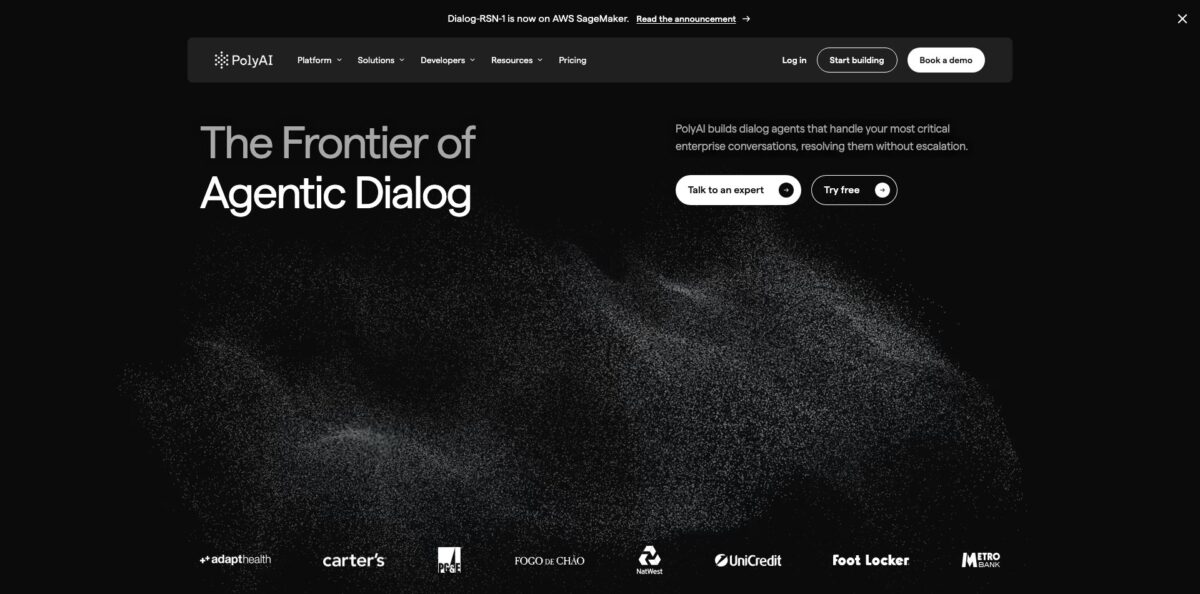
PolyAI is a London-based voice AI company, founded in 2017 as a Cambridge spinout, that builds agents to answer customer service calls for banks, utilities, hotels, restaurants and healthcare providers. Instead of a press-one IVR, callers speak normally, interrupt, change topic, and the agent books, verifies, routes or resolves the request against your own systems. Under the hood it runs on Raven, PolyAI’s own conversation-tuned LLM, plus a newer audio-native model called Dialog-RSN-1. Everything is built and tuned in Agent Studio, with an AI assistant named Wren, a Python ADK and REST APIs on top. The company claims 90% end-to-end resolution on its largest deployments and more than 100M calls a year. The weak spot is cost transparency: production pricing is per minute and quoted by sales. Pick it if phone volume is a real line item in your contact center budget.
How to start using PolyAI?
Agent Studio is now self-serve. Go to studio.poly.ai and sign up with Google SSO or an email and password; the docs say you can build your first agent free. You land on the Agent Studio home page, where clicking + Agent opens a short wizard. Fill in the agent name, the response language, a text-to-speech voice and the welcome greeting, then click Next to enter the editor. If you would rather describe the job than click through menus, open Wren and type something like “a booking agent for a three-site restaurant group” and let it scaffold flows and topics on a Branch.
Next, give the agent something to say. Open Knowledge > FAQs and click Add topic, then enter a topic name, up to 20 sample questions and the answer. You can also upload PDFs or URLs to auto-generate topics, or connect Zendesk or Google Sheets from the Connected tab. Each topic can carry actions, such as sending an SMS, calling a Python tool or handing the caller to a person. For multi-step jobs like changing a reservation, build a Flow with the no-code step editor or with code.
Then test where it is safe. Every change saves to your Branch in the Sandbox environment, which never reaches a customer. Click the phone icon in the top-right corner, choose Sandbox and talk to the agent through your microphone, or open the webchat icon to see tool calls and topic citations alongside the replies. Simulation tests let you script scenarios with assertions and rerun them after every change, and Wren can write those tests for you.
When you are happy, go to Deployments and click Publish. Your Branch merges onto Live, and every publish is saved, so you can roll back in one step. Phone numbers attach only to Staging and Live: buy one under Voice > Numbers or Integrations > Telephony, forward your existing line, or connect a SIP trunk from your contact center platform.
Who is it for?
Contact center directors
You pay for thousands of agent hours spent on balance checks, outage updates and password resets. PolyAI is built to absorb those calls end to end and pass only the hard ones to people. Its integrations with Five9, NICE CXone, Genesys, Amazon Connect, Zoom and Twilio mean you keep your existing telephony.
Hotel and restaurant groups
Phones ring hardest during service, exactly when nobody can pick up. Agents can take, change and cancel bookings through OpenTable, log room service requests via HotSOS and capture large-party leads with Tripleseat. Missed calls turn into reservations instead of voicemail.
Banks, insurers and utilities
Your calls involve identity checks, payments and regulated wording. The platform lists SOC 2 Type 2, ISO 27001, PCI DSS and GDPR, with data residency options in the US, UK, EU and APAC. Guardrails and PII redaction run on every turn.
Healthcare and patient transport providers
Scheduling and triage lines get swamped, and callers are often stressed. PolyAI lists HIPAA among its compliance controls and offers EHR integrations. Customer stories like SafeRide Health describe a million calls handled every month.
CX engineering teams
You want agents in Git, not only in a web UI. The ADK pulls the project as YAML and Python, so you can edit in your IDE, run poly validate and push changes through code review. REST APIs cover phone numbers, conversations and test runs.
Multilingual service teams
Hiring native speakers for every market is slow. Raven 3.5 handles 24 languages, including Cantonese, Korean and Arabic, and keeps answering in the target language even when your prompts are in English.
PolyAI pricing
PolyAI prices production voice agents per minute of usage, and that rate is quoted after a sales conversation rather than shown on the site. The official pricing page says the per-minute rate includes proactive performance improvements, maintenance and 24/7 support. A few concrete prices do appear in the developer docs, covering telephony and the standalone model API.
Free. Self-serve accounts can build and test a first agent without a sales call. The fair-use allowance for the Wren assistant is set per account and may change.
Calls on a number bought through PolyAI (UK, US, Canada, Australia or Ireland) or on a PolyAI number your existing line forwards to are billed at 1.5¢ per minute. Your own carrier may add forwarding charges.
$0.02 per minute of connected time, billed per second, plus $2.00 per million input tokens, $0.20 per million cached input tokens and $5.00 per million output tokens. New accounts get a launch credit, the self-serve cap is 10 concurrent sessions, and the model currently speaks English only.
Custom. Per-minute pricing negotiated on volume, with a 99.9% uptime SLA on your phone lines, a web ticket portal, a 24/7/365 emergency support line, monitoring and ongoing upgrades. Reserved capacity removes the self-serve concurrency cap.
PolyAI key features
Raven and Dialog-RSN-1 models
Raven 3.5 is a conversation-tuned LLM with sub-300ms median latency, out-of-domain detection and automatic reasoning on harder turns like date maths. Dialog-RSN-1 reasons directly over raw call audio for turn-taking and recognition. You can still pick OpenAI or Amazon Bedrock models, or bring your own endpoint, when a language or capability is missing.
Wren, the build assistant
Wren reads your project, proposes a plan and writes changes to a Branch only after you approve. It builds flows, topics and handoffs, writes simulation tests and answers questions about real calls with transcript evidence. Open it with Cmd+I from anywhere in Agent Studio.
Branches, Staging and experiments
Nobody edits Live directly: changes go into Branches, merge on publish and can be rolled back in one step. Experiments split real calls between Live and a Branch, anywhere from 1% to 99%, so you can test a new prompt or model on actual customers before it takes every call.
One agent across channels
The same project can answer phone calls, web chat, SMS, RCS, WhatsApp and email, with iOS and Android SDKs for in-app chat and WebRTC voice. A web calling widget lets visitors talk to the agent from your site through one script tag, with no phone number needed.
Contact center and business integrations
Telephony connectors cover SIP trunks, Five9, NICE CXone, Twilio, Amazon Connect, Genesys, Zendesk Talk, Dialpad and Zoom. Chat handoffs go to Salesforce, Zendesk, NICE CXone, Amazon Connect, Webex, Genesys and Five9, and CRM lookups reach Salesforce, HubSpot and Dynamics 365. Python tools fill the gaps for anything custom.
PolyScore and analytics
Every engaged conversation with more than three user turns gets a 1 to 5 PolyScore based on agent quality and task success, and handoffs are not counted as failures. You can add AI Scores with your own criteria, CSAT surveys and custom dashboards, then annotate transcripts to flag knowledge gaps.
ADK for engineers
The Agent Development Kit is a Python CLI that pulls a project as YAML and Python files and supports a Git-style workflow: init, pull, branch, validate, push, review. poly chat lets you talk to the agent from the terminal before merging. Agents built in Studio stay editable through the ADK and APIs, and the other way around.
PolyAI Pros & Cons
Pros
Voice quality and conversational flow are the most praised parts of PolyAI. Reviewers on G2 and Gartner Peer Insights describe callers speaking casually and interrupting without breaking the call, and a voice that rarely sounds robotic. The platform is also unusually complete for an enterprise vendor: Branches, rollbacks, A/B experiments, simulation tests and PolyScore cover the whole lifecycle, and the ADK gives engineers a Git workflow. Security credentials, regional data residency and deep contact center integrations remove many procurement blockers. The move to a free self-serve Studio account means you can now prototype before you talk to sales. Build your top call reasons in Sandbox first and bring those transcripts to the vendor conversation.
Cons
Production pricing is not published, and third-party reviews say contracts are sized for high call volumes, so smaller teams struggle to forecast cost. The per-minute rate on the pricing page is only revealed through a form. Raven covers 24 languages; anything else, such as Danish, needs a third-party model with its own trade-offs. The newer Dialog-RSN-1 API currently works in English only and caps self-serve accounts at 10 concurrent sessions. Some Gartner reviewers want better metrics and support, and a G2 reviewer mentions occasional slowness and harder edge cases. Get latency, language and containment targets written into the contract before signing.
Use PolyAI if you want…
- Automate routine customer service calls without a phone menu.
- Take restaurant and hotel bookings around the clock.
- Plug voice agents into Genesys, Five9 or NICE CXone.
- Answer callers in two dozen languages from one project.
- Test agent changes on real calls before full rollout.
- Run one agent across phone, chat, SMS and email.
- Version agent configuration in Git with a CLI.
- Score every conversation automatically for quality and resolution.
PolyAI alternatives



PolyAI Reviews
A parking operator on Gartner Peer Insights says the agent now resolves simple exit-gate issues across many simultaneous calls, so callers who still need a person wait about 30% less to connect.
A transportation company manager praises the sales and implementation teams for hitting every build benchmark during a long, complicated rollout, and says later changes to the agent are quick to make.
One IT services reviewer rates the integrations and the quality of conversations well, but gives three stars because metrics and support still need work.
G2 reviewers highlight a human-sounding voice and a simple interface that connects to their other systems, while noting it can be slow at times and some complex scenarios are still tricky.
FAQ
Is there a free version of PolyAI?
You can sign up for Agent Studio self-serve and build your first agent free. Production deployments are priced per minute and quoted by sales, and the Dialog-RSN-1 API comes with a launch credit before pay-as-you-go rates apply.
How much does PolyAI cost per minute?
The enterprise per-minute rate is not published. The docs list $0.015 per minute for calls on PolyAI-provisioned phone numbers and $0.02 per connected minute, plus token fees, for the Dialog-RSN-1 API.
Which languages does PolyAI support?
Raven 3.5 supports 24 languages, including English, Spanish, French, German, Japanese, Korean, Cantonese and Arabic. The platform accepts 73 response language codes in total, with languages outside Raven’s list handled by third-party models.
Does PolyAI integrate with my contact center platform?
Yes. There are connectors for Five9, NICE CXone, Genesys, Amazon Connect, Twilio, Zendesk Talk, Dialpad, Zoom and any SIP-capable system, plus chat handoff to Salesforce, Zendesk, Webex and others.
Is PolyAI secure enough for banking or healthcare?
PolyAI lists SOC 2 Type 2, ISO 27001, PCI DSS and GDPR, mentions HIPAA for its agents, and offers data residency in the US, UK, EU and APAC. It says customer data is never used for training without opt-in.
Can PolyAI hand calls over to a human agent?
Yes. Handoffs can be triggered from FAQ actions, flows or Python functions, and they pass context to your live agents in the destination you configure.
Do I need to code to build a PolyAI agent?
No. Agent Studio, no-code flows and the Wren assistant cover most builds. Python tools, the ADK and REST APIs are there when you need custom logic or a Git workflow.
Can I use my own LLM with PolyAI?
Yes. Besides Raven, you can select OpenAI or Amazon Bedrock models, or connect your own model endpoint through the bring-your-own-model option.
Similar tools
 Level AIContact center AI platform that scores every call, chat and email, runs voice and chat virtual agents, and gives live agents real-time
 TelozAI cloud contact center and business phone system with an AI receptionist, omnichannel inbox, dialers and live analytics for US teams.
 CallbellShared team inbox for WhatsApp, Messenger, Instagram, Telegram and TikTok with a no-code bot builder, AI agents and WhatsApp broadcasts.