

Qodo
Developer ToolsUpdated November 10, 2026
AI code review platform that runs specialized agents on every pull request, enforces team rules and checks changes against tickets and linked repos.
We may earn a commission when you sign up through our links. It does not affect our reviews.
What is Qodo?
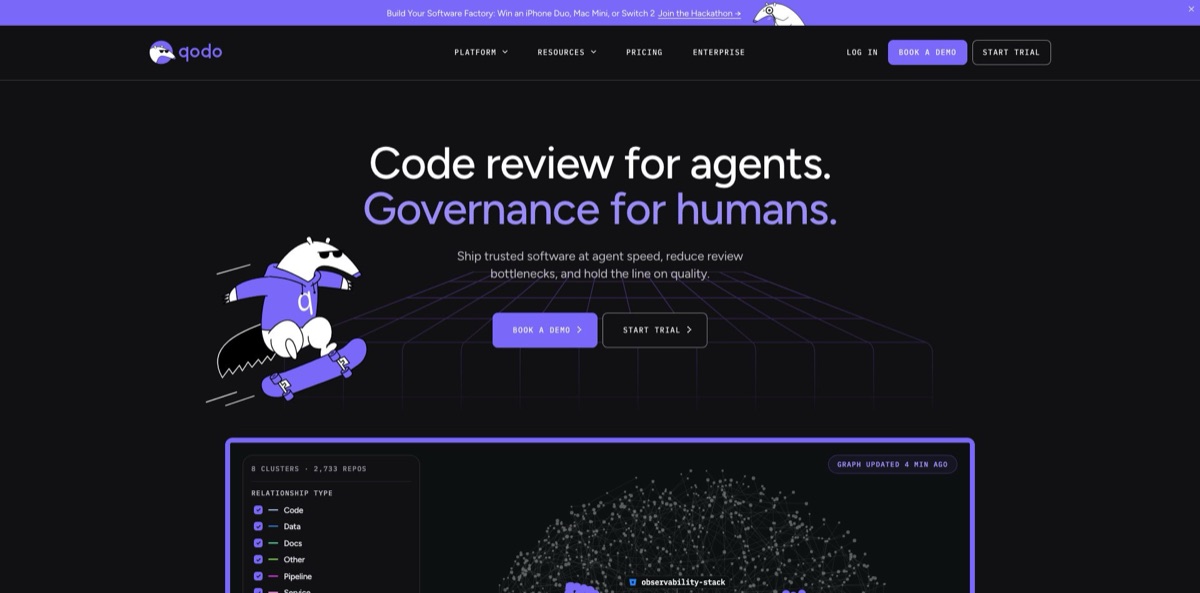
Qodo is an AI code review and governance platform that sits between your coding agents and production. The Israeli startup was called CodiumAI until its 2024 rebrand, and it has since shifted from IDE test generation to pull request review. Specialized review agents read each PR together with a context engine built from your codebase, past PR discussions, linked tickets and team rules, then post severity-ranked findings with suggested fixes in GitHub, GitLab, Bitbucket, Azure DevOps or Gerrit. A rules system mines standards from your review history and enforces them across repositories, and cross-repo review flags changes that break other services. The weak spots are the per-review cost of the credit model, the absence of a free tier for individuals, and the noise some teams still report. Pick it if your organization merges a steady flow of AI-written code across many repositories.
How to start using Qodo?
Go to app.qodo.ai and sign in with GitHub, Google or email. The 14-day trial needs no credit card and includes unlimited reviews and credits. An organization admin sees the onboarding wizard on first sign-in: it connects your Git provider, applies a Review preset matched to your team’s priorities and offers the Agentic Toolbox to developers. You need admin access on the Git organization to install the app, but developers whose pull requests get reviewed do not need their own Qodo accounts. Each developer can still link a Git user account from the sidebar so Qodo attributes PRs and commits correctly.
Then open a pull request as usual. By default Qodo starts a review when a PR is opened, reopened or marked ready for review, posts a temporary “review in progress” comment and typically finishes within a few minutes. Findings arrive ranked as High, Medium or Low, each with an explanation, the affected lines and an agent-ready prompt you can paste into your coding assistant. You can also trigger a fresh pass with /agentic_review, get a structured summary with /agentic_describe, ask about the change with /ask, or have Qodo analyze a failed CI run with /checks on GitHub.
The real tuning happens on the Configurations page of the Qodo portal or in a .pr_agent.toml file in the repository. Settings apply at workspace, Git organization or repository level, and a Search settings box finds any option quickly. The Finding types tab switches categories on or off: bugs and correctness, rule enforcement, skill insights, cross-repo impact, spec gaps and design gaps. Display modes such as Lean control how verbose the comments are. Connect Jira, Linear, Monday.com, Azure Boards, GitHub Issues or GitLab Issues so the agents can check each PR against the ticket it references in the description or branch name.
Close the loop inside the PR itself. Mention @qodo to ask why something was flagged, or tell it a finding is a false positive, deferred or intentional, and it updates the review threads. Asking it to fix an issue starts the Remediation agent, still a research preview, which opens a separate fix PR you review before merging. On GitHub and GitLab, Apply Suggestion commits a proposed change in one click. To catch problems before a PR exists, install the Agentic Toolbox CLI with curl -fsSL https://get.qodo.ai | sh (Node.js 20 or later) and run the Review skill from Claude Code, Codex or Kiro.
Run the trial on one busy repository and watch the credit burn rate on the dashboard before you choose a credit pack.
Who is it for?
Engineering leaders
Coding agents have multiplied PR volume while the number of senior reviewers stayed flat. Qodo gives every PR a severity-ranked first pass, and PR Triage, a research preview, groups the PRs one agent task opened into a single work package ranked by impact, review effort and SLA risk.
Platform and architecture teams
A signature change in a shared SDK, API or schema can break consumers in other repositories. Cross Repo Review maps how repos depend on each other, even across GitHub and GitLab, and flags the downstream break on the PR with a link to the affected line before merge.
Teams with unwritten standards
Conventions live in stale wikis and in senior engineers’ heads. Rules Miner turns recurring review comments into enforceable rules, and since October 2026 Qodo automatically deactivates rules whose findings rarely get fixed, so the rule set does not rot.
Regulated enterprises
Banks, insurers and public-sector teams cannot send code to a shared cloud service. Enterprise adds single-tenant SaaS, on-premises and air-gapped deployment, bring-your-own model keys, SSO/SAML and audit logs on top of SOC 2 Type II and zero data retention.
Open-source maintainers
One-off contributors send PRs that ignore project conventions, and you review them in your spare time. Qualified projects can apply for free access, which puts a consistent first review on every contribution.
Teams on mixed Git providers
If you run Gerrit, Bitbucket Data Center or Azure DevOps next to GitHub, many review bots leave gaps. Qodo applies the same agents and rules on all of them, including self-managed and on-premises installs.
Qodo pricing
Qodo prices by credits rather than seats, and the credit pool is shared by the whole team. Every review draws credits from the monthly pool: small PRs cost fewer credits, large or complex ones cost more, and the dashboard shows your balance and burn rate in real time. The pricing page lists $0.015 per credit, no limits on repositories, users or reviews, and no rate limits. When the pool runs out, reviews keep running as overage at the same per-credit rate until they hit a monthly spending cap you set. Unused credits expire at the end of each cycle, and there is no permanent free tier. The homepage FAQ still quotes older pack sizes, so trust the pricing page.
Unlimited reviews and credits with no credit card. When it ends, reviews pause until you choose a plan, and Qodo suggests a credit pack based on your trial usage.
Qodo estimates about 14 reviews a month. Includes agentic PR review, the rules system with no limit, Git integrations, pre-PR review skills, the analytics dashboard, standard support, strict data retention and a customer-set overage cap. Monthly billing with no annual commitment; the plan is designed for teams of up to 30 users.
Same features, roughly 29 reviews a month.
Same features, roughly 114 reviews a month.
$0/month for qualified open-source projects accepted into the Qodo for Open Source program.
Custom. Aimed at 30+ users; adds SSO/SAML and audit logs, a governance analytics dashboard, advanced self-learning, BYOK, single-tenant SaaS or on-premises deployment, priority support and a dedicated customer success manager.
Qodo key features
Multi-agent pull request review
Instead of one broad prompt, Qodo splits review into focused agents for critical bugs, duplicated logic, ticket compliance and rule violations, each delivering findings with severity and a structured fix. Fix loop optimization, on by default, makes follow-up reviews focus on your latest commits instead of the whole PR. You get fewer repeated comments and lower credit use as a PR moves toward merge.
Context engine
Before commenting, the agents pull context from the repository structure and dependencies, indexed PR history, your rules, linked tickets and web search, generally available since November 2026, for up-to-date documentation on third-party dependencies. Ticket fields such as Jira acceptance criteria let Qodo flag code that only partially implements a requirement. Reviews reflect how your system works rather than just the diff.
Rules system and Rules Miner
Qodo imports rules from files in your repositories and mines new ones from recurring PR comments and reviewer decisions. Rules run on every PR, can be locked or deactivated, and the portal shows how often violations get fixed before merge.
Cross Repo Review and software map
Qodo maps relationships between repositories, services and teams, including across Git providers. When a change to a shared library or schema could break a consumer elsewhere, the finding links to the affected line in the other repo. This feature is in beta.
Chat, suggestions and remediation in the PR
You talk to Qodo with @qodo or /ask, dismiss findings with a reason, and commit fixes through native Apply Suggestion buttons on GitHub and GitLab. The Remediation agent can fix selected findings or everything above a severity threshold in a separate PR. Cleanup that used to become a follow-up ticket happens inside the review.
Agentic Toolbox for coding agents
A CLI, an MCP server and plugins for Claude Code, Codex and Kiro give your agent skills called Codebase Wisdom, Get Rules, Review, Review Resolver and Manage Standards. The agent can pull the right rules before writing code and run a review before opening a PR. It replaces the Qodo IDE plugin, retired on October 30, 2026.
Governance and analytics
PR Triage puts open PRs from every repository and provider into one prioritized queue, while the Analytics dashboard (beta) shows how teams respond to findings by repository, author, severity and category, with CSV export. Every finding and compliance flag is logged for audit.
Qodo Pros & Cons
Pros
Qodo covers more Git setups than most rivals: GitHub Enterprise Server, self-managed GitLab, Bitbucket Data Center, Azure DevOps and Gerrit, with multi-tenant, single-tenant, on-premises and air-gapped options. Its review draws on cross-repo context, PR history and ticket requirements, so findings can catch breaking changes and missed acceptance criteria that diff-only bots never see. The rules system turns tribal knowledge into checks and prunes rules nobody acts on. One long-time team user singles out the effort labels and PR walkthroughs that speed up human review. Pooled credits mean you never pay for idle seats. Start with one high-traffic repository and connect your ticket tracker on day one.
Cons
There is no permanent free tier, and the entry pack of 2,000 credits covers only about 14 reviews a month, which busy teams will exhaust quickly. One Hacker News commenter compared that quota unfavorably with a rival at a similar price, and two engineering teams there called Qodo noisy enough that they built in-house tools instead. The October 2026 retirement of the IDE plugin leaves local review dependent on a supported coding agent, and several headline features (PR Triage, Cross Repo Review, remediation) are still beta or research previews. Set an overage cap and disable finding types you do not need before rollout.
Use Qodo if you want…
- Get an AI first review on every pull request.
- Enforce team coding standards across hundreds of repositories.
- Catch breaking changes that ripple into other repos.
- Check pull requests against Jira or Linear acceptance criteria.
- Review agent-generated code before a human opens it.
- Turn recurring review comments into enforceable rules automatically.
- Run AI code review on-premises or fully air-gapped.
- Give Claude Code or Codex your team’s rules.
- Add free AI reviews to your open-source project.
Qodo alternatives

Qodo Reviews
A developer whose team has used Qodo for a while finds it helpful and says it occasionally catches a serious issue, though the effort labels and file-by-file walkthroughs that speed up human review matter more day to day.
G2 reviewers credit Qodo with saving time and understanding the context of their code, while the most common complaints are slow responses on larger contexts and suggestions that miss on niche problems.
One engineer lumps Qodo in with other AI reviewers that have a very high noise ratio, while conceding that they still catch a legitimate bug now and then.
Commenting on Qodo’s benchmark, a user argues price matters as much as accuracy and notes that a rival bot at similar cost offers a far larger monthly review quota.
Two separate teams report trying both CodeRabbit and Qodo, finding the volume of low-value comments too high, and switching to review tools they built in-house.
FAQ
Is Qodo the same as CodiumAI?
Yes. CodiumAI renamed itself Qodo in 2024, keeping the same company and team. It is unrelated to Codeium, which built the Windsurf editor, and to the VSCodium open-source editor.
Does Qodo have a free plan?
No permanent free plan exists. You get a 14-day trial with unlimited reviews and no credit card, and qualified open-source projects can apply for free access.
What happened to the Qodo IDE plugin?
The plugin for VS Code, JetBrains IDEs and Visual Studio was retired on October 30, 2026 and no longer works. Local review now runs through the Qodo Agentic Toolbox inside a coding agent such as Claude Code, Codex or Kiro, which Qodo offers free throughout November 2026.
Which Git providers does Qodo support?
GitHub (cloud and Enterprise Server), GitLab (cloud and self-managed), Bitbucket Cloud and Data Center, Azure DevOps and Gerrit. Single-tenant and on-premises deployments are Enterprise-only.
Does Qodo train AI models on my code?
No. Qodo says code is analyzed and discarded with zero data retention, is never used for training, and the platform is SOC 2 Type II certified.
What happens if we run out of credits?
Reviews continue as overage at the same per-credit rate until they reach the monthly spending cap you set. You get notifications as you approach the cap and can raise it from the dashboard.
Can I use my own LLM API keys?
Yes, on Enterprise plans. BYOK supports OpenAI, Anthropic, Azure OpenAI or self-hosted models.
Is PR-Agent still free and open source?
Yes. PR-Agent is now a community-maintained, MIT-licensed project under The-PR-Agent organization on GitHub. It is separate from Qodo’s commercial review platform and is not Qodo’s free tier.
Similar tools
 Novita AIDeveloper cloud with one API for 200+ open-weight AI models, plus GPU instances, dedicated endpoints and isolated sandboxes for AI agents.
 You.comDeveloper platform of web search, content extraction, cited research and model inference APIs that feed AI agents and RAG apps real-time web
 Applitools EyesVisual AI testing tool that adds screenshot checkpoints to Playwright, Cypress or Selenium tests and flags real UI regressions across browsers.