

Scale AI
Data AnalysisUpdated October 26, 2026
Enterprise AI data platform for expert-labeled training data, RLHF, model evaluation and agent deployment through its GenAI Platform.
We may earn a commission when you sign up through our links. It does not affect our reviews.
What is Scale AI?
Scale AI is a managed data and AI infrastructure company that sells human-curated training data, RLHF, red teaming and model evaluation to AI labs, plus a Generative AI Platform (SGP) for enterprises that want to build and run agents on their own data. Under the hood, it pairs ML-assisted pre-labeling with a large network of vetted annotators and subject matter experts, then wraps the output in APIs, quality dashboards and SLAs. The problem it removes is the slowest part of model development: producing large, consistent, expert-level datasets and trustworthy evaluations. The catch is access. There is no public price list, onboarding runs through sales and engagement managers, and the company’s June 2025 deal with Meta pushed some rival labs to other vendors. Pick Scale AI if you run a serious model program with a budget to match; small teams will find it heavy.
How to start using Scale AI?
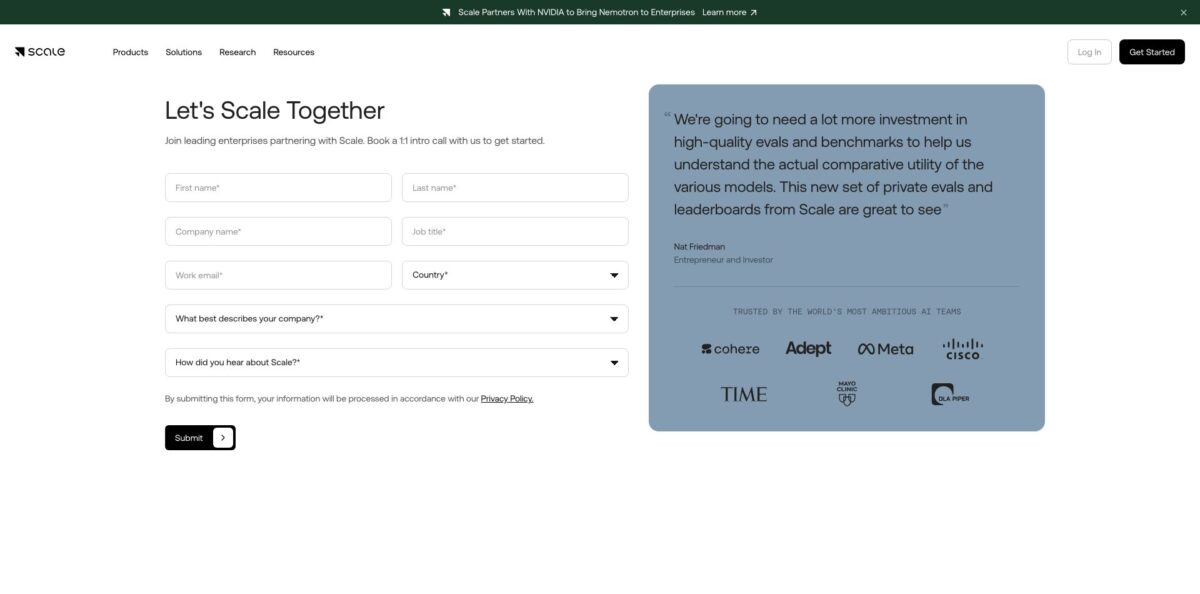
You start on the Get Started page, which is a demo request form rather than a sign-up flow. Describe your data type, volume and goal (LLM post-training, computer vision labeling, evaluation or an enterprise agent project), and Scale’s team matches you with a solutions contact. Once the contract is in place, the account owner becomes the Admin in the Scale dashboard and can invite teammates as Managers, Members or Labelers, all sharing one billing profile.
Your first real scenario is usually a pilot batch. In Scale Pro, a dedicated engagement manager helps you write labeling instructions, define the taxonomy and agree on quality targets. You connect data from AWS S3, Azure Blob Storage or Google Cloud Storage, or push tasks through the REST API with the official Python (scaleapi) or Node packages. A sandbox API key lets you test the integration without touching live data.
The screens you will live in are the Tasks tab and the Quality tab. Tasks shows every item and its status; Quality lets you audit a random sample of completed work by date range or by week, then mark each task Approve, Make Changes or Reject with comments that go back to the annotators. Audit results also land in the callback body, so your pipeline sees customer_review_status and prior responses automatically.
Before you scale a project to production volume, check the auditor reports and per-batch quality stats, then export labeled tasks to your training pipeline. If you are on SGP instead, the equivalent step is running evaluations against your own test set in the SGP dashboard before an agent goes live, with traces and scoring visible for every run.
Who is it for?
Frontier model teams
You need expert-written prompts, preference rankings and red-team data faster than you can hire. Scale’s Generative AI Data Engine supplies curated datasets from vetted experts, linguists and coders, with an Ops Center that shows collection progress in real time.
Autonomous driving and robotics engineers
LiDAR, sensor fusion and full-motion video are hard to label consistently. Scale has handled 3D sensor fusion for years and now runs a Physical AI data engine with teleoperated demonstrations and egocentric collection through its Scale Harness rig.
Enterprise AI and data leaders
Your pilots work in a notebook but stall before production. SGP connects sources like Confluence, SharePoint and S3, runs agents inside your VPC on AWS, Azure or GCP, and adds evaluation and monitoring so you can prove reliability to risk teams.
Public sector and defense programs
You need AI that runs under strict accreditation. Scale lists DoD IL4 Provisional Authorization and FedRAMP High, and its Donovan product deploys agents on unclassified GovCloud and classified networks.
Model evaluation and safety researchers
You want results that have not been overfit on public benchmarks. Scale’s SEAL lab maintains private evaluation sets and public leaderboards, and its evaluation service adds expert human raters and adversarial prompt libraries.
ML platform teams with existing pipelines
You already have training infrastructure and just need reliable labels on tap. The task API, callbacks and cloud storage connectors let you treat human labeling as one more service in your stack.
Scale AI pricing
Scale AI does not publish prices. As of October 2026, the old pricing URL redirects straight to the demo booking page, and every product page (Data Engine, Generative AI Data Engine, SGP, Physical AI, Donovan) ends in a Book a Demo button. Costs are negotiated per engagement and depend on data type, task complexity, expert seniority, volume, turnaround and deployment model. The former self-serve, pay-as-you-go labeling tier (Scale Rapid) no longer has a product page; its URL now redirects to the general Data Engine page.
Custom. Quote-based, with dedicated engagement managers and quality guaranteed via SLAs.
Custom. Priced per project around expert type and dataset size.
Custom. Includes proprietary evaluation sets and expert raters.
Custom. Can be deployed in your own cloud with embedded Scale experts.
Custom. Sold through government contracting channels.
Scale AI key features
The Generative AI Data Engine produces post-training data for large models: prompt-response generation, RLHF preference ranking, span-level feedback, red teaming and evaluation. Work is done by a global network of hand-picked experts, linguists and coders, monitored through an Ops Center for quality control. You get specialist data without building a recruiting and QA operation of your own.
Multimodal annotation covers text (document processing, NLP, transcription), images (including electro-optical and infrared), full-motion video and 3D sensor fusion with LiDAR. Scale Pro adds API-driven task creation, engagement managers and SLA-backed quality. One vendor can handle every data type a perception or language program needs.
Customer-side quality control lives in the dashboard
You audit random samples, approve, fix or reject tasks, and the audit status and comments flow back through API callbacks. Auditor reports show reviews, accepts and rejects per person and per batch.
The Scale GenAI Platform (SGP) runs the agent lifecycle in four stages: connect data, build and execute, evaluate and monitor, learn and improve. Its Agentex and AgentOps layers support long-running async and multi-agent workflows, and it works with models from OpenAI, Google, Meta, Mistral and others. Human feedback from production becomes training signal, so agents improve without full retraining cycles.
Evaluation comes from SEAL, Scale’s research lab, which maintains more than 20 benchmarks and has evaluated more than 100 models, including Humanity’s Last Exam, SWE-Bench Pro and MCP Atlas. For model developers, Scale adds private evaluation sets, thousands of trained red teamers and reporting built for apples-to-apples comparisons. You see weaknesses before your users do.
The Physical AI data engine collects real-world robotics data from data factories, homes and industrial sites, with more than 1,000 hours of demonstration data uploaded daily. Options include bimanual teleoperated robots, the robotless Scale Harness and your own hardware operated by Scale. Datasets go through internal policy fine-tuning tests before listing.
Security and compliance are built for regulated buyers: SOC 2 Type II, ISO/IEC 27001:2022, DoD IL4 Provisional Authorization and FedRAMP High, with reports in the Scale Trust Center. SGP deploys inside your VPC, and IP allowlisting is supported for API access. That shortens procurement reviews in finance, healthcare and government.
Scale AI Pros & Cons
Pros
Few vendors can match Scale’s breadth: one contract can cover LLM post-training data, LiDAR labeling, robotics demonstrations, expert evaluations and production agent infrastructure. The company has been doing this since 2016, claims that 90% of leading generative AI model builders work with it, and backs projects with engagement managers and SLAs rather than leaving you alone with a tool. Its SEAL leaderboards are widely cited at model launches, and the compliance stack (FedRAMP High, IL4, SOC 2, ISO 27001) clears procurement hurdles that stop smaller vendors. Use Scale AI when a bad dataset would cost you more than the contract itself.
Cons
Everything is quote-based and sales-led, so you cannot test the service on a small budget or compare costs quickly. Reviewers describe long onboarding with multiple calls and custom planning, and some report uneven label quality on crowdsourced tasks that forced extra in-house QA. The June 2025 Meta deal, which gave Meta a 49% stake, led OpenAI and reportedly Google to move work elsewhere, so competing labs may worry about neutrality even though Scale says customer data stays confidential. The CEO seat has also changed hands twice since mid-2025. Ask for a paid pilot with explicit quality metrics before signing a long contract.
Use Scale AI if you want…
- Source expert RLHF and preference data for LLM training.
- Label LiDAR, sensor fusion and video at production volume.
- Red-team your model against misuse and safety risks.
- Benchmark models on private, non-overfit evaluation sets.
- Deploy enterprise agents inside your own cloud environment.
- Collect real-world robotics demonstration data at scale.
- Meet FedRAMP High or IL4 requirements for government AI.
- Plug human labeling into your pipeline through an API.
Scale AI alternatives




Scale AI Reviews
Engineers in the self-driving space have long credited Scale with solving LiDAR point cloud labeling when few others could, while noting that simpler labeling work is easy for competitors to copy.
A verified G2 reviewer praised having data pipelines, human feedback loops, model evaluation and fine-tuning in one place, though that profile holds only a single review.
Independent review roundups say buyers value the sheer capacity and data type coverage, but complain about opaque pricing and a slow, sales-heavy onboarding.
Some practitioners on Hacker News call the labeling tooling poor and question how transparent Scale is about the crowdsourced workforce behind its labels.
Smaller teams report that Scale mostly favors large projects and responds more slowly to small clients, pushing them toward self-serve platforms.
FAQ
Does Scale AI have a free plan or public pricing?
No. Scale AI has no public price list, and its pricing URL redirects to a demo request form. All products are quoted per project based on data type, volume, expertise and deployment.
Does Meta own Scale AI?
Meta bought a 49% stake in June 2025 for a reported $14.3 billion, and founder Alexandr Wang moved to Meta while staying on as chairman of Scale’s board. Scale remains an independent company; Francis deSouza became CEO on August 10, 2026, succeeding interim CEO Jason Droege.
Is my data shared with Meta or other customers?
Scale stated at the time of the deal that Meta would not get access to confidential customer information. For contractual detail, review the security documentation and SOC 2 report in the Scale Trust Center before signing.
What data types can Scale AI label?
Scale handles text, documents, transcription, images including infrared, full-motion video, LiDAR and 3D sensor fusion, plus generative AI tasks such as prompt writing, preference ranking and red teaming.
Does Scale AI have an API?
Yes. The Scale API is RESTful with JSON responses, offers a sandbox mode tied to your API key and has official Python and Node libraries. It processes one object per request, so there are no bulk updates.
Can I deploy Scale’s GenAI Platform in my own cloud?
Yes. SGP can be deployed in your own VPC on AWS, Azure or GCP and works with models from OpenAI, Google, Meta, Mistral and others, so you are not locked into one provider.
Which security certifications does Scale AI hold?
Scale lists SOC 2 Type II, ISO/IEC 27001:2022, DoD IL4 Provisional Authorization and FedRAMP High authorization, with current reports available in its Trust Center.
Who actually labels the data?
Scale combines ML-assisted pre-labeling with human review from a global network of annotators and vetted subject matter experts. Generative AI projects rely on hand-picked experts, linguists and coders rather than general crowd workers.
Similar tools
 HexCollaborative analytics workspace that mixes SQL, Python and AI agents in notebooks, then publishes results as data apps and plain-language answers.
 WindwardMaritime AI platform that fuses AIS, satellite and ownership data into vessel risk scores, sanctions screening, alerts and container ETAs.
 Delve AIAI market research platform that builds personas from analytics, CRM and social data, then lets you chat with them or run synthetic