

Scite
Data AnalysisUpdated October 5, 2026
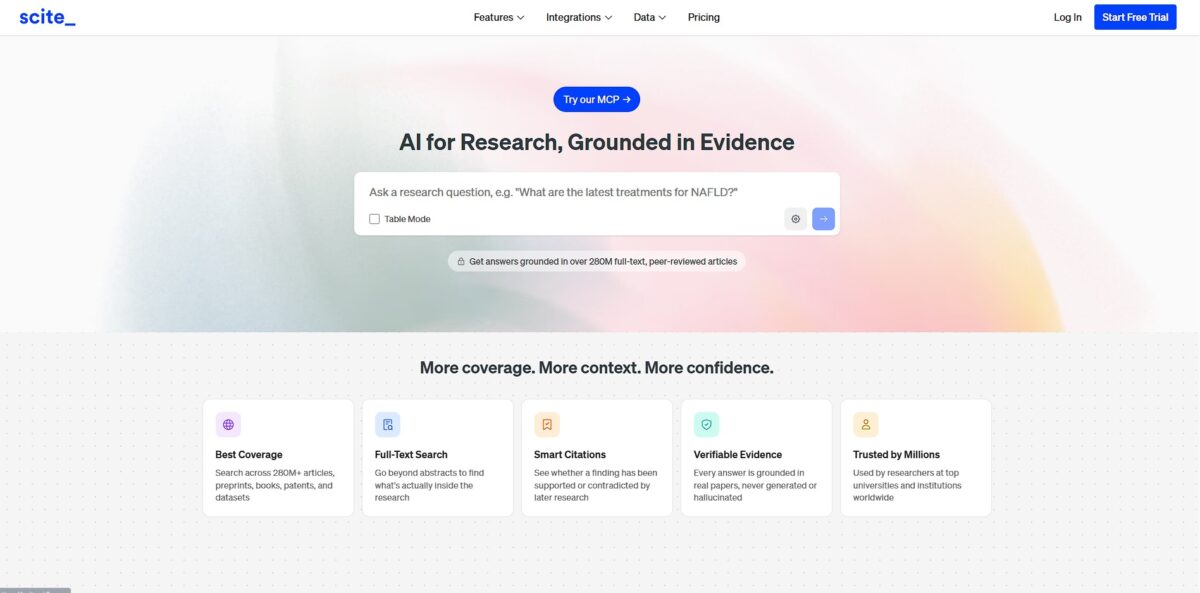
Scite AI is a smart citation tool that evaluates research credibility by revealing if papers support or contrast claims.
We may earn a commission when you sign up through our links. It does not affect our reviews.
What is Scite?
Scite replaces the hollow metric of citation counts with “Smart Citations” that actually explain how papers talk to each other. Instead of just seeing that a study has 500 citations, you get to see the specific snippets of text where other researchers supported, mentioned, or contradicted its findings. This helps you spot retracted work or disputed claims instantly without opening dozens of PDFs. It works great for mapping out a consensus in medical or life sciences, though the machine learning model might miss the nuance in niche methodology-heavy fields. This context matters because it prevents you from building a research project on a foundation of debunked or fragile evidence. Useful takeaway: Always check the “contrasting” tab first to find the most interesting debates in your field.
How to start using Scite?
Start with the browser extension. It’s the least intrusive way to see Smart Citation badges while you browse Google Scholar or publisher sites. You will see immediately if a paper has been supported or contradicted without opening a new tab. This stops you from citing a study that was debunked three years ago.
Create a free account to test the Assistant. Type a specific research question and watch it pull answers with verified citations. It is better than a standard LLM because you can click every footnote to see the original context. This saves hours of manual fact-checking.
Upload your bibliographies or PDFs to a custom dashboard. Scite then monitors these papers for new citations or retractions in real-time. You won’t have to manually check if your primary sources are still considered reliable by the scientific community.
The Reference Check tool is essential before submitting any manuscript. Upload your draft to see if your citations are actually making the claims you think they are. It catches accidental misinterpretations that could tank a peer review. Your professional reputation stays safe from sloppy citations.
Useful takeaway: Install the extension first to see citation sentiment in your current workflow before diving into the full dashboard.
Who is it for?
PhD students deep in the writing phase
You avoid citing a paper that was retracted or debunked while you were busy in the lab. Scite flags contradicting citations directly in your reference manager. That spares you an embarrassing correction during your final defense.
Literature reviewers seeking the signal in the noise
Raw citation counts often hide the fact that people are just arguing with the author. You filter for supporting statements to find the actual consensus. Your reading time goes to papers that moved the field forward instead of chasing ghosts.
Grant applicants building a case for new funding
Show that your proposed study addresses a specific contradiction in current findings. You pinpoint the exact claims where the community currently disagrees. It shows reviewers that your project fills a critical gap rather than being redundant.
Systematic Reviewers handling massive data sets
Screen your initial list by looking at citation snippets instead of downloading every single PDF. In practice, it speeds up the first round of exclusions significantly, cutting weeks off a grueling production timeline.
Evidence-based practitioners verifying a specific claim
Works well for checking if a clinical trial’s result was replicated by others. It is less effective for niche social theories where support is purely interpretive. Either way, you get a reality check on a protocol before you apply it to a real-world scenario.
Scite pricing
Scite follows a freemium model that gates the depth of your literature analysis rather than just the number of papers you find. While casual searching costs nothing, serious research requires moving past the paywall to see if a claim is actually supported or contradicted by others.
View basic citation counts and a limited number of Smart Citation reports each month. This works for quick checks but hits a wall during deep literature reviews.
You get full access to the Assistant, citation alerts, and custom dashboards to track specific research niches. No more guesswork when evaluating if a paper is still considered reliable by the scientific community.
Offers 3 months of premium features for free with a valid institutional recommendation.
Custom pricing for universities and R&D teams requiring IP-based access or API integrations. I noticed that while the individual plan feels steep compared to a standard Netflix sub, the time saved by not manually hunting for contradictory evidence is significant.
Scite key features
Smart Citation Classification
Scite uses deep learning to categorize citations into supporting, contrasting, or mentioning, based on the context of the sentence. This saves you from reading five irrelevant papers just to find one that actually challenges a specific method. You can immediately see if a breakthrough paper has been debunked or refined by newer data.
AI-Powered Assistant with Full-Text Access
Ask the Assistant natural language questions, and it synthesizes answers using a database of 280 million articles, including many behind paywalls. Unlike generic LLMs that might hallucinate sources, this points to specific, existing text snippets. The result is a draft of your literature review section grounded in real evidence.
Custom Research Dashboards
Group papers by topic or author to track their collective impact and receive alerts when new citations appear. It’s a specialized workspace for monitoring the credibility of a specific bibliography. A static list of references becomes a living feed of scientific consensus.
Citation Chaining Visualizations
Map out forward and backward connections between papers to see how an idea evolved over decades. You can spot “co-cites” to find foundational works you might have missed during a keyword search. That helps you escape the bubble of your own search terms and discover adjacent research.
Browser Extension Integration
The plugin overlays citation stats on top of search results in Google Scholar or directly on publisher sites. I noticed it saves a lot of back-and-forth clicking by showing the “Scite Badge” before you even open a PDF. You can skip low-credibility papers without ever leaving your primary search engine.
Patent Search and Analysis
Search over 200 million patent applications to see how academic research is being applied in commercial technology. It bridges the gap between theoretical science and industrial innovation. It’s the fastest way to find prior art or commercial competitors using specific scientific principles.
Scite Pros & Cons
Pros
Scite turns a flat citation count into a multidimensional map. It extracts the actual sentence where a paper is mentioned, so you see if peers are validating the methods or debunking the results. I noticed the “Smart Citations” badge highlights supporting and contrasting claims directly on search results, which keeps you from wasting time on papers that the community has already questioned. This level of transparency stops you from building your research on a shaky foundation. Use the Reference Check tool before you submit a manuscript to ensure you haven’t accidentally cited retracted or heavily disputed work.
Cons
The machine learning model isn’t perfect and sometimes misclassifies a neutral mention as supporting. It relies heavily on full-text access from partner publishers, meaning its coverage of niche journals or older, un-digitized archives can feel spotty. This trade-off means you still need a human eye to verify the context of a “contrasting” label, as a disagreement might be about a minor variable rather than the entire thesis. That matters because blind trust in an AI label can lead to misrepresenting a peer’s stance. Stick to using the summaries as a guide for deeper reading rather than a final verdict.
Use Scite if you want…
- Verify if research claims are supported or contradicted.
- See how specific papers are being cited in context.
- Avoid accidental reliance on retracted or disputed studies.
- Visualize deep citation networks for any research topic.
- Automate literature reviews with AI-powered citation auditing.
- Identify influential experts through smart citation metrics.
- Ensure your thesis is backed by verifiable evidence.
Scite alternatives


Scite Reviews
The smart citation metric is a game changer; it’s the only tool that actually tells me if a paper has been disputed or supported by others.
Assistant is like a ChatGPT with actual footnotes, though the $20 monthly price point is a bit steep for a student budget.
It slashes literature review time by surfacing the consensus immediately, but the interface takes a few days to really master.
Great for STEM research, but I found some gaps when digging into niche humanities topics; still, the browser extension is a must-have.
FAQ
What are Smart Citations?
Smart Citations are a feature that allows users to see the context of a citation and whether the citing paper provides supporting or contrasting evidence for the cited claim using deep learning models.
How does Scite ensure the accuracy of citation classifications?
Scite uses a deep learning model to automatically classify citations as supporting, mentioning, or contrasting based on the surrounding text, though users are encouraged to verify classifications by reading the provided snippets.
What is the Reference Check tool?
Reference Check allows users to upload a manuscript to see how their references have been cited by others and whether any of those references have been retracted or received editorial notices.
Can Scite be used with reference managers?
Yes, Scite offers a Zotero plugin that allows users to see Smart Citation data directly within their research library and while writing.
Does Scite provide access to full-text articles?
Scite partners with dozens of major publishers to index and analyze full-text articles, allowing it to extract and display citation statements that are often behind paywalls.
How can I stay updated on new research using Scite?
Users can set up citation alerts and topic notifications to receive emails when a new publication on a topic is released or when a specific paper receives a new citation.
Similar tools
 HexCollaborative analytics workspace that mixes SQL, Python and AI agents in notebooks, then publishes results as data apps and plain-language answers.
 WindwardMaritime AI platform that fuses AIS, satellite and ownership data into vessel risk scores, sanctions screening, alerts and container ETAs.
 Delve AIAI market research platform that builds personas from analytics, CRM and social data, then lets you chat with them or run synthetic