

Scrapingdog
Data AnalysisUpdated November 17, 2026
Web scraping API that handles proxies, headless browsers and CAPTCHAs, returning HTML, LLM-ready Markdown or parsed JSON from Google, Amazon and more.
We may earn a commission when you sign up through our links. It does not affect our reviews.
What is Scrapingdog?
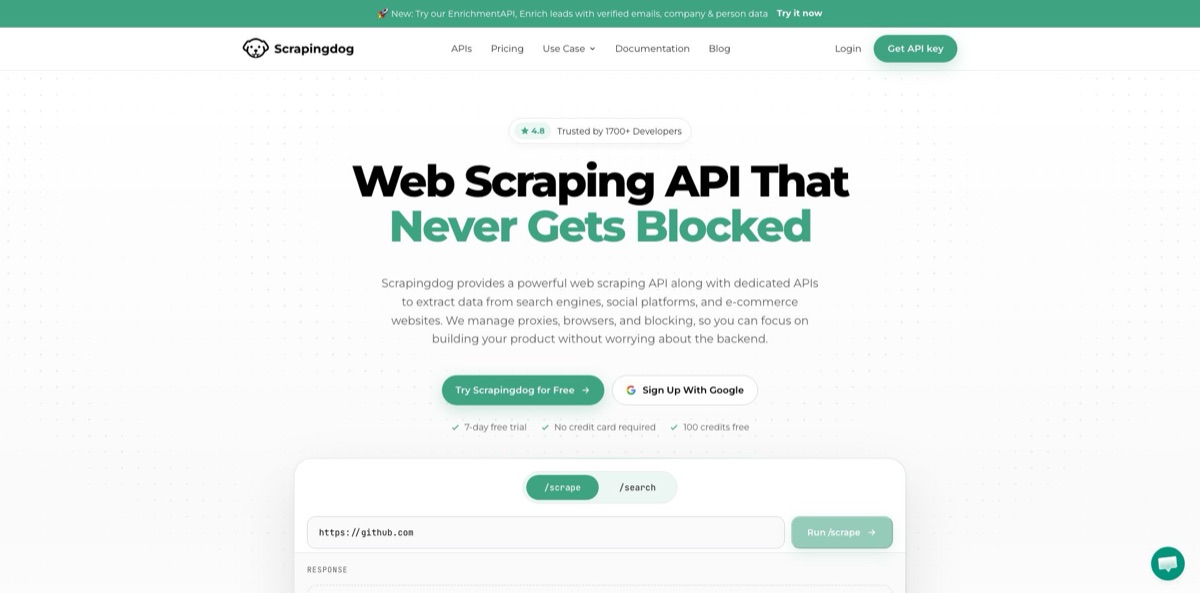
Scrapingdog is a web scraping API from OpenData Labs that fetches pages for you through rotating proxies and headless Chrome, solves CAPTCHAs, and hands back raw HTML, clean Markdown or parsed JSON. Next to the general scrape endpoint it sells dedicated scrapers for Google Search, Maps, AI Mode, Amazon, Walmart, YouTube, public profiles and dozens of other targets, all paid from one credit pool. Most of the extraction is rule-based rather than model-driven. The AI-related pieces are Markdown output for LLM and RAG pipelines, Google AI Overview and AI Mode trackers, a ChatGPT scraper, a lightly documented AI Parser add-on and an MCP server for agents. It removes the proxy and browser plumbing you would otherwise maintain yourself. The weak spots are uneven success on heavily protected sites and a support record that splits reviewers. Pick it for cheap Google and Amazon data at volume.
How to start using Scrapingdog?
Create an account at api.scrapingdog.com with an email address or a Google login. Every new account gets 100 free credits, one concurrent request and access to all APIs, with no payment card. Copy your API key from the dashboard and store it in an environment variable rather than in your code, which is also what the official SDK guide recommends. The free tier comes with community support only, so keep your first tests simple and well logged.
Your first real request goes to the /scrape endpoint with two parameters: api_key and url. Watch the rendering setting from the start. The JavaScript rendering docs say dynamic rendering is on by default and costs 5 credits per request, while dynamic=false drops a static page to 1 credit. If you plan to pass the page to a language model, add markdown=true to get boilerplate-free Markdown instead of HTML. Requests time out after 60 seconds, so wrap calls in a retry loop.
Then tune the request for harder targets. Set premium=true to route through residential proxies (10 credits, or 25 with rendering), add country with an ISO code for local results (the pricing table lists geo requests at 10 credits), and pass session_number to keep the same IP across calls; sessions expire 60 seconds after last use. For Cloudflare-style protection the docs point to stealth_mode=true at 10 credits. If your target is Google, Amazon, Maps or YouTube, call the dedicated endpoint instead, because it returns parsed JSON and you skip writing selectors. Python users can run pip install scrapingdog, Node users npm install scrapingdog-sdk.
Before you scale, check what each test really cost. The Account API at api.scrapingdog.com/account returns your remaining credits and current concurrent requests, so you can compare spend against the volume you expect. Going past your plan’s concurrency returns a 429 error. For long jobs, the webhook endpoint posts results to your own URL instead of making you poll. Spot-check the returned data against the live page, since an empty but successful response still costs credits.
Run your ten hardest URLs on the free credits with dynamic=false first, then turn on rendering or premium proxies only where pages come back incomplete.
Who is it for?
SEO tool builders
Rank trackers and audit tools need fresh SERP data every day, and running your own Google scraper means fighting blocks constantly. The Google SERP API starts at 5 credits per call on its Light version and returns organic results, ads, featured snippets and People Also Ask data as JSON. You can spend your time on the product instead of the scraper.
E-commerce and pricing analysts
Competitor price tracking breaks whenever a marketplace changes its layout or blocks your IP. Amazon product and search calls cost 1 credit each, and Walmart, eBay and Flipkart endpoints cost 5. Those numbers make daily checks on thousands of SKUs affordable on mid-tier plans.
AI engineers building RAG or agents
Your model needs current web content, but raw HTML wastes tokens and context. The markdown=true flag returns clean Markdown, and the MCP server lets Claude Desktop, Claude Code or Cursor call Scrapingdog tools directly. You feed fresh pages to your agent without writing a crawler.
Marketing teams tracking AI search
Google now answers many queries before anyone clicks a link. The AI Overview and AI Mode APIs capture those answers along with the cited sources, so you can see whether your domain is mentioned. Pair them with the classic SERP API to compare AI visibility and rankings week by week.
Lead generation and local SEO agencies
Building prospect lists by hand from Google Maps is slow and error-prone. The Maps API returns places, ratings, hours and contact details as JSON for 5 credits a request. You can pull a city’s worth of listings into a spreadsheet in one job.
No-code operators
Not everyone wants to touch an API client. A verified n8n node, a Google Sheets add-on, and the Zapier and Make connections let you trigger scrapes from tools you already use. Expect some setup, but no backend code.
Scrapingdog pricing
Scrapingdog sells monthly credit bundles, and every plan, including the free one, opens all APIs. What changes between tiers is the credit count, concurrency and support level. Each endpoint has its own price in credits: 1 for a plain request through rotating proxies, 5 with JavaScript rendering, 10 with premium proxies, 25 for rendering plus premium proxies, 5 for Google SERP Light, 10 for Google AI Mode, 1 for Amazon product data and 50 for the Profile Scraper. Failed, blocked and timed-out requests are credited back. From the Standard plan upward, unused credits roll over to the next billing cycle. Annual billing charges ten months for twelve. Upgrades and downgrades are not prorated: you pay the full price of the new plan, credits roll over on an upgrade and reset on a downgrade. When credits run out, requests return an over-limit response until the next billing date.
100 credits, 1 concurrent request, all APIs, community support, no credit card required.
200,000 credits, 5 concurrent requests, geotargeting and email support. Unused credits do not roll over on this tier.
1,000,000 credits, 50 concurrent requests and priority email support, with credit rollover.
3,000,000 credits, 100 concurrent requests and team support. The pricing page marks it as popular and works it out to $0.067 per 1,000 credits.
6,000,000 credits and 150 concurrent requests.
9,000,000 credits and 200 concurrent requests.
Twenty-two more plans run from Business Plus (19 million credits, 250 concurrency) to Nova Pro (1.1 billion credits, 2,200 concurrency). Dedicated support starts at Enterprise Plus ($5,000/month) and a dedicated account manager at Ultra Starter ($12,000/month).
Custom. Custom plans with dedicated infrastructure and a named account manager for volumes beyond the listed tiers.
Scrapingdog key features
The general Web Scraping API takes a URL and returns the page while Scrapingdog handles the hard parts
The company says it runs more than 40 million rotating proxies, renders JavaScript in headless Chrome, solves CAPTCHAs and supports custom headers, POST requests, sticky sessions and country targeting. You trade a proxy contract and a browser farm for one HTTP call.
More than 80 dedicated APIs sit under one key, according to the homepage
They include Google Search, Maps, News, Scholar, Trends, Shopping and Lens, plus Amazon, Walmart, eBay, Flipkart, YouTube, X, TikTok, Zillow, Booking.com, Airbnb and Indeed. Each returns parsed JSON with named fields such as title, price, ASIN or rating. You skip selector maintenance whenever the target changes its layout.
LLM-ready output converts pages into Markdown or JSON for prompts, embeddings and RAG indexes
The LLM-ready data page also advertises domain crawling, PDF and DOCX parsing and browser actions such as click, type and wait before extraction. The credit table lists an AI Parser add-on at 10 extra credits per request, but public documentation on how it works is thin. Test it on your own pages before you build a pipeline around it.
AI search monitoring is where Scrapingdog leans hardest into AI
The Google AI Overview and AI Mode APIs capture Google’s generated answers with their cited sources, and AI Mode costs 10 credits per request. A separate ChatGPT Scraper API sends a prompt and returns the full conversation as structured JSON, also at 10 credits. Brand and SEO teams can track whether AI answers mention them alongside classic rankings.
Developer and agent integrations reduce glue code
There are official Python and Node.js SDKs with typed responses, and an MIT-licensed MCP server published on npm as scrapingdog-mcp for Claude Desktop, Claude Code and Cursor. A verified n8n node scrapes URLs and runs Google, Bing and Amazon searches, and a Google Sheets add-on pulls results straight into a spreadsheet.
Operational tools help you keep spend and uptime under control
The Account API reports remaining credits and concurrency, the webhook endpoint pushes results to your server, and a Screenshot API captures pages for 5 credits. The SLA targets 99% monthly uptime and compensates outages with service credits rather than cash.
Scrapingdog Pros & Cons
Pros
Scrapingdog makes high-volume scraping of popular targets cheap and simple. One key opens every endpoint, Amazon calls cost a single credit, Google searches cost five, and parsed JSON spares you from writing and fixing selectors. Failed, blocked and timed-out requests are refunded to your balance, and credits roll over from the Standard plan up. Concurrency is generous for the money, with 50 parallel requests at $90 a month. On Trustpilot the service holds a 4.5 score from 589 reviews, and many reviewers single out fast, founder-level chat support and low prices. SDKs, an MCP server and an n8n node make it easy to wire in. Route Google and Amazon jobs through the dedicated endpoints to get the best value.
Cons
Results on heavily protected sites are uneven. In Scrapeway’s October 2026 benchmark Scrapingdog reached a 59% overall success rate across 11 targets, below the 72.3% average, with 99% on Amazon and X but 36% on Etsy and 16% on Booking.com. Recent Trustpilot complaints describe credits spent on empty Google results, a YouTube endpoint returning errors and refund requests that went unanswered. The terms rule out refunds once services are rendered, and the SLA pays outages in credits, not cash. JavaScript rendering is on by default at 5 credits, and the AI Parser is barely documented. Test your exact targets on the free credits and cancel from the dashboard before the next billing date.
Use Scrapingdog if you want…
- Pull Google search results as structured JSON cheaply.
- Monitor Amazon and Walmart prices without maintaining scrapers.
- Track which domains Google AI Overviews cite.
- Feed clean Markdown from live pages into RAG pipelines.
- Give Claude or Cursor live web access via MCP.
- Build local lead lists from Google Maps listings.
- Run scrapes from n8n or Google Sheets without code.
- Scale concurrent requests without managing your own proxies.
Scrapingdog alternatives

Scrapingdog Reviews
Long-time Trustpilot reviewers say early bugs were fixed over the years and praise low prices and a founder who sorts out problems directly in chat.
Users pulling Google Maps and Places data at scale describe the results as reliable and the chat support as quick, and Amazon users say a single request now returns product data they struggled to collect before.
A reviewer who liked the competitive pricing still gave two stars over unstable service and inaccurate data, saying support blamed Google and kept postponing bug fixes.
Recent one-star reviews report credits charged for Google searches that returned empty results and a YouTube transcript endpoint returning 404 errors, with refund requests left unanswered.
Opinions on the LinkedIn endpoints are split: one user says the jobs scraper saved them from building their own, while another calls the LinkedIn scraping API unreliable and costly on failed calls, a claim the company disputes.
FAQ
Is there a free plan?
Yes. Every account gets 100 free credits, one concurrent request and access to all APIs without a credit card. That is enough for about 20 Google searches or 100 plain page fetches, so use it to test your hardest targets.
How do Scrapingdog credits work?
Credits are shared across all APIs, and each endpoint has its own cost: 1 credit for a basic request or an Amazon product, 5 for JavaScript rendering or Google SERP Light, 10 for premium proxies or Google AI Mode, and 50 for the Profile Scraper. The full list sits on the pricing page and in the docs.
Am I charged for failed requests?
No. Scrapingdog refunds failed, blocked and timed-out requests to your balance automatically. A request that succeeds but returns little useful data still counts, so validate responses in your code.
Does Scrapingdog use AI?
Only in parts. Core scraping relies on proxies, headless browsers and fixed parsers, while the AI-related features are LLM-ready Markdown output, Google AI Overview and AI Mode tracking, a ChatGPT scraper, an AI Parser add-on and an MCP server for AI agents.
Can I use Scrapingdog with Claude, Cursor or n8n?
Yes. The open-source scrapingdog-mcp server connects Scrapingdog to Claude Desktop, Claude Code, Cursor and other MCP clients, and n8n lists a verified Scrapingdog node. Official Python and Node.js SDKs cover custom code.
Can I cancel or get a refund?
You can cancel anytime from the dashboard, but the terms make cancelling before the next billing cycle your responsibility. They also state there are no refunds once services have been rendered, and charges must be disputed in writing within 15 days.
Is Scrapingdog GDPR compliant?
Scrapingdog publishes a GDPR notice, a data processing agreement and a list of subprocessors. Its notice says API requests are logged for monitoring and service improvement, so avoid sending personal data in URLs.
Are Scrapingdog and SerpDog the same company?
Yes. The same founding team built SerpDog, a Google-focused scraping API, and integrated it with Scrapingdog in August 2024, so both products’ APIs now come in one package.
Similar tools
 InnovatianaFrench managed data labeling service with in-house annotators for computer vision, NLP, RLHF and evaluation datasets, plus a self-serve Dataset Finder.
 Y2DocWeb tool that turns public YouTube videos into structured notes, timestamped transcripts and PDF, Markdown or Docx files, plus MP3 downloads.
 InfinityCall tracking and AI call analytics platform that ties phone calls to campaigns and keywords and sends call outcomes into Google, Meta