

Tinybird
Data AnalysisUpdated November 17, 2026
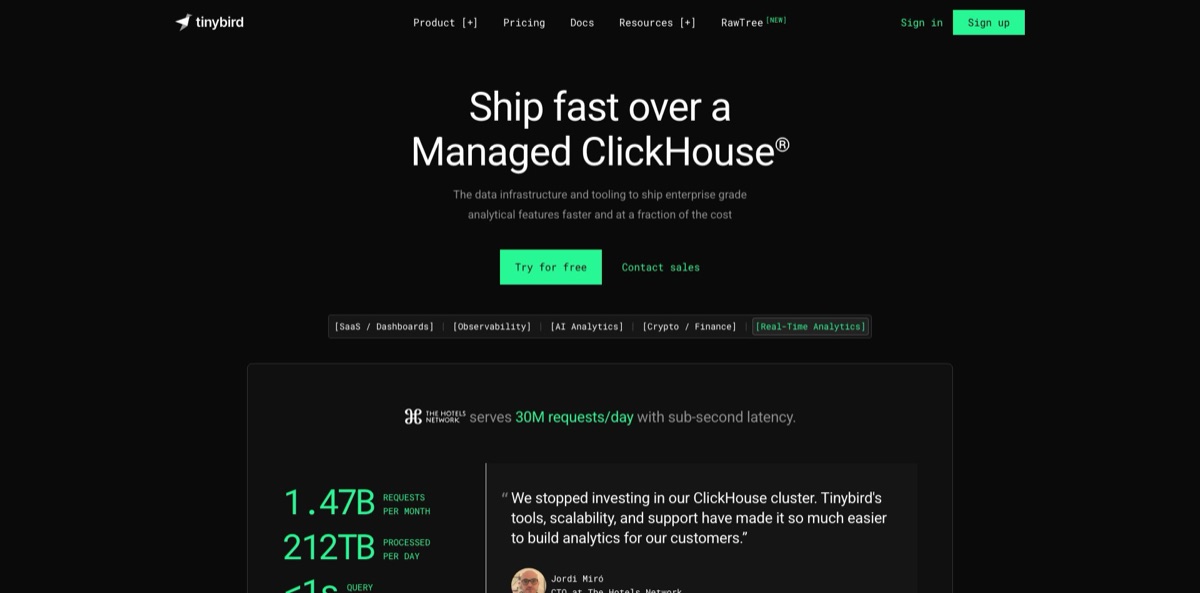
Managed ClickHouse platform that turns SQL into real-time API endpoints, with local dev tooling, an MCP server for agents and an AI chat for data.
We may earn a commission when you sign up through our links. It does not affect our reviews.
What is Tinybird?
Tinybird is a managed ClickHouse® platform for developers who need to ship analytical features, such as usage dashboards, metering or log search, inside their own product. You stream events in over HTTP, Kafka or object storage, write plain ClickHouse SQL in versioned files, and publish each query as a low-latency REST endpoint without running a cluster or building an API layer yourself. The AI layer is real but secondary: an in-app chat called Explorations that turns questions into SQL, a remote MCP server that lets agents query your workspace, and agent skills that teach Cursor or Claude Code how to build Tinybird projects. The weak spot is that this is still infrastructure. You need SQL, a CLI and some feel for ClickHouse data modeling, and business users will not get a point-and-click BI tool. Pick it when your engineers want real-time analytics in production without hiring a database operations team.
How to start using Tinybird?
Create an account at cloud.tinybird.co; the Free plan needs no credit card. Install the Tinybird CLI, which runs as the
tbcommand, and checkwhich tbfirst if you ever used the older Classic CLI, since both share the same name. Make a new folder, rungit initand thentb init. That scaffolds the project structure and also drops in Agent Skills files, so a coding agent can work on the project from the first commit.Next, define one real use case instead of exploring blindly. The official quickstart has you create a
page_views.datasourcefile for the schema and atop_pages.pipefile holding the SQL that ranks pages by views. If your app is written in TypeScript or Python, the SDKs let you declare the same data sources and endpoints in code with type checking. Prefer to delegate? Runnpx skills add tinybirdco/tinybird-agent-skillsand describe the endpoint you want to your coding agent.Then build and feed it data.
tb local startruns the full stack in Docker on your machine, including ClickHouse, the Events API and the Kafka consumer, whiletb buildvalidates every file and reports errors with line numbers. Copy the admin token withtb token copy “admin”, POST a few sample events to the Events API with curl, and call your endpoint at/v0/pipes/top_pages.json. In Tinybird Cloud, the Explorations chat lets you ask questions about the same data in plain English and shows the SQL it wrote.When the endpoint returns what you expect, run
tb deploy. Deployments do a dry run against production first, and if one fails, the previous version stays live. Git branches carry over to Tinybird branches, so schema changes can be tested on real data before merging, and GitHub Actions or GitLab CI templates automate the same checks on every pull request. Open the workspace withtb --cloud opento watch requests and latency.
Who is it for?
SaaS Product Engineers
Customers want in-app dashboards, and analytical queries against your Postgres primary keep slowing the whole app down. Tinybird moves those events into ClickHouse and exposes each chart as an API endpoint your frontend calls directly. You ship the feature without standing up Kafka, a cluster and a custom API service.
Startup CTOs Without a Data Team
You have a few engineers and no one who wants to be on call for a database. Shared infrastructure, two replicas and automatic version upgrades remove most of the operations work. The trade-off is that someone still has to learn ClickHouse table design to keep queries fast.
Usage-Billing and Fintech Teams
Metering, cost tracking and fraud monitoring all need fresh numbers, not yesterday’s batch. Events land through the Events API or Kafka and are queryable right away, and materialized views keep aggregates current. Customers see accurate usage while it still matters.
Observability and Platform Engineers
Logs and telemetry pile up fast, and a general-purpose warehouse gets slow and expensive at that volume. Tinybird ships templates for log analytics and web analytics, plus connectors for Kafka, S3 and GCS. You get a queryable log store without operating it.
AI Product Builders
If you track LLM calls, token costs or agent runs, you need an event store that handles high write volume. Tinybird publishes an open-source LLM performance tracker template, and its MCP server lets your own agents answer questions over that data with scoped access.
Teams Building With Coding Agents
Agent Skills teach Cursor, Claude Code, Codex, Gemini CLI and similar tools the Tinybird file formats, SQL conventions and deployment flow. The agent writes datafiles that tb build validates, so mistakes surface before production rather than after.
Tinybird pricing
Billing follows compute rather than seats or data scanned. You choose a plan size measured in vCPUs, get a storage allowance and a monthly pool of LLM credits, and pay usage-based extras on top. Self-service plans can be resized at any time, while SaaS and Enterprise go through sales. All prices below are in USD from the official pricing page.
You get shared infrastructure with 0.25 vCPUs, 1 thread per request, 1,000 requests per day, 10 GB of storage and community support. Explorations comes with a limited monthly credit allotment and is restricted once that is used up.
The plan card shows $49/month for the 0.5 vCPU size, and sizes scale from 0.25 to 8 vCPUs with 1 to 8 threads and 0.5 to 4 GB of memory per request. It includes 25 GB of storage, 2 replicas, email support, $100 of LLM credits per billing cycle, 3 data branches and up to 5 Kafka topics. Billing is monthly with no commitment.
Custom. Shared infrastructure up to 32 vCPUs, 4 to 16 threads per request, storage starting at 250 GB, unlimited Kafka topics, 6 data branches and $200 of LLM credits. It runs on a 12-month commitment with credit-based billing, and support comes as a Standard or Premier plan.
Custom. A dedicated ClickHouse cluster with unlimited vCPUs, bottomless storage, horizontal scaling, cluster management, private regions on demand, SAML SSO and 15 data branches. The SOC 2 report is shared with Enterprise customers.
Extras apply across paid plans: vCPU overages cost $0.0002 per second of extra compute instead of throttling queries, storage beyond the allowance is $0.058/GB, and egress is $0.01/GB within the same cloud or $0.10/GB across clouds. Queries per day are unlimited on paid plans.
Tinybird key features
SQL to API endpoints
You write a query in a .pipe file, add parameters, and Tinybird publishes it as a REST endpoint that returns JSON or CSV. Tokens and JWTs control which endpoints a caller can hit and can filter rows per tenant. That replaces the API service you would otherwise build and scale in front of the database.
Managed ingestion
The Events API accepts JSON over HTTP (up to 100 requests per second and 10 MB per request per table on Developer), and connectors pull from Kafka, S3, GCS, DynamoDB and remote Parquet, CSV or NDJSON files. Table functions read from MySQL, Postgres and Iceberg, and sinks push results back to Kafka, S3 or GCS. Most pipelines need no separate ETL tool.
Local development and branches
tb local start runs the whole stack in Docker, and watch mode rebuilds on every save. Branches create isolated environments with production data for testing schema changes, then disappear on merge. You catch broken queries before your customers do.
Schema migrations and CI/CD
Change a .datasource file and deploy: backward-compatible changes apply automatically, and breaking ones take a FORWARD_QUERY that defines the migration. GitHub Actions and GitLab CI templates run build, tests and a dry run on every pull request. Schema changes stop being a weekend project.
Explorations AI chat
Inside Tinybird Cloud you ask a question in plain English, and the assistant answers with the SQL it generated so you can check the logic. Workspace rules steer how it responds, and the @ menu points it at specific data sources or pipes. Tinybird notes that a limited sample of your data is processed to produce answers, and each user’s chats stay private and cannot be exported.
Remote MCP server
Agents connect to mcp.tinybird.co with a token and get tools such as call_endpoint, execute_query, text_to_sql, list_endpoints and list_datasources. Which tools appear depends on the token’s scopes, and setup guides cover Claude Code, Cursor, Codex CLI and Amp. Agent queries are tagged, so you can track them in the service data sources.
Agent Skills for coding agents
One command installs skills that teach agents the project layout, SQL optimization and testing patterns. The docs list Cursor, Claude Code, Amp, Codex, Gemini CLI, Windsurf, Cline, Aider, OpenCode and GitHub Copilot as compatible.
tb build and branch tests gate it.Tinybird Pros & Cons
Pros
Tinybird removes the three jobs that usually stall real-time analytics: running ClickHouse, building ingestion and maintaining an API layer. Reviewers on G2 and Product Hunt keep returning to the same strengths, namely how fast a small team gets from raw events to a working endpoint and how well it copes with heavy event ingestion. The developer workflow is unusually complete for a database product, with local Docker builds, branches on real data, CI templates and typed SDKs. Because the platform runs standard ClickHouse SQL, your schemas and queries move with you if you later switch to self-managed ClickHouse. Start with one customer-facing endpoint and measure latency before migrating everything.
Cons
You still need ClickHouse knowledge once data grows. Several G2 reviewers mention a learning curve, an interface that feels unintuitive to newcomers and cases where a skilled data engineer had to fix materialized view problems. Pricing is tied to vCPU sizes, so bursty workloads can add overage charges that are easy to miss without monitoring. Developers who need on-prem deployment or open-source components have ruled it out on Hacker News. The AI features help explore data, but they do not replace a BI tool for non-technical staff. Budget time for learning ClickHouse sorting keys and materialized views before you commit.
Use Tinybird if you want…
- Publish SQL queries as low-latency REST API endpoints.
- Build customer-facing dashboards on top of live event data.
- Run managed ClickHouse without operating clusters yourself.
- Stream events over HTTP or Kafka into queryable tables.
- Let AI agents query your workspace through an MCP server.
- Ask data questions in plain English and inspect the SQL.
- Test schema changes on production data in isolated branches.
- Track LLM usage, token costs and agent runs live.
Tinybird alternatives
Tinybird Reviews
An engineer who runs production fraud monitoring and customer-facing analytics on Tinybird says it beat Apache Druid on their workloads and that the team was easy to work with, although they first tried it only to rule ClickHouse out.
G2 reviewers like the SQL-first approach that lets small teams build analytics without complex aggregation pipelines, but some find the interface unintuitive for beginners and need workarounds for missing customization.
One G2 reviewer points out that a skilled data engineer is still needed when ClickHouse internals and materialized views misbehave, even though the platform itself is managed.
Product Hunt reviews, many of them from startup founders, praise how well it handles large event ingestion for time-series and usage analytics and how quickly data becomes an API, with no drawbacks listed.
On Hacker News, one indie developer found building analytics on Tinybird cheaper than paying a hosting provider, while a game developer who needed on-prem infrastructure chose ClickHouse Cloud instead.
FAQ
Is there a free plan?
Yes. The Free plan costs nothing, needs no credit card and has no time limit, with 0.25 vCPUs, 10 GB of storage and 1,000 requests per day.
Can I query Tinybird data in plain English?
Yes, through Explorations in Tinybird Cloud, which turns questions into SQL and shows the query next to the answer. The MCP server also exposes a text_to_sql tool for agents.
Does Tinybird work with Claude, Cursor and other AI agents?
Yes. Agents can connect to the remote MCP server at mcp.tinybird.co with a scoped token, and Agent Skills help coding agents such as Claude Code, Cursor and Codex build Tinybird projects.
Is my data secure?
Tinybird states it is SOC 2 Type II, HIPAA and GDPR compliant, and Enterprise customers get SAML SSO and access to the SOC 2 report. Explorations processes a limited sample of your data to generate answers.
Do I need to know ClickHouse to use Tinybird?
Basic SQL is enough to get started, since the platform handles infrastructure and migrations. For large datasets, knowing ClickHouse table design and materialized views makes a real difference to speed and cost.
What happens if my queries exceed my plan size?
On Developer and SaaS plans, queries can burst above your vCPU allocation and the extra compute is billed at $0.0002 per second. Requests beyond the burst capacity get HTTP 429 errors.
Will I be locked in?
Your data sources and pipes are ClickHouse schemas and standard ClickHouse SQL, so Tinybird says they transfer directly to self-managed ClickHouse. Endpoints, tokens and the CLI workflow are Tinybird-specific and would need replacing.
Which clouds and regions does Tinybird run in?
Tinybird runs on AWS and Google Cloud, with regions in the US, Europe and Asia-Pacific, and Enterprise customers can request private regions.
Similar tools
 InnovatianaFrench managed data labeling service with in-house annotators for computer vision, NLP, RLHF and evaluation datasets, plus a self-serve Dataset Finder.
 Y2DocWeb tool that turns public YouTube videos into structured notes, timestamped transcripts and PDF, Markdown or Docx files, plus MP3 downloads.
 InfinityCall tracking and AI call analytics platform that ties phone calls to campaigns and keywords and sends call outcomes into Google, Meta