

Typeface
Content CreationUpdated November 20, 2026
Enterprise marketing AI platform that turns brand guidelines into AI agents for on-brand emails, ads, web pages and campaign variants at scale.
We may earn a commission when you sign up through our links. It does not affect our reviews.
What is Typeface?
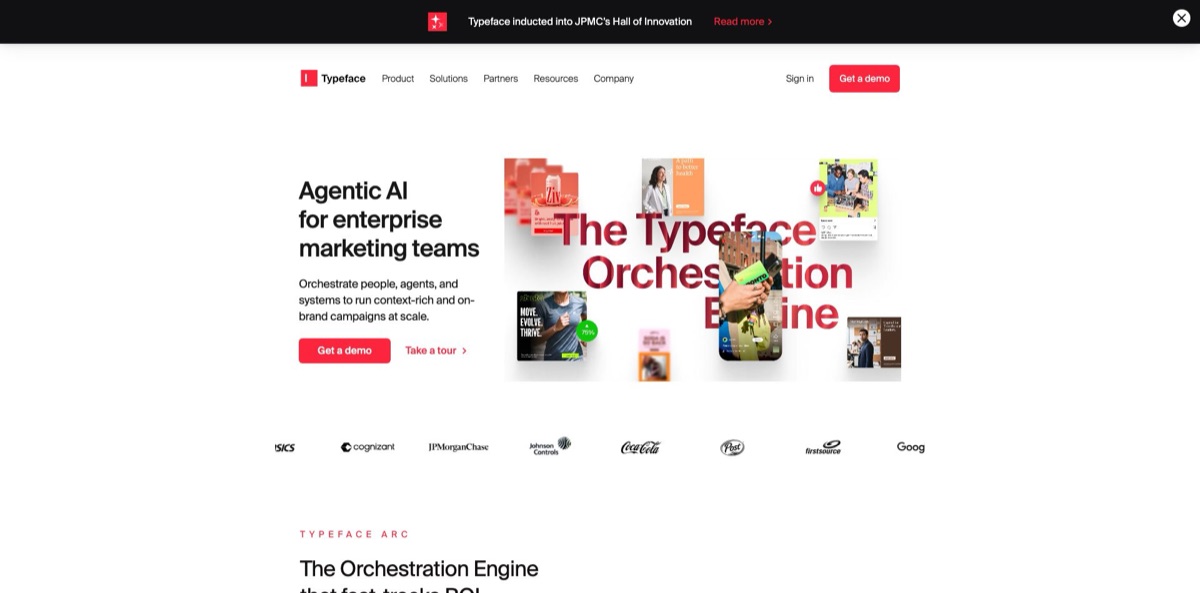
Typeface is an enterprise marketing platform that turns a company’s brand guidelines, approved assets, audience data and campaign results into structured knowledge that AI agents use to produce emails, ads, web pages, images and short videos. The current product, the Typeface Orchestration Engine, has three layers: Arc Graph stores and enforces the brand, Arc Fabric runs agents and multi-step workflows, and Arc Loop feeds performance data back into the next brief. It targets the familiar problem of generic AI copy that brand and legal teams end up rewriting, and it plugs into Salesforce, Microsoft, Google, Figma and MCP-compatible assistants. The weak spots are access and cost: there is no public price list or self-serve plan, and independent user reviews are scarce. Typeface is still an independent company backed by Microsoft’s venture fund, not a Microsoft product. Pick it if you run multi-brand, multi-market campaigns at enterprise scale.
How to start using Typeface?
Access starts with sales rather than a sign-up form. The website offers a Get a demo request and an interactive product tour that walks through brand knowledge, on-brand creation, agent orchestration and performance learning, while the Sign in button only serves existing accounts. Companies that buy through Microsoft can also request the Essentials, Teams or Enterprise plan on Microsoft Marketplace, which triggers a private offer from a Typeface representative. Typeface pairs new customers with marketing engineers who map workflows, set guardrails and launch the first agents with you, so plan for a rollout project rather than an afternoon trial.
Your first real task is teaching the platform your brand in Arc Graph, which replaced the older Brand Hub. Upload brand books, PDFs, DAM assets and work samples, and Typeface extracts voice, visual guidelines and rules into a governed Brand Kit. Typeface Academy also describes a Detect Voice option that learns tone from your homepage URL or a content sample, plus brand colors, a default language, words to avoid or replace, and a custom image style trained on 10 to 15 images that share one visual theme. Add saved audience profiles built from age, interests and spending behavior so each output can be tailored to a segment.
Next, run one concrete campaign. Open a project, pick an agent such as Email Agent, Ad Agent or Web Agent, or start from a template, and describe the outcome you need. Feeds let you generate several documents in one pass by selecting multiple audiences and languages at once, which is where the personalization and localization value shows up. To polish a draft, highlight a paragraph and use the in-line AI writing assistant, or click an image and choose Edit image for the AI editing tools. Creative teams can import email, web and ad layouts from Figma and fill them with brand-safe content.
Before anything goes live, the brand graph checks each output against your rules, flags what falls outside them and suggests a correction. Publish to Salesforce Marketing Cloud, Marketo, Klaviyo or Braze, or push updated assets back into Figma with the export plugin. Once campaigns run, connect Google Ads, HubSpot or BigQuery to Arc Loop, or upload a CSV of results, and it turns the numbers into ranked, explainable recommendations for the next brief. A human still approves every variant before it publishes.
Who is it for?
Enterprise marketing leaders
You run campaigns across many brands, regions and channels, and production capacity, not ideas, is the bottleneck. Typeface puts brand rules, audiences and agents in one governed system, so regional teams can create variants without drifting from the global brand. Showcase customers named on its site include JPMorganChase, Chime and Post.
Brand and creative teams
You spend too much time resizing approved ads and policing off-brand assets. The Figma integration, Adaptive Templates and the Visual Brand Evaluator let you approve a few seed layouts and have Typeface generate the remaining sizes and formats, while checking images against your visual system. Your designers stay in Figma, Photoshop and Illustrator instead of learning a new canvas.
Lifecycle and email marketers
Building personalized journeys in Salesforce Marketing Cloud, Marketo, Klaviyo or Braze means writing dozens of near-identical variants. Email Agent drafts them from structured audience data and publishes directly to those platforms, and email modules can move between Typeface and Salesforce without rebuilding. Note that personalization runs on audience attributes, not live behavioral triggers.
Retail and ecommerce content teams
Product catalogs need descriptions, lifestyle images and retailer-ready copy for every SKU and channel. Typeface converts product data into channel content and can turn one product shot into ecommerce visuals, resize it for several placements and animate it. You keep catalogs consistent without a copywriter per marketplace.
Marketing ops and IT leads
Your job is to let marketers use AI without leaking data or breaking compliance. Typeface offers SSO, role-based access, MFA, tenant isolation, SOC 2 Type II, ISO 27001 and ISO/IEC 42001 certification, plus MCP, APIs, webhooks and 30+ connectors. You get one governed layer instead of a dozen unsanctioned AI subscriptions.
Small businesses and solo creators
You will struggle here. There is no self-serve plan or published price, and the product assumes brand systems, data connections and onboarding support that a small team rarely has. A lighter writing tool will get you to a first draft faster.
Typeface pricing
Typeface does not publish prices. There is no pricing page on typeface.ai, every call to action leads to a demo request or the sales team, and contracts are customized per company. Expect the quote to follow the scope you bring: number of teams, brands and markets, which agents and connectors you need, and how much hands-on onboarding you want. The only public plan names appear on the Microsoft Marketplace listing, where “subscribing” is a request for information rather than a purchase.
Custom. Listed on Microsoft Marketplace; a Typeface representative follows up with a private offer tailored to your needs.
Custom. Same process on Microsoft Marketplace, aimed at broader team rollouts; no public seat or usage limits are published.
Custom. Typeface Academy ties some capabilities, such as training a custom image style for visual consistency, to the Enterprise plan. Arc Graph, Arc Fabric and Arc Loop are described as available to enterprise customers.
none published. The interactive product tour and a live demo are the only ways to see the product before talking terms.
Typeface key features
Arc Graph brand intelligence
Arc Graph holds a brand graph (voice, rules, compliance), a knowledge graph (products, campaigns, channels and past learnings), audiences, approved assets and a design system for logos, colors and typography. It can keep several voices, such as a blog voice and an executive voice, and maps which rules parent and sub-brands inherit. Every generated output is checked against these standards, and anything off-brand is flagged with a suggested fix.
Arc Agents for marketing work
Ad Agent adapts creatives across channels, audiences and regions and can bulk-generate variations from a CSV. Email Agent builds personalized journeys, Web Agent produces landing pages, blogs and localized page variants, and a library adds Creative, Image, Ideation, Video and Localization agents. An Agent Marketplace lets you install ready-made agents built by Typeface and partners.
Arc Fabric and Agent Studio
Arc Fabric is the runtime behind Typeface’s conversational chat: it plans multi-step work, writes and runs its own code, and keeps revising until the result clears your bar. Agent Studio lets you build custom agents from templates or a blank canvas without code, and repeatable tasks can be saved as skills the whole organization reuses. Failed automation steps can route down an alternate path instead of stopping the run.
Typeface MCP and integrations
Through MCP over OAuth 2.1, your brand kit, audiences, approved assets and campaign history become available inside ChatGPT, Claude, Gemini, VS Code and other MCP clients. Plugins cover Word, PowerPoint and Chrome, and a connector library of 30+ integrations reaches CMS platforms, DAMs, marketing automation, ad channels and CRMs. You can also import any REST API and make it callable by agents.
Arc Loop performance learning
Arc Loop pulls results from Google Ads, Salesforce Marketing Cloud, HubSpot, Google BigQuery and Salesforce Data Cloud, or from a zero-setup CSV upload. It ranks what worked by the metric you choose, such as CTR, open rate or conversions, and shows the sample size behind each recommendation. Published learnings write back to Arc Graph, so the next brief starts from evidence.
Creative production tools
The Figma integration imports layouts with sections pre-identified for generation and exports updated assets back to the original file. Adaptive Templates turn your design system into reusable modules you can assemble by describing a layout in plain language, and Video Agent cuts a webinar or keynote into a social-ready sizzle reel. Any video can also be exported as a five-second GIF for email.
SEO and AI-search tooling
Web Agent pages get auto-generated Schema markup you can edit or copy into your CMS, and the AEO Analyzer scores content against a 25-point rubric for AI answer engines. Semantic interlink suggestions point to related high-performing pages.
Typeface Pros & Cons
Pros
Typeface treats brand governance as the core product rather than a prompt add-on. Arc Graph turns guidelines into enforceable rules, handles multiple voices and parent and sub-brand hierarchies, and checks every output before it ships, which suits regulated industries and large brand portfolios. The agent set covers the real production chain, from ideation and ad variants to email journeys, web pages, localization and video cut-downs, and Arc Loop closes the gap between results and the next brief. Integrations run deep into Salesforce Marketing Cloud, Figma, Microsoft Teams, Dynamics 365 and Google Ads, and the MCP server brings brand context into ChatGPT, Claude and Gemini. SOC 2 Type II, ISO 27001 and ISO/IEC 42001 will satisfy most procurement checklists. Use it where brand consistency across markets justifies an enterprise budget.
Cons
You cannot try Typeface on your own: there is no public pricing, no self-serve plan and no free tier, so evaluation runs through demos and sales calls. Independent reviews are scarce, and the few public ones are mixed. One marketing team reported that brand training never produced usable copy and that the interface felt dated, while earlier users mention slow generation on large requests and drafts that still need editing. Setup is a real project, because output quality depends on how well you load brand books, assets and audience data. Email personalization relies on structured audience data rather than live behavioral triggers, and product names change often. Insist on a pilot with your own content and clear success metrics before you commit.
Use Typeface if you want…
- Keep campaign content on-brand across many regions.
- Generate email, ad and web variants per audience segment.
- Turn brand guidelines into rules AI can enforce.
- Localize campaigns for global markets without losing brand control.
- Feed campaign performance back into the next brief.
- Bring brand context into ChatGPT, Claude or Gemini.
- Fill approved Figma layouts with brand-safe copy and images.
- Cut webinars into short social video clips automatically.
Typeface alternatives



Typeface Reviews
Strong pitch and a big-name investor list on paper, but the brand training did not produce copy in the team’s own voice, and the output felt weaker than ChatGPT or Claude.
Integrations turned out thinner than promised and the interface feels dated; a trial sign-up was charged right away, and support steered the conversation toward an expensive enterprise contract.
The AI models handle context well and the templates save real time on routine content, though generation gets noticeably slow on larger requests.
Easy to find your way around, and first drafts arrive quickly, but quality is uneven and most drafts need another editing pass before they are final.
FAQ
Does Typeface have a free plan or free trial?
No free plan or trial is published. You can take the interactive product tour on the website or book a demo, and pricing is quoted by the sales team.
Is Typeface owned by Microsoft?
No. Typeface Inc is an independent company founded by former Adobe CTO Abhay Parasnis, and Microsoft’s venture fund M12 was among its early investors. Microsoft is also a technology partner: Typeface runs on Azure AI, works inside Microsoft Teams and integrates with Dynamics 365 Customer Insights.
Does Typeface train its models on my data?
Typeface states that it does not train its models on your proprietary data and that you keep ownership of prompts, inputs and outputs. Data is encrypted at rest with AES-256 and in transit with TLS 1.2+, with tenant isolation, and the platform runs on US-based public clouds such as Microsoft Azure and Google Cloud.
What security certifications does Typeface have?
Typeface is SOC 2 Type II, ISO 27001 and ISO/IEC 42001:2023 certified, and reports are available through its Trust Portal. It supports SSO with leading identity providers, role-based access control and multi-factor authentication.
Which marketing tools does Typeface integrate with?
Named integrations include Salesforce Marketing Cloud, Salesforce Data Cloud, Marketo, Klaviyo, Braze, HubSpot, Google Ads, Google BigQuery, Contentful, Figma, Microsoft Teams and Dynamics 365. A connector library of 30+ integrations covers CMS, DAM, ad channels and CRMs, and anything else can be connected through APIs, webhooks or MCP.
Can I use Typeface inside ChatGPT or Claude?
Yes. Typeface MCP connects over OAuth 2.1 to ChatGPT, Claude, Gemini, VS Code and other MCP-compatible tools, so your brand kit, audiences and approved assets follow you there. Plugins for Word, PowerPoint and Chrome bring the same brand rules into everyday documents.
Can Typeface handle multiple brands and languages?
Yes. Arc Graph can hold several brand voices and maps rule inheritance between parent and sub-brands, flagging conflicts for your team. Localization Agent adapts copy and creatives for global markets, and Feeds generate variants for several languages and audiences in one pass.
Does Typeface offer an API?
Yes. Developer APIs let you embed Typeface into internal tools and custom workflows, and you can import external REST APIs so agents can call them. Webhooks and custom code are also supported for deeper extensions.
Similar tools
 WritefullAcademic writing AI for Word, Overleaf and the browser, with journal-trained language edits, an Academizer, a paraphraser and title and abstract generators.
 Storyboarder.aiAI pre-production platform that turns scripts or ideas into shot lists, consistent storyboard frames, animatics and pitch decks for film and ad
 Repurpose.ioAutomation service that takes videos, images, Stories and podcasts from one channel and republishes them to TikTok, Reels, Shorts and other platforms.