
Windward
Data AnalysisUpdated November 10, 2026
Maritime AI platform that fuses AIS, satellite and ownership data into vessel risk scores, sanctions screening, alerts and container ETAs.
We may earn a commission when you sign up through our links. It does not affect our reviews.
What is Windward?
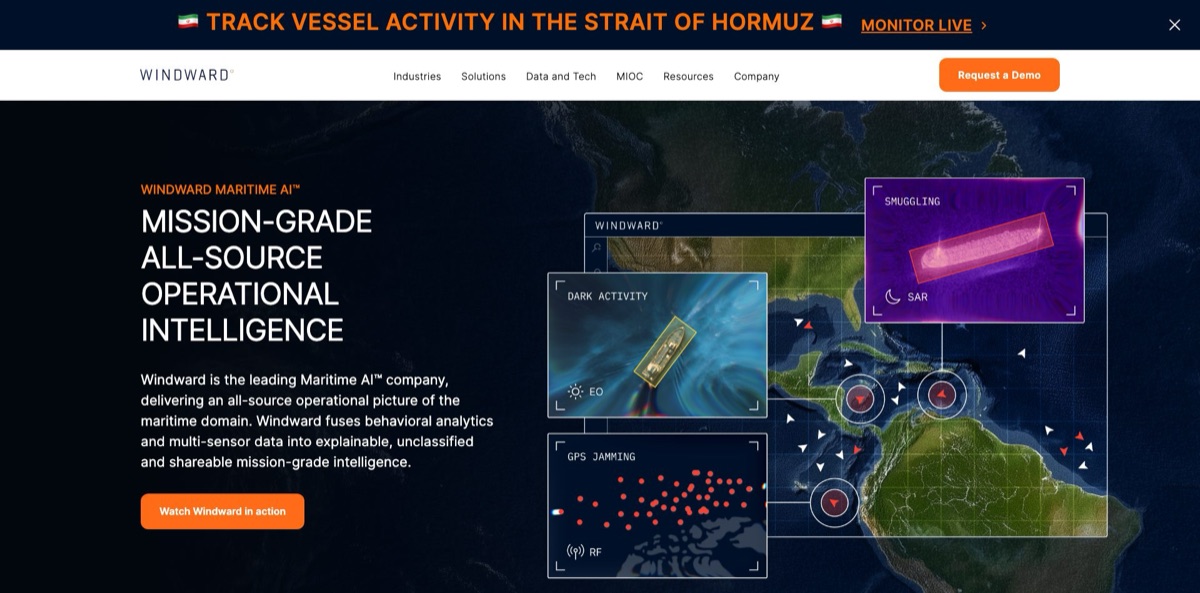
Windward is an enterprise maritime intelligence platform that fuses AIS feeds, satellite imagery, RF signals, ownership registries and sanctions lists into one picture of what ships are actually doing at sea. Proprietary behavioral models score every vessel for risks such as dark activity, GPS spoofing and suspicious ship-to-ship transfers, and the MAI Expert generative AI layer explains those scores in plain language. The goal is to replace list-only checks, which miss a tanker that has not been designated yet, with evidence drawn from real voyages. The weak spots are access and transparency: there is no self-serve plan, no pricing page and almost no independent user reviews, so every evaluation runs through a sales demo. Pick it if you screen vessels, insure cargo, finance trades or patrol waters for a living; hobby ship trackers should look elsewhere.
How to start using Windward?
There is no sign-up button, so begin with what Windward publishes for free. The daily Strait of Hormuz page at insights.windward.ai shows crossings, dark transits, sanctioned tankers and GPS jamming counts, and the Maritime Intelligence Operations Center (MIOC) runs live dashboards on the shadow fleet and counter-narcotics. Spending ten minutes there tells you how Windward labels risk before you talk to anyone. When you are ready, fill in the Request a demo form. Windward says the session is led by one of its maritime experts and built around scenarios from your own business, so bring two or three real vessels or shipments you already know well.
Once you have access, the first real job is usually vessel screening. Enter a vessel and the platform returns a bottom-line risk score, up to seven levels of ownership including the ultimate beneficial owner, matches against LSEG World-Check and more than 1,000 configurable lists, and the behavioral events behind the score. Before you roll it out to a team, set up Organization Defined Risk (ODR). It lets you write your own thresholds for low, moderate and high risk, and it sits on top of Windward’s baseline indicators rather than replacing them, so a reviewer always sees both views.
The screens you will return to most are the vessels of interest (VOI) list, Search & Analytics and the webhook portal. VOI monitoring sends custom alerts when a ship’s risk, behavior or status changes, and a time-to-leave setting drops vessels from the list automatically. Search & Analytics adds sequence search, advanced ship-to-ship search, pivot tables and Visual Link Analysis for investigations. The webhook portal, a tab in the top navigation, lets you create endpoints, push events into Microsoft Teams, set rate limits and transform payloads with JavaScript. Developers get a GraphQL API with dedicated onboarding, and Windward says expert-led implementation support comes at no additional cost.
Verification is the step that makes the output defensible. Open the evidence behind every flag, down to the contributing indicator such as a dark period or a ship-to-ship meeting, and pull the PDF vessel profile report for your audit file. Treat MAI Expert summaries as drafts: Windward’s own AI terms say outputs can be inaccurate and must be cross-checked. The developer docs also mark the webhook portal’s Testing tab and event catalog as not yet fully functional, so confirm integrations through the Logs screen with real traffic.
Who is it for?
Sanctions compliance teams at banks and trade finance desks
You approve payments and letters of credit tied to voyages you cannot see, and static list checks keep clearing ships that are only sanctioned months later. Windward adds behavioral flags, ownership chains and Bill of Lading checks against real port calls. Your go/no-go decision comes with an evidence trail an auditor can follow.
Commodity traders and chartering desks
Pre-fixture screening eats hours when every vessel needs a manual dig through ownership and voyage history. Automated go/no-go recommendations handle routine cases, and only the hard ones reach an analyst. You fix ships faster without widening your sanctions exposure.
Marine insurers and underwriters
Pricing a risk is guesswork when a vessel’s flag history and ship-to-ship behavior sit in five different databases. Windward puts deceptive shipping indicators and ownership changes on one profile. You can decline or price a risk with a documented reason instead of a hunch.
Navies, coast guards and border agencies
Small analyst teams cannot watch every dark vessel near a coastline, cable or smuggling corridor. Windward fuses AIS with EO, SAR and RF satellite data, flags anomalies and can attach managed analysts from its MIOC. Patrol time goes to the targets that actually behave suspiciously.
Freight forwarders and logistics operators
Carrier updates arrive late, conflict with each other and leave customers chasing ETAs. Container Tracking harmonizes milestones per vessel, predicts arrivals and flags rollovers or transshipment delays. Your team answers fewer “where is my box” emails.
Offshore energy and subsea infrastructure operators
Pipelines and cables are exposed to vessels that loiter above them for days, sometimes with transponders switched off. Area monitoring and remote sensing show who was over your asset and when. You get early warning and a forensic record if something goes wrong.
Windward pricing
Windward sells annual enterprise contracts, and pricing is quote-based. The windward.ai site has no pricing page, and every product page ends in “Request a demo”. The only public figures sit on Windward’s own AWS Marketplace listings, which price 12-month contracts on a single “Platform user” dimension, state that terms are negotiated through a private offer and list no refunds. Treat those numbers as a reference point for budgeting, not a final quote.
Free. The daily Strait of Hormuz page and the MIOC live dashboards for the shadow fleet and counter-narcotics are open without an account. They are read-only reports, not the platform.
It targets screening, monitoring and investigations for trade, energy and finance teams, including MAI Expert summaries.
It covers maritime domain awareness, remote sensing workflows, custom risk rules, geofencing and integration into existing systems.
Custom. Scope depends on modules such as Vessel Screening, Container Tracking, Remote Sensing Intelligence or API access; Windward says expert-led API implementation support carries no additional cost.
Custom. These add Windward analysts or Forward Deployed Engineers who build agents and reports around your data.
Shipowners that share verified ownership data and join Windward’s “A-rated” coalition get free MAI Expert access and enhanced UBO data, according to the company.
Windward key features
All-source data fusion pulls in more than 30 sources, including terrestrial, satellite and vessel-based AIS, ownership registries and sanctions data. Windward says its models distill over 100 million daily signals into about 10 million validated movements and suppress GPS jamming noise. The result is a vessel timeline you can trust before any risk logic runs on it.
Behavioral risk models detect dark activity, AIS and GNSS manipulation and illicit ship-to-ship transfers using more than 15 proprietary models trained on 12+ years of data. The vendor claims it flagged 99% of vessels before their 2024 sanctions and cuts spoofing false positives by about 75%. Those figures are Windward’s own and have not been independently audited.
Vessel Screening with Organization Defined Risk combines seven ownership levels, LSEG World-Check, Dun & Bradstreet and over 1,000 configurable lists with your own scoring rules. Up to 9 in 10 vessels get an automated go/no-go recommendation, according to the API page, while complex cases are escalated. Teams apply one consistent policy instead of ad hoc judgment calls.
MAI Expert is a generative AI agent that turns detections into written assessments, fleet analysis and shipowner query emails. Templates come in English, Spanish, French, German and Italian, and the same agent answers through WhatsApp mobile screening. Windward cites an average saving of 20 minutes per screening and says customer data is never used for model training.
Search & Analytics supports sequence search, which turns a known smuggling or evasion pattern into a query that finds other vessels behaving the same way. Advanced ship-to-ship search filters meetings by behavior, location, duration and the profile of both ships. Pivot tables and Visual Link Analysis expose sister vessels and ownership networks for investigations.
Remote Sensing Intelligence lets you task and review EO, SAR and RF collections from multiple commercial providers inside the app. Vessel Correlation matches every detected object to a known identity or flags it as dark, and the imagery archive has no expiration. You can also upload your own EO or SAR images for automatic detection, and the November 2026 Azimut.ai acquisition adds camera-based identification at chokepoints.
Container Tracking and the GraphQL API cover the logistics side and integration
Tracking unifies carrier data into AI-validated departures, arrivals and predictive ETAs, with alerts on rollovers and long port stays. The API exposes risk scores, ownership, timelines and webhooks to Teams or Slack.
Windward Pros & Cons
Pros
Windward goes well beyond list matching by explaining why a vessel is risky, with every score traceable to events such as dark periods or ship-to-ship meetings. Fusing AIS, satellite imagery, RF and ownership data in one place spares analysts from stitching together several subscriptions. The mix of self-service screening, a GraphQL API and optional MIOC analysts means one vendor can serve a compliance desk and a coast guard alike. The free Hormuz and shadow fleet dashboards also prove the data is fresh and actively maintained. Under FTV Capital ownership since 2025, the company keeps buying capability, adding Prominent Edge and Azimut.ai in 2026. Use the free dashboards to sanity-check coverage of your regions before booking a demo.
Cons
You cannot try the platform yourself, and the only public prices are AWS Marketplace references of $29,000 and $500,000 for 12-month contracts, far beyond small-business budgets. Independent validation is thin: G2, TrustRadius and the AWS listings show no user reviews, so headline accuracy figures come from the vendor. Generative AI outputs carry Windward’s own warning that they may be wrong, and non-English text is machine-generated. Parts of the webhook portal are documented as not fully functional. Expect a sales-led cycle and plan a structured pilot with your own historical cases before committing.
Use Windward if you want…
- Screen vessels against sanctions and behavioral risk together.
- Detect dark activity and AIS spoofing before official designations.
- Trace ship ownership up to the ultimate beneficial owner.
- Automate go/no-go decisions with your own risk thresholds.
- Monitor watchlisted vessels with alerts in Teams or Slack.
- Verify Bills of Lading against real port calls.
- Correlate satellite imagery with known vessel identities automatically.
- Predict container arrivals and catch rollovers early.
- Feed maritime risk scores into your own systems via API.
Windward alternatives
Windward Reviews
Hacker News commenters following Strait of Hormuz traffic in 2026 called Windward’s free daily dashboard superb and fresher than other public sources, though one admitted being unsure which data sources sit behind the counts.
In vendor-published testimonials, a global freight forwarder credits Windward with lifting container milestone coverage to 91%, and frames that number as a starting point that kept improving as both teams tuned the integration.
Compliance heads from a bank and a payments firm, quoted on Windward’s own site, say it strengthened their screening, AML controls and investigations; these are vendor-selected quotes, not independent reviews.
One client quoted on Windward’s homepage likes that the platform adapts to its own workflow and risk policy rather than forcing a standard model, while a marine underwriter says the switch cut manual workload.
FAQ
Does Windward have a free plan or free trial?
No self-serve plan or trial is advertised. You can view free public dashboards, such as the daily Strait of Hormuz report and the MIOC shadow fleet and counter-narcotics pages, and then request a guided demo.
How much does Windward cost?
Pricing is quote-based. Windward’s AWS Marketplace listings show 12-month contracts at $29,000 for the Trading and Shipping platform and $500,000 for the Government and Public Sector platform, with final terms set in a private offer.
Who owns Windward?
Growth equity firm FTV Capital completed its acquisition of Windward in March 2025, taking it off the London Stock Exchange and making it a U.S. majority-owned company. Windward still operates under its own brand and has since acquired Prominent Edge (April 2026) and Azimut.ai (November 2026).
Does Windward have an API?
Yes. Windward offers a GraphQL API covering risk scores, ownership, sanctions exposure and vessel timelines, plus webhooks that push events to your endpoints or Microsoft Teams.
Does Windward use my data to train AI models?
No. Windward states that customer inputs and outputs are not used to train its own or third-party models, and that AI model providers such as AWS do not use them either.
Which languages does MAI Expert support?
Off-the-shelf MAI Expert templates work in English, Spanish, French, German and Italian. Non-English output is generated automatically, and Windward treats the English version as authoritative.
Can Windward track vessels that switch off AIS?
Yes, within limits. Behavioral models flag dark activity, and Remote Sensing Intelligence matches ships seen in EO, SAR or RF data to known identities or marks them as dark.
Is there a mobile app?
Windward does not advertise a standalone app on its site, but MAI Expert works through the platform’s mobile interface, and vessel screening is available over WhatsApp.
Similar tools
 HexCollaborative analytics workspace that mixes SQL, Python and AI agents in notebooks, then publishes results as data apps and plain-language answers.
 Delve AIAI market research platform that builds personas from analytics, CRM and social data, then lets you chat with them or run synthetic
 Speak AIConversation intelligence platform that transcribes interviews, calls and meetings in 100+ languages and turns them into themes, scores and structured data.