

You.com
Developer ToolsUpdated November 12, 2026
Developer platform of web search, content extraction, cited research and model inference APIs that feed AI agents and RAG apps real-time web data.
We may earn a commission when you sign up through our links. It does not affect our reviews.
What is You.com?
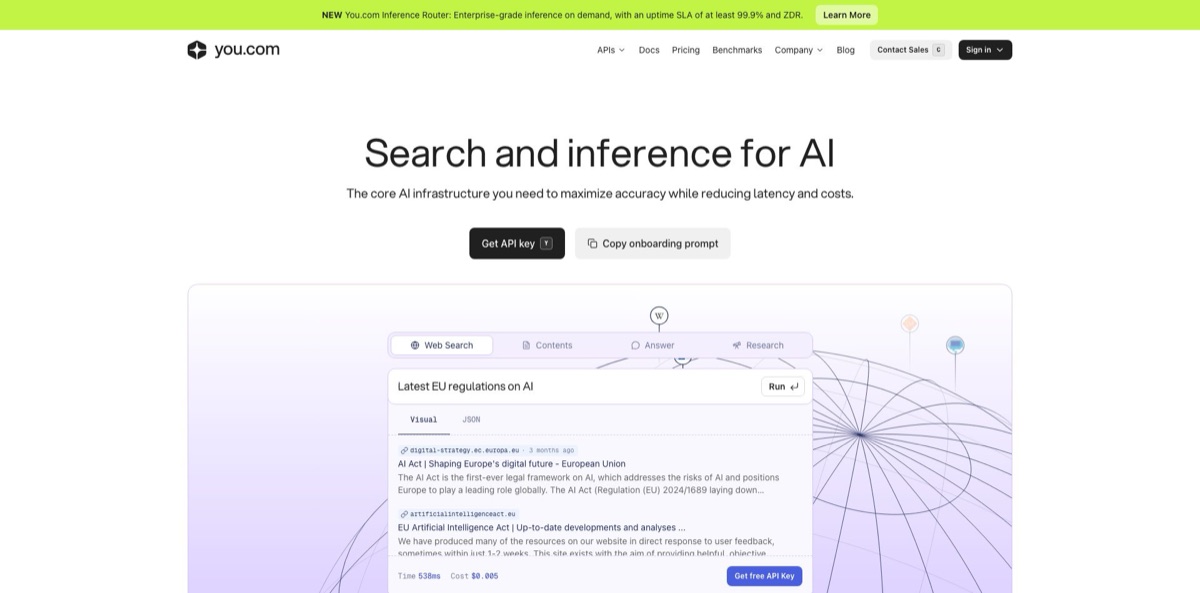
Behind the familiar domain now sits a developer platform rather than a chat app. You.com sells real-time web data and model access to software that needs it: a Web Search API that returns ranked web and news results as LLM-ready JSON, a Contents API that turns URLs into clean Markdown, Answer and Research APIs that hand back cited answers, a Finance Research API, and an Inference Router that serves open-weight models through OpenAI- and Anthropic-compatible endpoints. The problem it solves is stale model knowledge: your agent or RAG pipeline gets fresh, sourced context without you running a crawler or stitching several vendors together. The weak spot is the consumer side, which is effectively gone, since new You Chat subscriptions closed in August 2026 and free users lost chat access. Pick it if you build AI products and want search, research and inference behind one key; look elsewhere for a personal assistant.
How to start using You.com?
The quickest test needs no account at all. Point any MCP client, such as Claude Code, Cursor or VS Code, at the hosted server with the
?profile=freeparameter, and your agent gets theyou-searchandyou-discovertools for up to 100 queries a day. When you need the REST APIs, sign in at you.com/platform, create a key on the API Keys page and store it asYDC_API_KEY. New accounts receive $10 in API credit, plus another $90 after verifying the account, and no credit card is required.Your first real scenario is usually grounding a model with fresh results. Install the Python SDK with
pip install youdotcom, or send a POST request to/v1/searchwith your key in theX-API-Keyheader. Setextraction_modetohighlightswhen the output feeds a prompt, because you get the passages most relevant to the query instead of short generic snippets. If you already know which pages you need, call the Contents API directly and skip the search step.The settings that shape quality and cost live on each request. Country, language and freshness filters narrow results,
include_domainsandexclude_domainsbuild allowlists or blocklists, andboost_domainsnudges trusted sources up without removing others. A highlights budget between 1,024 and 8,192 tokens keeps context small in tight agent loops, and settingknowledgetocoreadds licensed data such as stock prices, macro figures, sports scores and weather. For research jobs, choose the lowestresearch_efforttier that answers the question, since prices jump sharply between tiers.Before going live, run your own evaluation set. You.com publishes an open eval harness and its own benchmark scores, but those are vendor numbers, so check them against your real queries. The platform dashboard shows balance and usage, and since October 2026 you can put a dollar spending cap on each API key so a runaway agent cannot drain the whole organization’s credits. Read the
X-RateLimitheaders and back off on429responses, because self-serve accounts start at 10 requests per second on most endpoints.
Who is it for?
RAG and AI application developers
Your model answers confidently from training data that is months old, and users catch the mistakes. The Web Search API returns ranked results with highlights and metadata in one call, so the pipeline cites fresh sources instead of guessing. You still own prompt design and the final synthesis.
Agent and coding-tool builders
Your agent needs current docs, error messages and changelogs while it works. The hosted MCP server and Agent Skills plug into Claude Code, Cursor, Codex CLI, VS Code and other clients, and the keyless profile lets you prototype before paying anything. The agent decides when to search, so keep an eye on call volume.
Enterprise platform and security teams
Procurement blocks AI vendors that log queries or lack paperwork. You.com offers SOC 2, DPA-ready terms, CCPA compliance and Zero Data Retention for the Web Search and Answer APIs on enterprise agreements. Expect a sales conversation, because ZDR has no self-serve toggle.
Financial analysts and fintech product teams
You need cited answers about filings, fundamentals and market moves rather than a pile of generic web pages. The Finance Research API runs over a finance-optimized index and can return JSON that matches your own schema. At $110 per 1,000 calls for the Deep tier, it suits targeted workflows more than bulk screening.
Startups running open-weight models
Your closed-model inference bill keeps growing, and you pay a separate search vendor on top. The Inference Router serves models such as Kimi, GLM and DeepSeek through OpenAI- and Anthropic-compatible endpoints, runs web search server-side and charges no platform fee. Eligible early-stage startups can also apply for extended free credits.
Former You Chat subscribers
You wanted a Perplexity-style assistant with a model picker and cited answers. That product no longer accepts new subscriptions and free users have lost access, so You.com is not the right pick for personal chat today. Move to a consumer assistant and come back only if you start building your own tools.
You.com pricing
Pricing is purely usage-based: no seats, no minimums and no platform fee, with every endpoint billed per call or per page from a prepaid credit balance. One search call costs the same whether it returns 1 result or 100. Signup credits ($10 at registration plus $90 after verification) expire after 60 days, while purchased credits do not expire as long as the account stays active. Consumer chat plans such as YouPro are no longer sold, so the figures below are the API prices on the official pricing page as of November 2026.
Up to 100 Web Search queries a day through the MCP server, with no API key, account or card. It covers prototyping and light agent use, not production traffic.
usage-based, no monthly fee. The Web Search API costs $5 per 1,000 calls with up to 100 results each, and live full-page extraction adds $1 per 1,000 pages (pages served from cache are free). The Contents API costs $1 per 1,000 pages and the Answer API $5 per 1,000 calls. Auto top-up keeps long jobs from stalling.
Lite costs $12, Standard $50, Deep $100, Exhaustive $450 and Frontier $1,200, and Frontier runs in background mode only. Latency grows from seconds on Lite to several minutes on the top tiers.
$110 per 1,000 calls for Deep and $500 per 1,000 for Exhaustive, with answers in under 2 and under 5 minutes respectively.
price varies by model. You pay per-model rates with a 0% platform fee, and the full price list sits behind the pricing link on the Inference Router page.
Custom. Adds Zero Data Retention, custom QPS limits, dedicated capacity, SLA-backed support and negotiated rates for volume above 1 million calls a month.
You.com key features
The Web Search API returns web and news results in one unified array, with a classifier that mixes in news only when the query has news intent. You choose between snippets for a results UI, query-relevant highlights for prompts, or full-page Markdown and HTML for indexing. The pricing page lists a p50 latency of about 0.4 seconds, which keeps chained agent searches responsive.
Knowledge results add licensed data next to web pages when you set knowledge to core. Coverage spans stocks, prices and rates, macroeconomics, company data, sports, politics and weather, with the data provider named in each result. It is included in the base $5 per 1,000 rate, so numeric questions stop depending on whatever a scraped page happens to say.
The Answer and Research APIs do the reasoning for you
Answer runs one search pass and returns a Markdown answer with inline citations and verbatim excerpts at a reported p50 of 2.67 seconds. Research plans several searches, reads full pages and cross-checks sources across five effort tiers, with optional structured JSON through output_schema and background mode for long jobs.
The Finance Research API uses the same response shape over an index built for company fundamentals, equity and commodity prices, SEC filings and financial news. Since October 2026 it accepts output_schema at every effort level. That lets you drop earnings comparisons straight into a dashboard or spreadsheet instead of parsing prose.
The Inference Router exposes /v1/chat/completions and /v1/messages, so existing OpenAI and Anthropic SDKs work after you change the base URL and key. Declare web_search or web_extract and the router runs searches server-side, then returns the answer with its sources. You.com promises at least 99.9% uptime, US-hosted models and automatic failover to backup providers.
Agent tooling covers a hosted MCP server with you-search, you-contents, you-research, you-finance, you-balance and you-discover tools, plus Agent Skills packaged as plugins for Claude Code, Cursor, Codex, GitHub Copilot CLI and other clients. A separate Docs MCP server lets your agent search the documentation itself. Setup in a coding agent takes a couple of commands.
Account controls include per-key spending caps, rate-limit headers and role-based key management for Owners, Admins and Developers. Agents can even pay per request without an account through x402 (USDC on Base or Solana) or MPP, at $0.005 per web search via x402.
You.com Pros & Cons
Pros
You get search, page extraction, cited answers, deep research and model inference behind one key and one bill, which removes a lot of glue code between vendors. Pricing is published for almost everything, and $5 per 1,000 searches matches the cheapest mainstream search APIs. The keyless MCP tier lets you test before signing up. Highlights and the token budget keep context lean, and an independent community benchmark measured You.com as the fastest of the five providers it tested, with the leanest output. Enterprise buyers get SOC 2, DPA terms and Zero Data Retention from the same vendor. Start agent loops with highlights and a 1,024-token budget, and raise it only when answers lack detail.
Cons
The consumer product most people remember is closed to new users, and former subscribers report lost chat history, unexpected renewals and slow support, so trust among individuals is low. On the API side, the same community benchmark put You.com behind Exa, Firecrawl and Tavily on answer accuracy and completeness, even though it won on speed. Research tiers get expensive quickly, from $12 to $1,200 per 1,000 calls, and Zero Data Retention requires an enterprise contract. Most headline accuracy figures are self-reported by the company. Run a 100-query test on your own traffic against at least one rival before you commit a budget.
Use You.com if you want…
- Ground your LLM answers in fresh, cited web results.
- Give coding agents live documentation search through MCP.
- Turn known URLs into clean Markdown for ingestion.
- Get one-call cited answers without building retrieval yourself.
- Run multi-step research with adjustable depth and price.
- Pull cited financial analysis from filings and market data.
- Route open-weight models through one OpenAI-compatible endpoint.
- Keep search queries out of logs with Zero Data Retention.
- Prototype web search for free without an API key.
You.com alternatives

You.com Reviews
Developers running it in production RAG pipelines like that results arrive as structured, LLM-ready data with a source trail and low latency, which keeps multi-step agent searches responsive; other reviewers note it can be slow to respond at peak times.
In an independent 252-query benchmark shared on Reddit, You.com was the fastest provider and returned the leanest context with almost no noise, but it ranked last of five on accuracy and completeness of answers.
Former paying chat users who enjoyed the model collection and agent builder are frustrated that the chat business was wound down and their conversation history disappeared with it.
Consumer reviewers complain about support that is hard to reach, outages without refunds and a charge after cancellation, although one credits You.com’s own crawler and index as the strongest part of the service.
Open-source maintainers dropped plans to wrap the old chat interface and added the documented Search API with its free tier instead, after a You.com staff member confirmed the chat product is no longer updated.
FAQ
Can I still use You.com as a free AI chat or search engine?
No. You.com stopped selling new chat subscriptions in August 2026, and free and trial users lost chat access; existing paid subscribers lose it for good once they cancel. The site now offers developer APIs instead of a consumer search box.
Does You.com have a free plan?
Yes, for the API. You can run up to 100 Web Search queries a day through the MCP server with no key, and a new account gets $10 in credit plus $90 more after verification, valid for 60 days.
Do I need a credit card to start?
No. You only add a payment method when your free credits run out or you move to paid usage.
What happens when I run out of credits?
API calls return a 402 Payment Required response until you add credits from the dashboard. If a key hits its own spending cap, its requests return 429 with a spend_cap_exceeded code.
Does You.com store or train on my queries?
With Zero Data Retention, which is available on enterprise agreements for the Web Search and Answer APIs, queries and results are not stored, not used to train models and not sent to Google or Bing. ZDR does not cover keyless machine-payment requests, and the platform is SOC 2 certified.
What are the default rate limits?
Self-serve accounts get 10 requests per second on the Web Search, Contents, Answer and Research APIs and 5 per second on Finance Research. Enterprise contracts set custom limits.
Which tools and frameworks does You.com work with?
The MCP server and plugins cover Claude Code, Cursor, Codex CLI, VS Code, JetBrains IDEs, Windsurf, Zed and Gemini CLI, and there is an official Python SDK. The Inference Router works with existing OpenAI and Anthropic SDKs once you change the base URL and key.
Can I filter results by country, language or website?
Yes. The Web Search API accepts country, language, freshness and safesearch settings, an allowlist of up to 500 domains, a blocklist of up to 5,000 domains, and a boost list that favors chosen sites without excluding others.
Similar tools
 Novita AIDeveloper cloud with one API for 200+ open-weight AI models, plus GPU instances, dedicated endpoints and isolated sandboxes for AI agents.
 QodoAI code review platform that runs specialized agents on every pull request, enforces team rules and checks changes against tickets and linked
 Applitools EyesVisual AI testing tool that adds screenshot checkpoints to Playwright, Cypress or Selenium tests and flags real UI regressions across browsers.