
Zilliz Cloud
Data AnalysisUpdated November 17, 2026
Fully managed Milvus vector database for RAG, semantic and hybrid search, with serverless, dedicated and BYOC clusters on AWS, Google Cloud and Azure.
We may earn a commission when you sign up through our links. It does not affect our reviews.
What is Zilliz Cloud?
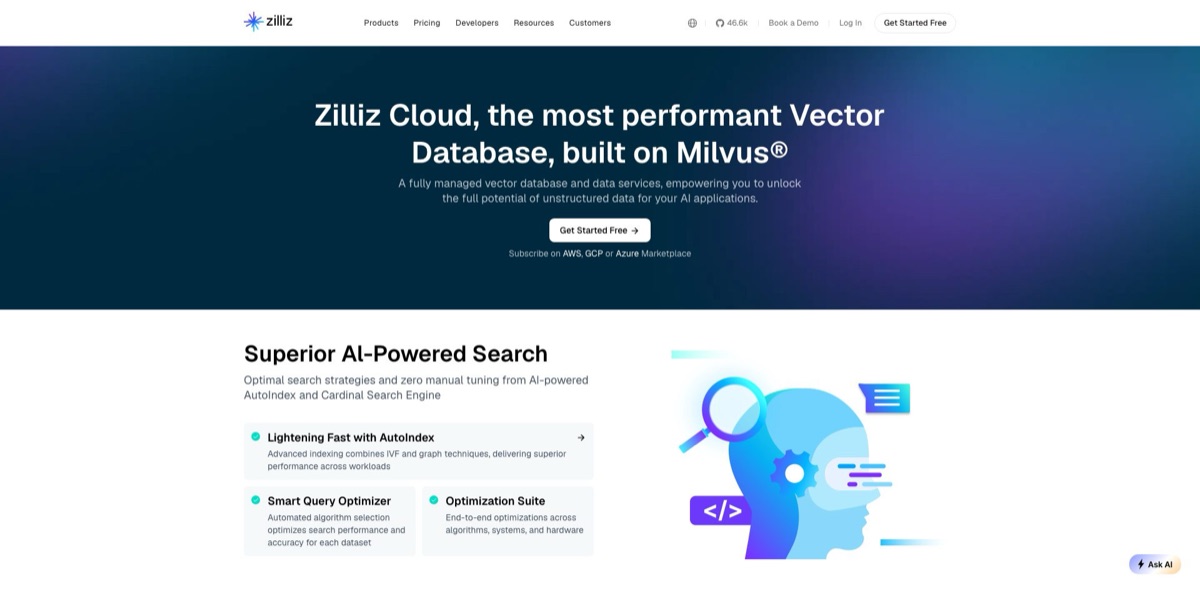
Zilliz Cloud is the fully managed version of Milvus, the open-source vector database that Zilliz engineers built and then donated to the LF AI & Data Foundation under the Linux Foundation. Milvus itself stays free under the Apache 2.0 license; Zilliz Cloud is the paid service where Zilliz runs it for you on AWS, Google Cloud or Azure and adds its own Cardinal search engine, AutoIndex tuning, tiered storage, backups and enterprise security. You store embeddings next to structured metadata, then run vector, hybrid, BM25 full-text and filtered searches for RAG, recommendations, semantic search or agent memory. Since mid-2026 Zilliz also pitches it as a Vector Lakebase that can search Parquet, Lance, Iceberg and Vortex files sitting in your own buckets. The weak spot is complexity: plans, compute unit types and vCU billing take real effort to model. Pick it if you want Milvus at scale without running Kubernetes yourself.
How to start using Zilliz Cloud?
Sign up at cloud.zilliz.com with a work email, a Google account or a GitHub account. No payment details are required. A work email gives your organization $100 in credits for 30 days to test Serverless and Dedicated clusters, and adding a card or a marketplace subscription adds another $100 and stretches the expiry to one year. Every organization can also keep one Free cluster with 5 GB of storage and 2.5 million vCUs per month. If you register through GitHub, make sure your GitHub profile shows a public email address first.
Your first real scenario is a cluster. Inside your project, click Real-Time Serving, then Create Cluster, choose Free, Serverless or Dedicated and pick a cloud provider and region. Copy the credentials straight away, because the password appears only once. When the status switches to Running, grab the endpoint and an API key, run pip install pymilvus and connect with MilvusClient. Official SDKs cover Python, Java, Go and Node.js plus a RESTful API, and the quickstart also shows C#, Rust and C++ samples. The same client code talks to open-source Milvus, which keeps your exit door open.
The settings that shape cost and quality live in the collection schema. Declare vector fields with their dimension and metric (Cosine, Euclidean or inner product), add scalar fields you plan to filter on, and set a partition key if you split data by tenant, since filtering on it scans less data and lowers read vCUs on Serverless. If you would rather not run your own embedding pipeline, add a model provider integration and define a text embedding function, so Zilliz Cloud turns raw text into vectors at insert time and embeds query text at search time. On Dedicated clusters you also choose between Performance-optimized, Capacity-optimized and Tiered-storage compute.
Before you put traffic on it, import a realistic sample from a local file or an S3, Google Cloud Storage or Azure Blob bucket. Bulk import is not charged on Serverless, while regular inserts are. Run a plain vector search, a filtered search and a hybrid search, then open metrics and alerts and set a backup policy. Moving from Pinecone, MongoDB, Qdrant or PostgreSQL? The migration flow lets you review how the source schema maps to a Zilliz collection. Keep in mind that a Free cluster suspends itself after 7 days without activity, so it is not a home for a demo that must stay online.
Who is it for?
RAG and AI application developers
You need a retrieval layer for a chatbot, copilot or agent and have no wish to babysit database nodes. Zilliz Cloud gives you an endpoint, hybrid search and optional built-in embedding, so your time goes into prompts and evaluation rather than index tuning.
Teams already running open-source Milvus
Your self-hosted cluster works, but upgrades, scaling and on-call duty eat engineering hours. Because the managed service speaks the same API, you can move collections over, keep your pymilvus code and hand operations to the people who wrote the engine.
Recommendation and search teams at large scale
You serve hundreds of millions or billions of vectors and storage cost is the main line item. Tiered-storage clusters hold about 40 million 768-dimensional vectors per compute unit, so cold catalogs stay searchable without paying in-memory prices.
Enterprise platform and security teams
Procurement asks for SOC 2 Type II, ISO 27001, GDPR and HIPAA paperwork before anything ships. SAML SSO, SCIM, granular RBAC, audit logs, private endpoints, customer-managed keys and Bring Your Own Cloud cover the usual checklist on the higher plans.
Data engineering teams with an existing data lake
Your embeddings already sit in Parquet or Iceberg tables and copying them into another store feels wasteful. External collections and on-demand compute let you index and search that data in place, paying only while a job runs.
Startups watching every dollar
You want production-grade search but cannot justify a fixed monthly cluster yet. Serverless starts at $0 and bills $4 per million vCUs, so a low-traffic feature costs little until usage proves itself.
Zilliz Cloud pricing
Billing has two engines. Serverless charges per operation in vCUs (virtual compute units) plus storage, while Dedicated clusters charge pay-as-you-go for reserved compute units (CUs) on top of storage. Project plans (Standard, Enterprise, Business Critical) decide which features, SLAs and support you get. Prices below come from the official pricing page and documentation as of November 13, 2026, in USD.
5 GB storage, 2.5 million vCUs per month, up to 5 collections and one Free cluster per organization, on AWS or Google Cloud, with community support on Slack. Inserts are capped at 2 MB/s, and the cluster suspends after 7 days of inactivity.
Reads and writes cost $4 per million vCUs, every read costs at least 6 vCUs, and storage is billed separately by region. The docs estimate about $3 to write 1 million 768-dimensional vectors and about $60 for 1 million searches across them.
Manual scaling up to 32 CUs, backup and restore, basic monitoring, encryption in transit and at rest, and community support. No uptime SLA is listed for this plan.
Adds a 99.95% uptime SLA, audit logs, SAML 2.0 SSO, granular RBAC, multi-replica, auto-scaling and manual scaling up to 2,048 CUs, private endpoints and VPC peering, on-demand compute and enterprise support.
Custom. Global clusters with disaster recovery, customer-managed encryption keys, full-path in-transit encryption, HIPAA eligibility, priority support and 99.99% uptime when multi-replica is on.
Custom. Runs in your own cloud account with the same feature set as Business Critical; pricing comes through sales.
Dedicated rates depend on cluster type, measured on 768-dimensional vectors: Performance-optimized starts at $63 per million vectors per month (about 2 million vectors per CU, 500 to 1,500 QPS, around 10 ms latency), Capacity-optimized at $16 (8 million per CU, 100 to 300 QPS) and Tiered-storage at $5 (40 million per CU, 10 to 50 QPS). Dedicated storage in the docs example costs $0.025/GB per month on AWS us-east-1. Annual commitments earn extra credits, and on-demand compute bills only for active job runtime.
Zilliz Cloud key features
Cardinal engine and AutoIndex: Zilliz Cloud runs its own Cardinal search engine on top of Milvus and picks index parameters automatically, mixing IVF and graph techniques. A query optimizer selects the algorithm per dataset, so you do not hand-tune HNSW settings. You get high recall and low latency without a dedicated search engineer.
Three cluster types with tiered storage: Performance-optimized clusters keep data in memory for real-time apps, Capacity-optimized clusters trade some speed for 4x more vectors per CU, and Tiered-storage clusters push cold data to object storage.
Hybrid, full-text and multi-vector search: A single collection can hold dense and sparse vectors, text with BM25 full-text search, JSON and geospatial fields. Queries combine several vector fields with reranking, scalar filters, grouping search and tunable consistency levels. Free and Serverless collections allow 4 vector fields, Dedicated ones 10.
Built-in embedding and broad integrations: Text embedding functions call a third-party model provider during insert and search, so you can send raw text instead of vectors. The integrations catalog lists model providers such as Cohere, Voyage AI and Jina AI, plus LangChain, Haystack, DSPy, n8n, Langflow, Databricks, Confluent, Datadog and Prometheus. Most RAG stacks connect with little glue code.
Vector Lakebase and on-demand compute: Announced in public preview in June 2026, external collections map to Parquet, Lance, Iceberg or Vortex data in S3, Google Cloud Storage or Azure Blob without copying it. On-demand clusters of 8 to 256 CUs build indexes and run batch searches, then stop billing when idle. This suits periodic analytics and batch search jobs over huge corpora.
Enterprise security and deployment options: Encryption at rest and in transit, RBAC with custom project roles, SAML SSO, SCIM for Okta and Microsoft Entra, audit logs, slow-query logs, IP allowlists, private endpoints and CMEK are available by plan. BYOC keeps the data plane inside your own AWS, Google Cloud or Azure account, and the service spans more than 30 regions.
Milvus compatibility and migration: Because the API is Milvus, code moves between self-hosted and managed deployments with only an endpoint change. Guided migrations import from Pinecone, MongoDB, Qdrant and PostgreSQL, and Zero Downtime Migration became available on request in October 2026. Milvus 3.0, in public preview on Dedicated clusters, adds schema changes on existing collections and entity-level TTL.
Zilliz Cloud Pros & Cons
Pros
The biggest advantage is portability: you run the managed edition of a widely adopted Apache 2.0 database, so leaving for self-hosted Milvus never means rewriting your application. Reviewers on G2, AWS Marketplace and PeerSpot consistently praise low-latency search, stability with tens of millions of vectors and responsive support during integration. Pricing scales down well for cold data, with Tiered-storage clusters starting at $5 per million vectors per month, and the Free cluster plus up to $200 in trial credits lets you test real workloads. Compliance coverage, BYOC and private networking satisfy most enterprise security reviews. Use it when you expect serious scale and want an escape hatch from vendor lock-in.
Cons
The pricing model takes homework. vCUs, CUs, three cluster types, four plans and separate storage charges make monthly bills hard to forecast, and several reviewers say costs climb steeply near a billion vectors or feel high for solo developers. The Standard plan carries no uptime SLA, while SSO, audit logs and private networking require Enterprise. Free clusters suspend after a week of inactivity and run only on AWS and Google Cloud. Schema changes historically meant a full migration; Milvus 3.0 fixes that, but only in preview on Dedicated clusters. Vector Lakebase features are also still in preview. Build a cost model with your real dimensions and query volume before you sign anything.
Use Zilliz Cloud if you want…
- Run Milvus in production without managing Kubernetes.
- Power RAG pipelines with hybrid and full-text retrieval.
- Scale semantic search to billions of stored vectors.
- Cut storage costs with tiered, object-backed clusters.
- Search Parquet and Iceberg data without copying it.
- Keep vector data inside your own cloud account.
- Migrate off Pinecone or pgvector with guided tooling.
- Avoid lock-in through an open-source compatible API.
Zilliz Cloud alternatives

Zilliz Cloud Reviews
A G2 reviewer storing about 50 million vectors calls the service stable over a full year and credits support for smoothing the integration, but warns that the bill gets heavy as you approach a billion vectors.
Search is fast and the SDK slots into existing code easily, according to another G2 review, though cloud pricing feels steep for small projects and individual developers.
One reviewer liked the speed, scaling and ease of use but found that changing a collection schema forced a complex, time-consuming migration.
A verified AWS Marketplace customer running RAG workloads says managed Milvus removed deployment and maintenance chores and delivers low latency, while wishing for more cloud connections and a bigger marketplace.
On Hacker News, a developer who had tried both Qdrant and Zilliz Cloud said turbopuffer beat them on operational simplicity, so Zilliz is not the lightest managed option to run.
FAQ
Is Zilliz Cloud the same as Milvus?
Zilliz Cloud is the fully managed service built on Milvus by the company that created it. Milvus remains free and open source under Apache 2.0, while Zilliz Cloud adds managed hosting, the Cardinal engine, AutoIndex, backups and enterprise controls.
Does Zilliz Cloud have a free plan?
Yes. Each organization gets one Free cluster with 5 GB of storage, 2.5 million vCUs per month and up to 5 collections, with no credit card required. Work-email sign-ups also receive $100 in trial credits for 30 days.
How is Serverless usage billed?
Reads and writes are measured in vCUs at $4 per million, with a minimum of 6 vCUs per read, and storage is charged separately. Bulk imports do not incur vCU costs.
Which clouds and regions are supported?
Dedicated clusters run on AWS, Google Cloud and Azure across more than 30 regions, while Free and Serverless clusters run on AWS and Google Cloud. You can request a new region through a form on the Zilliz site.
Is my data secure and compliant?
Zilliz holds SOC 2 Type II and ISO/IEC 27001 attestations and supports GDPR and HIPAA requirements. Higher plans add SSO, audit logs, private endpoints, customer-managed keys and BYOC deployment.
Can I migrate from Pinecone or self-hosted Milvus?
Yes. Zilliz Cloud offers migration flows for Pinecone, MongoDB, Qdrant, PostgreSQL and Milvus, and Zero Downtime Migration is available on request.
Which programming languages and SDKs are supported?
Official SDKs exist for Python, Java, Go and Node.js, plus a RESTful API, and the docs show C#, Rust and C++ examples. Integrations cover LangChain, Haystack, DSPy, n8n and other frameworks.
What happens when the free trial ends?
Without a payment method, your organization is frozen and Serverless or Dedicated clusters move to the recycle bin. They are permanently deleted if you do not add payment details within 30 days.
Similar tools
 InnovatianaFrench managed data labeling service with in-house annotators for computer vision, NLP, RLHF and evaluation datasets, plus a self-serve Dataset Finder.
 Y2DocWeb tool that turns public YouTube videos into structured notes, timestamped transcripts and PDF, Markdown or Docx files, plus MP3 downloads.
 InfinityCall tracking and AI call analytics platform that ties phone calls to campaigns and keywords and sends call outcomes into Google, Meta